

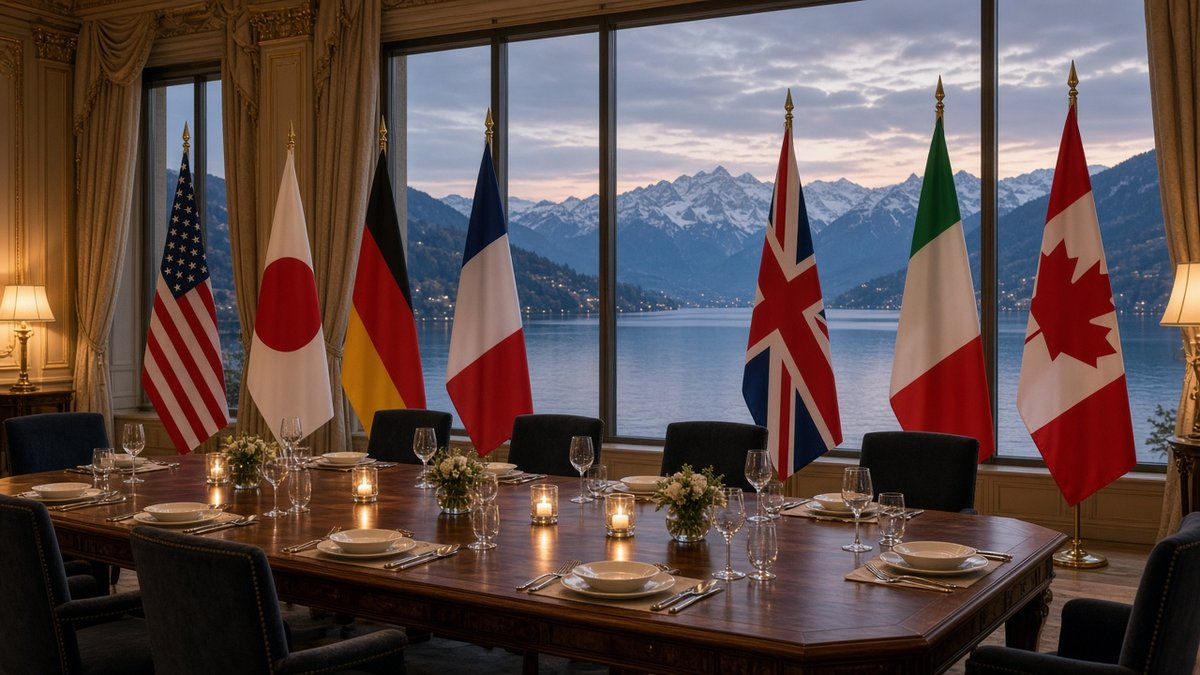
The line everyone will remember from the G7 summit in Évian-les-Bains did not come from a communiqué. On Wednesday, June 17, the last day of the June 15–17 meeting hosted by French President Emmanuel Macron, President Trump arrived late for a leaders’ session and said, “I’m the boss.” Newsweek reported that he joked he was “the boss” as he arrived, and that he also joked with photographers who had been briefly allowed into the room: “Would you like to stay for the meeting? It’s OK with me.” Al Jazeera likewise placed the remark as he took his seat on the final day. Reuters, in a story this draft could not retrieve in full, called it a tongue-in-cheek acknowledgment of an unspoken truth hanging over the summit.
That is a more precise picture than a myth about stunned silence around a grand table. The remark was theater, and theater can still tell you something about leverage. The question is what the summit actually produced after the cameras left.
What the G7 Summit Actually Accomplished
The overriding story was the US-Iran Islamabad Memorandum. The American Presidency Project publishes the memorandum under the date June 17, 2026, the summit’s closing day. Al Jazeera reported that G7 leaders welcomed a deal between the United States and Iran to reopen the Strait of Hormuz, and that Britain and France offered help with resuming maritime traffic. “We reaffirm that the right of transit passage without restrictions or tolls is the bedrock of international trade,” the leaders’ statement said, according to Al Jazeera. The group also agreed that a “multinational, independent, and defensive initiative led by France and the UK can play an important role to facilitate the resumption of maritime traffic in the Strait of Hormuz.”
That is a real diplomatic outcome, if it holds. A preliminary deal is not the same as ships moving safely. Conservatives should take the announcement seriously and still wait to see whether the mines are gone, the tolls stay off, and both sides keep the bargain. The memorandum is a document. The strait is a test.

The G7 also rallied around Ukraine. “We, the Leaders of the G7, stand united in our unwavering support for Ukraine in defending its freedom, sovereignty, and territorial integrity,” the statement said, according to Al Jazeera. “To support and accelerate this new momentum, we agree to increase the delivery of air defence capacities, additional systems and interceptors, and long-range capabilities.” The leaders said they were “ready to consider extending to Ukraine the benefit of licenses to allow for an increase in Ukraine’s military production.” They also said they would “increase the pressure on the Russian war economy” and “strengthen our sanctions, including those on the oil and gas sectors,” tying the moment to the Hormuz deal: “We consider this the right moment to proceed with additional measures, as President Trump has delivered a deal that we support in reopening the Strait of Hormuz.”
European Pravda later noted what the declaration did not contain: no figures for additional systems, no timetable, and no breakdown of which country would provide which capability, or how licenses and financing would work. That is a fair caution. A statement of direction is not a delivery schedule. Support for Ukraine can be real and still need to be counted, shipped, and paid for.
The America First Equation
Here is what conservatives should take from Évian. Trump showed up, put an Iran memorandum on the closing-day calendar, and left with G7 language that treats the Hormuz deal as American-led and the Russia pressure as unfinished business. Some on the left will call any friction at a G7 a degradation of Western alliances. The honest read is more complicated. Alliances matter. So does the fact that the other leaders were writing around an American president who would not be managed like a junior partner.
Whether you like the “I’m the boss” line or not, the useful question is whether American interests were advanced. A G7 endorsement of an effort to reopen Hormuz is in the interest of every country that buys oil and every family that buys gasoline. Tighter language on Russian oil and gas, if it is enforced, is in the interest of a Ukraine policy that is not just speeches. Those are results. They are also promises, and promises expire if no one follows through.
It is also fair to say that American leverage is not the same thing as American blank checks. The Ukraine passage talks about deliveries, licenses, and pressure on Moscow. It does not, in the text Al Jazeera quoted, announce a new U.S. dollar figure. European Pravda made the same point about the lack of operational detail. Conservatives can support arming Ukraine and still insist on seeing the inventory, the cost, and the strategy. A signature under a statement is the start of that argument, not the end of it.
The Limits We Shouldn’t Ignore
Principled conservative analysis requires honesty. A G7 statement is not a reopened strait, a rebuilt Ukrainian air-defense network, or a weaker Russian war treasury. Supply-chain talk about China, which Reuters previewed in its headline on critical minerals, is likewise a direction, not a mine or a factory. Words and actions need to match. The follow-through on every commitment made at Évian needs to be tracked, reported, and held accountable by Congress, the press, and every American who cares about whether their government keeps its word.
Trump walking into the last day’s session late and declaring himself the boss is the image that will define this G7 summit. Behind the theater, though, is a body of real work and a pile of untested pledges. The West is not as unified as it was in earlier eras. But it was functional enough, in Évian, to back an American-led Hormuz effort and to put more pressure on Russia on paper. That is worth noting even as we demand receipts.
The Hormuz test will be practical, not rhetorical. If commercial ships resume transit, if mines are actually cleared, and if Iran does not reimpose a de facto toll, the memorandum was worth the diplomatic capital. If the strait stays dangerous, the G7 statement will read like a press release from a resort town. The same is true of the Ukraine language. Air-defense systems and interceptors matter when they arrive, not when they are listed in a paragraph. Licenses for Ukrainian production matter when factories can legally build and sell the equipment. Sanctions on Russian oil and gas matter when they change revenue, not when they are “strengthened” in a sentence.
That is the conservative way to read a summit. Take the win if there is one. Do not confuse a photograph with a settlement. Do not pretend that a joke at the table is a strategy, and do not pretend that a strategy is complete because leaders issued a statement. Évian gave Washington a chance to lead on Hormuz and to stiffen the language on Russia. Congress, the Pentagon, and the Treasury will decide whether that chance was used. Americans should keep the receipts, including the ones that come due after the motorcade leaves Lake Geneva.
Update (November 2026)
Added November 2026. The Islamabad memorandum did not settle the war. The June arrangement collapsed, fighting around Hormuz continued, and by November the United States was again in a cycle of threats, limited strikes, and talks. We later reported the Qeshm Island strikes of November 2 and the wider post-midterm debate over another campaign. The Évian endorsements were a snapshot, not a finish line. That is why the “follow the money and the ships” test still applies.
- Trump’s Iran Deal: The Islamabad Memorandum — Win, Workaround, or Warning? (2026-07-02)
- Trump Called Off the Iran Strike. Tehran Says He Is Lying About Why (2026-08-05)
- Mike Waltz Says the Iran War Could Last Another Year. Believe Him. (2026-10-23)
- Oil Just Hit $117. Iran Is Betting You’ll Blame Washington. (2026-10-23)
- Trump Just Put Another Iran Strike Back on the Table (2026-10-24)
- Iran Is Plotting to Kill Americans Abroad. Take It Seriously. (2026-10-24)
- Iran Strike After Midterms? US Tells Gulf to Brace for a Short War (2026-10-28)
- Bombs on a Tanker Hull in Hormuz. Now Trump Has to Decide. (2026-10-30)
- Iran Says It Can Reopen Hormuz in Two Days. Read the Fine Print. (2026-11-02)
- Netanyahu Wants More Iran Strikes. America Sets the Clock. (2026-11-02)
- Iran Fired at U.S. Forces. The Qeshm Island Strikes Were the Right Answer. (2026-11-03)
- Hegseth Impeachment Aims at the Wrong Man. Congress Owns This War. (2026-11-09)
Sources
- Newsweek: Trump jokes he is “the boss” after arriving late on the G7’s final day in Évian-les-Bains
- Al Jazeera: G7 statement on Ukraine air defenses, production licenses, Russia oil-and-gas sanctions, and the Hormuz deal
- European Pravda: the Ukraine declaration’s direction, and the lack of figures or timetables
- American Presidency Project: Islamabad Memorandum, dated June 17, 2026
- Reuters: “I’m the boss,” Trump says at G7 (cited in the original post; the full page was blocked)


