

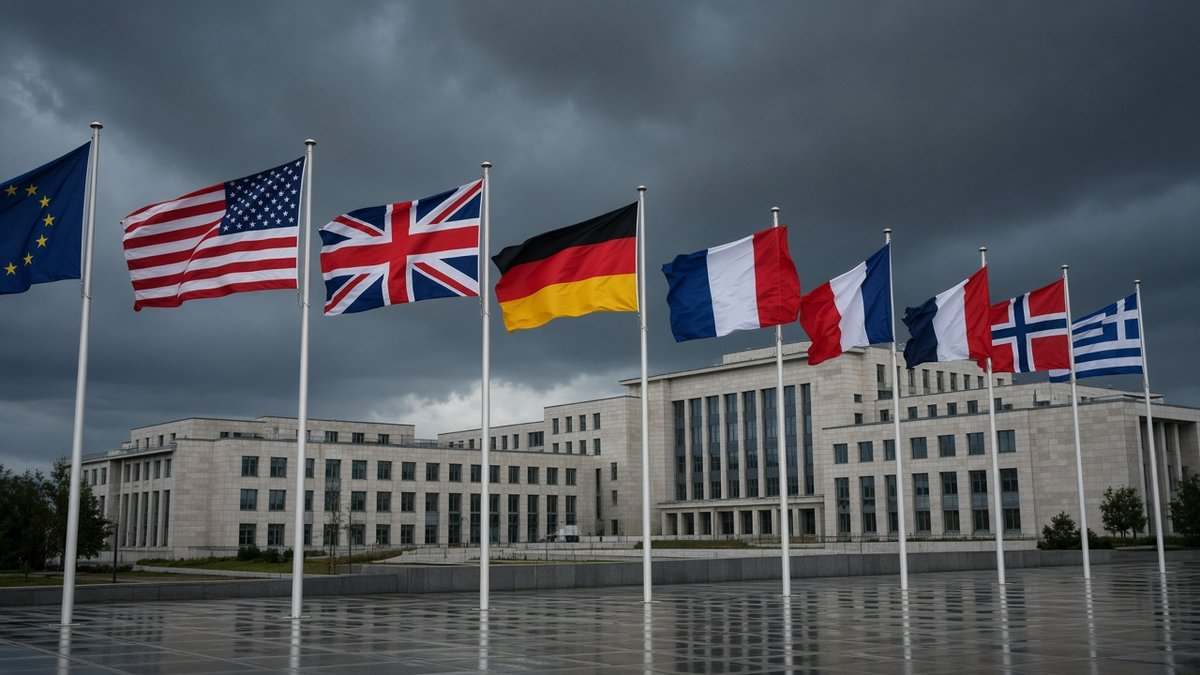
With Trump calling NATO allies cowards, think like a chess player right now, not a fan. What has happened to the global alliance structure this spring is not just a story about diplomatic feelings or protocol. It is a story about whether the United States will have the partners it needs to end the war in Iran on favorable terms, deter China in the Pacific, and get through an economic environment squeezed from several directions at once.
Look at the whole board: Russia, China, NATO and Britain. Each piece is moving, and not all of them are moving our way.
Russia: Not a Spectator
On April 27, Iranian Foreign Minister Abbas Araghchi sat down with Vladimir Putin in St. Petersburg. Putin said he saw “how courageously and heroically the people of Iran are fighting for their independence,” NBC News reported, and promised Russia would “do everything that serves your interests.”
Araghchi used the stage to mock Washington. The United States, he said after the meeting, hasn’t “achieved a single goal,” which is why Trump is “asking for negotiations.” Putin also said he had received a message from Iran’s new supreme leader, Mojtaba Khamenei, and confirmed that Russia intends to continue its strategic relationship with Tehran.
That came after reporting that Russia has been providing Iran with intelligence on the location of American forces during this war. In April, a Ukrainian intelligence assessment reported by Reuters said Russian satellites surveyed U.S. and allied bases across the Middle East shortly before Iranian missiles and drones hit them, as summarized by The Guardian.
Russia is not neutral. Russia benefits from every day America is tangled up in the Persian Gulf instead of focused on Eastern Europe and the Pacific.
China: Counting the Days
Asia is the main customer for Gulf oil. China, India, Japan and South Korea together took 69% of all crude oil and condensate that moved through the Strait of Hormuz in 2024, according to the U.S. Energy Information Administration. The war’s disruption of that route hurts Beijing too.
Yet when Trump called on countries that depend on Hormuz oil to help reopen and police the Strait in March, China, like most NATO allies, rebuffed him, NPR reported. Beijing urged de-escalation instead.
China is making a strategic calculation. Every day the Middle East consumes America is a day America is not fully focused on Taiwan, the South China Sea or the technology race. China is not rooting for Iran. China is rooting for American distraction.
NATO: The Sidelines and Polite Regret
On March 20, Trump called NATO allies “cowards” for declining to help reopen the Strait. “They didn’t want to join the fight to stop a Nuclear Powered Iran,” he wrote on Truth Social, calling NATO a “paper tiger” without the United States. “COWARDS, and we will REMEMBER!” UPI and Reuters reported.
The day before, the leaders of Britain, Canada, France, Germany, Italy, the Netherlands and Japan had issued a joint statement expressing “readiness to contribute to appropriate efforts to ensure safe passage through the Strait.” Readiness is not the same as ships on station, and the president knew it.
The costs were landing at home. By April 27, Brent crude had climbed to $107 a barrel and the average U.S. gallon of gas cost $4.11, NBC News reported. Allies who buy Gulf oil were paying those prices too.
Earlier in March, after Britain initially refused to let the U.S. use its bases for the opening strikes, Trump told reporters that Prime Minister Keir Starmer was “not Winston Churchill,” the BBC reported. Starmer later allowed British bases to be used for what he called “defensive” strikes on Iranian missile sites.
Former British ambassador Lord Darroch called Trump’s comments “pretty brutal” and said there was “obviously a serious rift.” He also noted that military and intelligence cooperation remained “as close and effective as ever.” That is the bedrock worth protecting.
European leaders have pressed for de-escalation. On April 27, German Chancellor Friedrich Merz said Iran was “humiliating” the United States in the stalled talks and that he did not see an American exit strategy, The Times of Israel reported. He also said Europeans had offered German minesweepers to help clear the Strait.
A Defensive Mission, Once the Shooting Stops
On May 12, Britain and France convened defense ministers and representatives from 38 nations to back an “independent and strictly defensive” multinational mission for the Strait, and 29 countries signed a joint statement of support, according to the U.K. government. The mission would protect shipping and clear mines, but only “in a permissive environment.” None of those countries has joined active combat operations.
The America-First Case Is Real
The America-first case for Trump’s frustration is legitimate. These allies’ energy security depends on the Strait, and they should be contributing to securing it. The burden-sharing argument is real and has been made correctly by multiple administrations.
The complicating factor: alliances are strategic assets built over decades through blood and shared interest. The Five Eyes intelligence partnership, NATO’s Article 5 and decades of military interoperability are not bumper stickers. When a president publicly humiliates the elected head of Britain’s government, it enters the institutional memory of that country’s diplomats, intelligence services and military. It costs something real, and future administrations spend years rebuilding it.
King Charles Arrives: The Surreal Backdrop
On April 27, the same day Araghchi met Putin, King Charles III and Queen Camilla landed at Joint Base Andrews for a four-day state visit, the first of his reign. They were welcomed at the White House for tea with the president and first lady, and the King later addressed Congress.
The personal relationship between Trump and Charles appears genuine. At the Windsor Castle state banquet in September 2025, the King praised the “special relationship” in his speech to the president.
But Charles is a constitutional monarch. The elected government is Starmer’s, the same Starmer who was publicly told he is “not Winston Churchill.” Royal pageantry does not resolve whether Britain will stand with America in the next hard moment. That question lives in the working relationship between governments, not in state visits.
The Honest Conservative Tension
America-first foreign policy is legitimate and necessary. We have been taken advantage of. But the test of any policy is its results, not its principles.
Here is the result so far: Russia openly backing Iran, NATO watching from the sidelines, China counting the days of American distraction, and Britain’s king at the White House while Britain’s prime minister is publicly belittled. That is the board as it sits in mid-May. Eyes open.
Update (November 2026)
Added November 2026. The United States and Iran signed a memorandum of understanding on June 17 to end military operations and negotiate a final deal within 60 days, according to the text published by the BBC. The truce did not last. As of November 9, the war had passed eight months, attacks on tankers in the Gulf were continuing, and Qatar was still mediating, Reuters reported via NBC News.
Editor’s note (November 2026): President Trump’s “cowards” remark about NATO allies was first reported on March 20, 2026, and King Charles III’s state visit began in late April. This post, published May 15, discusses both.
Sources
- Reuters: Trump calls NATO “cowards” over lack of support in Iran war (March 20, 2026)
- AP: King Charles III meets with Trump and addresses Congress
- UPI: Trump: NATO “cowards” for not helping to open Strait of Hormuz
- BBC News: Trump says Starmer is “not Winston Churchill” over Iran strikes
- NPR: NATO allies, China so far rebuff Trump’s demand to police Hormuz
- U.S. Energy Information Administration: Strait of Hormuz oil flows
- GOV.UK: Joint statement on the Multinational Military Mission for the Strait of Hormuz
- Joint Base Andrews: King Charles III and Queen Camilla arrive for state visit
- The Royal Family: The King’s speech at the US State Banquet (September 2025)
- NBC News: Iran presented Trump with proposal to open Strait of Hormuz
- The Times of Israel: Rubio rejects new Iranian proposal; Merz says Iran “humiliating” US
- The Guardian: Kyiv lays out how “Russian satellites help Iran in war”
- BBC News: US-Iran memorandum of understanding in full
- NBC News/Reuters: U.S. signals breakthrough in Iran talks unlikely


