

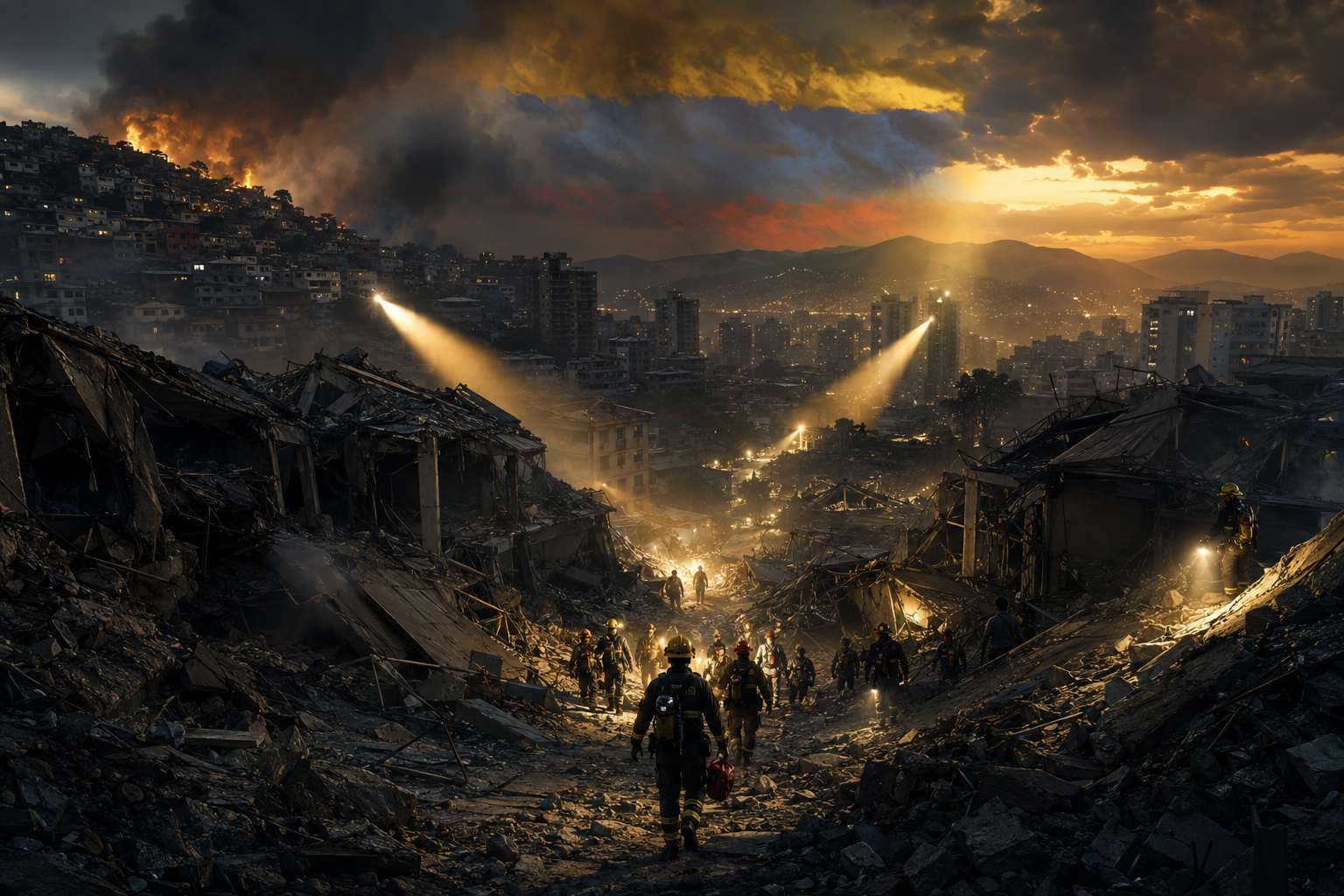
On June 24, 2026, Venezuela was hit by two massive earthquakes in quick succession a 7.2 magnitude foreshock followed 39 seconds later by a 7.5 magnitude mainshock, both centered near Veroes in the Yaracuy state. The result was catastrophic. Buildings crumbled in Caracas, the coastal state of La Guaira was devastated, and by the end of June the confirmed death toll had climbed past 1,943 with over 10,500 injured and more than 43,000 reported missing. The USGS warned the true count could exceed 100,000. These were the strongest earthquakes to strike Venezuela since 1900.
The Scale of the Venezuela Earthquake Destruction
The numbers are almost incomprehensible. Nearly 800 buildings collapsed. NASA imagery estimated 59,000 structures were damaged across the country. Thirteen hospitals were among the casualties. Twenty-five shopping centers were destroyed. In the coastal city of Catia La Mar in La Guaira one of the hardest-hit areas entire neighborhoods were reduced to rubble. Rescue workers from El Salvador located a fifteen-year-old girl still alive on the ninth floor of a collapsed building. A three-year-old boy was pulled from the rubble after six days. A mother and infant were rescued after being trapped for over thirty hours, her son kept alive by rescuers sliding water through a straw in the pipes. These are the stories that remind us what human resilience looks like and what a functioning international community is actually for.

And to his credit, President Trump responded immediately. The U.S. committed $150 million in humanitarian aid. Secretary of State Marco Rubio deployed search-and-rescue teams from Fairfax County, Virginia, and Los Angeles County, two of America’s most sophisticated urban rescue units. A Defense Department Disaster Assistance Response Team was dispatched. Whatever the politics of US-Venezuela relations and they are complicated, with Trump having ordered the arrest of Nicolas Maduro in January 2026 when tragedy strikes, America shows up. That is who we are.
What Socialism Left Behind
But this story cannot be told honestly without confronting the political context. Venezuela didn’t just suffer an earthquake. Venezuela suffered an earthquake after decades of socialist mismanagement that left its infrastructure crumbling, its medical system in collapse, and its institutions too hollowed out to respond. Hospitals were already in shambles before the first building fell on June 24. Emergency response machinery was nonexistent in many hard-hit areas. Civilian volunteers in coastal communities were clearing debris with pickaxes and shovels because there were no mechanical excavators to deploy. Constant aftershocks slowed what little organized response existed.
Meanwhile, the government of acting President Delcy Rodriguez, Maduro’s vice president, who took charge after Maduro’s capture, maintained one of the most restrictive media environments in the world throughout the disaster. More than 200 websites were blocked, including international news outlets, social media platforms, and VPN tools. The United Nations had to publicly demand that Venezuela restore access to media and social networks, stating that ‘timely access to reliable information and communication channels will be vital for the protection of lives.’ Let that sink in. People were trapped under rubble, loved ones abroad couldn’t find out if their families were alive, and the Venezuelan government was more concerned with media control than rescue operations.
The Deportation Dimension
There is one more uncomfortable layer to this story. At least one of the hotels in La Guaira that collapsed was housing Venezuelans who had been recently deported from the United States asylum seekers detained by immigration authorities and removed to a country that was already in political chaos before the earthquake. Some of those individuals died. This is not a simple immigration talking point in either direction. It’s a reminder that immigration enforcement policy and humanitarian outcomes are sometimes entangled in ways that demand careful, honest thought. You can believe in sovereign borders and the rule of law as I do and still ask whether deportation logistics need to account for destination conditions. We should be capable of holding both truths.
Venezuela’s tragedy in June 2026 is a human story, a geopolitical story, and a policy story all at once. The earthquake was natural. The depth of the suffering was not. Decades of socialism, censorship, and institutional destruction created the conditions that turned a natural disaster into a potential 100,000-person death toll. America’s response was swift and generous. The question now is whether the international community stays engaged long enough to actually rebuild and whether Venezuela’s political transition can create something stable enough for its people to come home to.