

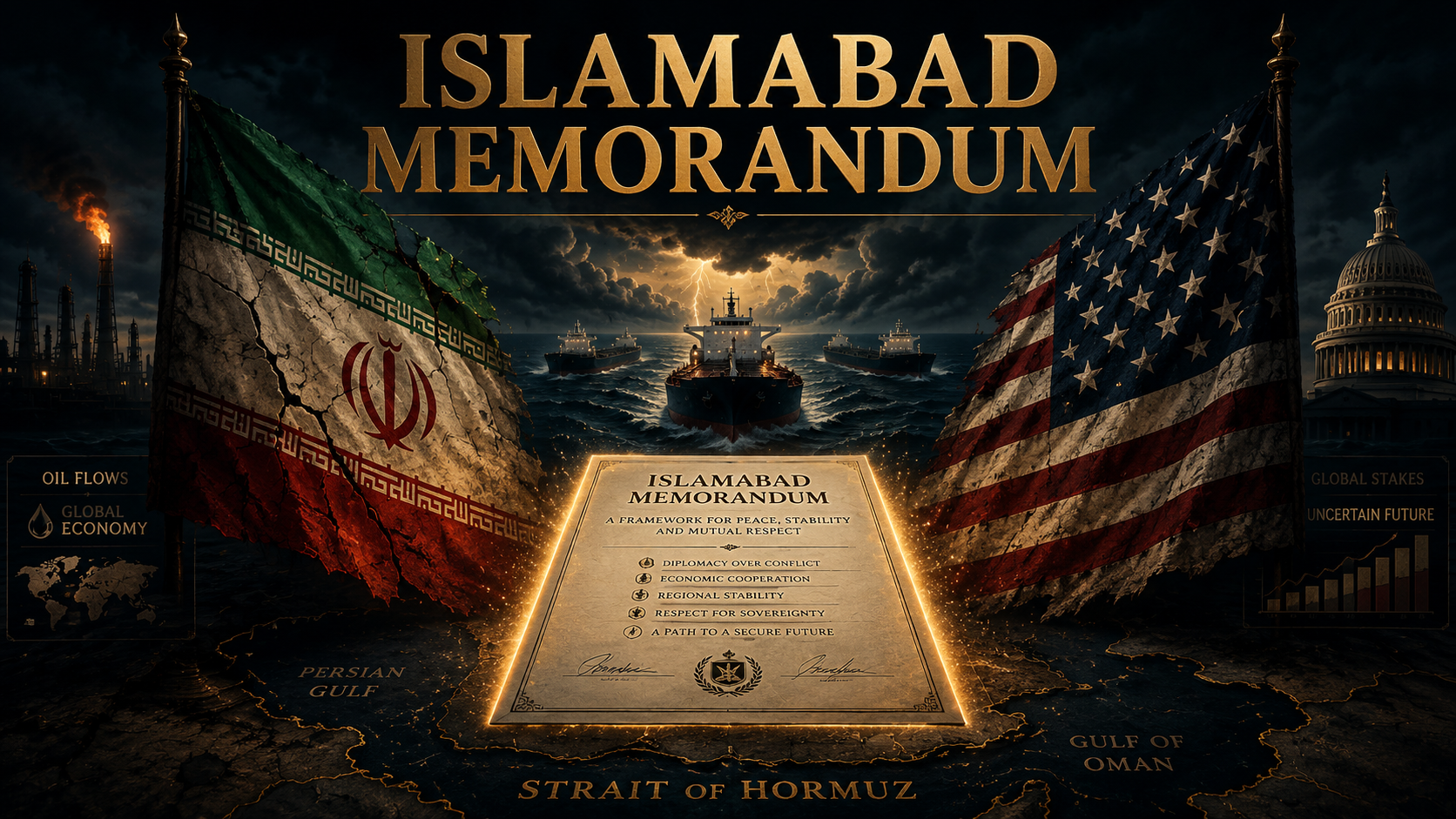
On June 17, 2026, President Donald Trump signed the Islamabad Memorandum of Understanding with Iran, officially ending the 2026 Iran War, a conflict that began on February 28 when the United States and Israel launched coordinated strikes against Iranian nuclear and military infrastructure. The signing took place in two locations simultaneously: Trump at the Palace of Versailles in France, fresh off the G7 summit, and Iranian President Masoud Pezeshkian in Tehran. It is, without question, one of the most consequential diplomatic moments of this decade. But what exactly did we get and what did we give up?
A: It’s a 14-point interim agreement signed June 17, 2026 between the U.S. and Iran, brokered by Pakistan, that ended the 2026 Iran War, reopened the Strait of Hormuz, and established a 60-day window for a final nuclear deal.
A: Partially. Iran committed to never acquiring nuclear weapons and agreed to down-blend its highly enriched uranium stockpile under IAEA supervision — but enrichment itself and ballistic missiles were deferred to final deal negotiations.
A: No. Israel explicitly said it is not bound by the agreement and that military operations in Lebanon will continue regardless of the MOU.
What the Deal Does
Within the 14-point framework, the agreement—known as the Islamabad Memorandum—does several significant things. First, it declares an immediate and permanent end to military operations on all fronts, including Lebanon. Second, it requires Iran to reopen the Strait of Hormuz to commercial shipping, the chokepoint through which roughly 20% of the world’s oil flows, within 30 days. Third, it establishes a 60-day negotiation window for a final comprehensive agreement, during which the U.S. lifts its naval blockade and waives certain sanctions on Iranian oil exports. The deal was brokered primarily by Pakistan, with supporting roles from Qatar, Saudi Arabia, Turkey, and Egypt.
The strategic wins here are real. Securing the Strait of Hormuz depended on the Islamabad Memorandum and its terms. The Strait of Hormuz had been closed since late February, sending global energy prices through the roof and choking supply chains across the planet. American consumers felt it at the gas pump. American businesses felt it in shipping costs. Getting that waterway reopened matters full stop. And the framework does commit Iran, in writing, to never seeking, developing, or acquiring nuclear weapons, with a mechanism for down-blending Iran’s stockpile of near-bomb-grade uranium under IAEA supervision. Trump called it better than Iran’s unconditional surrender, and some of his most vocal critics on the left would have to admit: the Strait is reopening, the shooting has stopped, and Iran’s air force and navy are in ruins.

What the Deal Doesn’t Do
Here’s where honest conservative analysis demands we slow down and read the fine print. Unfortunately, the Islamabad Memorandum leaves some critical issues for later negotiation. The Islamabad Memorandum explicitly defers the most critical issues to the 60-day follow-on negotiation. Iran’s nuclear enrichment program remains intact. Iran’s ballistic missile program is not mentioned. Iran’s network of regional proxies Hezbollah, the Houthis, Hamas-aligned factions is not addressed. And critically, Israel never agreed to any of this. Israeli Prime Minister Benjamin Netanyahu stated publicly that Israel is not bound by the MOU and that military operations in Lebanon will continue.
Then there’s the $300 billion reconstruction fund. VP Vance suggested Gulf states would foot the bill, and Trump insisted no American taxpayer money was involved. But the language in the agreement establishes a reconstruction and development fund for Iran worth at least $300 billion. Even if it’s private investment funneled through Gulf partners, that is an enormous economic lifeline flowing to a regime whose Supreme Leader’s Assembly of Experts issued a statement calling for the assassination of Trump and Netanyahu as a ‘religious duty’ just weeks before the deal was signed. That needs to be said clearly in the context of the Islamabad Memorandum’s impact.
The Conservative Reckoning
Conservatives who love America First should feel two things simultaneously: relief that the shooting stopped, and vigilance about what comes next. The maximum pressure campaign worked to get Iran to sign on to the Islamabad Memorandum. The Islamic Republic was on its knees. But a ceasefire is not a transformation of the Iranian regime. The mullahs who fund terrorism, oppress women, execute dissidents, and chant ‘Death to America’ still control Tehran. A deal that doesn’t address their missile program, their proxies, or their ongoing nuclear ambitions is a deal with an expiration date.
What history has shown us, from the JCPOA under Obama to every ceasefire in the modern Middle East, is that weak frameworks without teeth become permission slips for bad actors to regroup and rearm. This is especially true if the Islamabad Memorandum terms are not enforced. The 60-day window ticking down right now is the most important diplomatic sprint of Trump’s second term. Congress needs to be in this conversation. The American people deserve transparency on every point. And if Iran violates the terms of the MOU, as Iran has violated every agreement it has ever made, we need to be ready to act with overwhelming force. Not to restart the war. But to finish it decisively, once and for all.
Trump achieved something real in June 2026. He stopped a hot war. He reopened a critical waterway. He got the G7 to back him. But the hardest work is still ahead, and the faith-and-facts crowd needs to stay engaged, stay informed, and stay ready. The Islamabad Memorandum will matter only as much as its enforcement does.
Key Takeaways
- On June 17, 2026, Trump and Iran signed the Islamabad Memorandum, ending the 2026 Iran War and reopening the Strait of Hormuz.
- The 14-point agreement includes U.S. sanctions relief and a commitment from Iran not to acquire nuclear weapons, though key issues remain unresolved.
- Israel is not bound by this memorandum, and military operations in Lebanon will continue despite the agreement.
- The deal establishes a $300 billion reconstruction fund for Iran, raising concerns about funding a regime with a history of hostility.
- While the shooting has stopped, conservatives should remain vigilant about Iran’s nuclear ambitions and regional influence, as the 60-day negotiation window begins.