


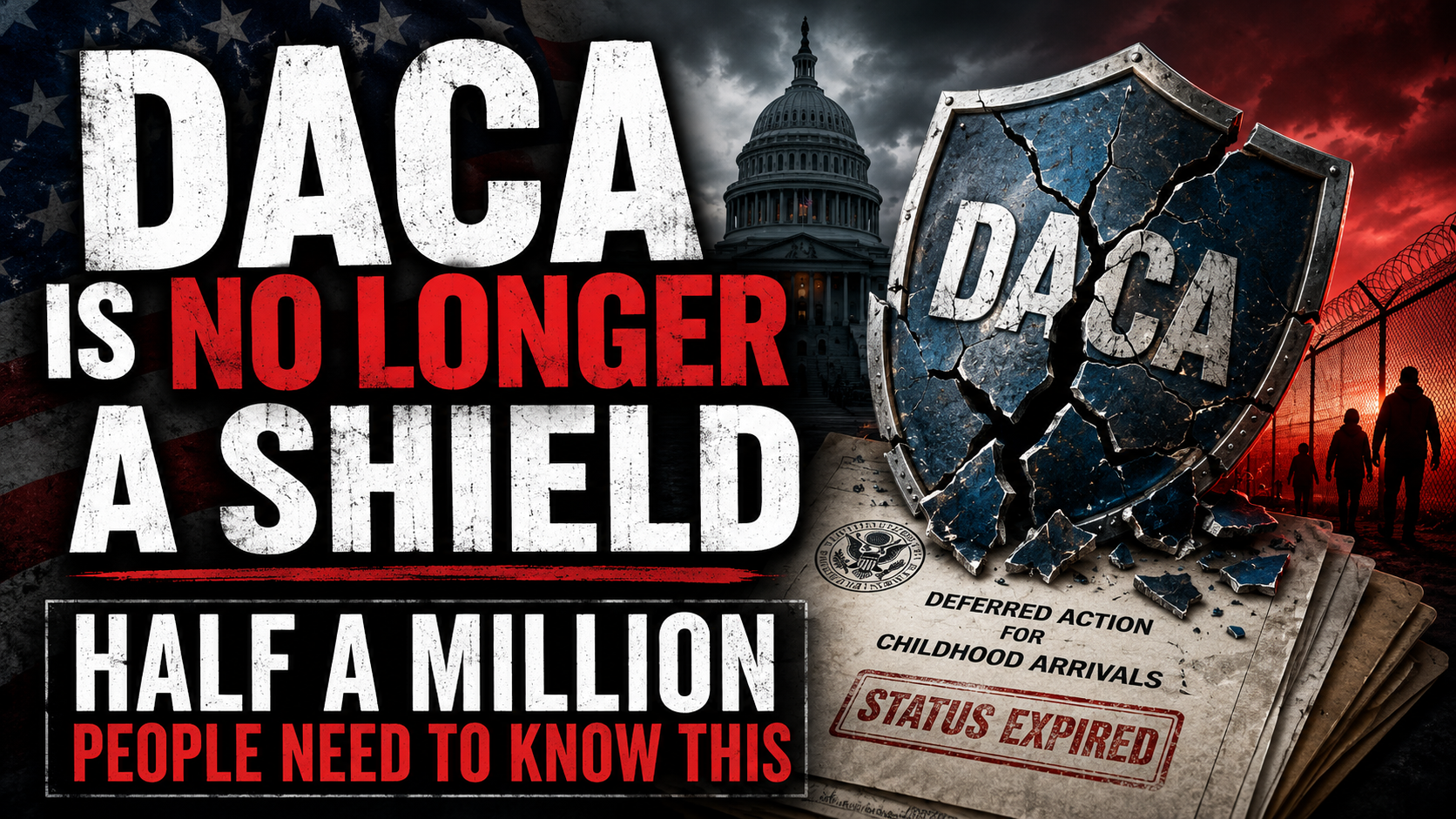

On Friday, April 25th — the same day Cole Allen was waiting in a hotel room in Washington — a three-judge panel at the Board of Immigration Appeals quietly issued a DACA ruling that changed the legal landscape for approximately five hundred thousand people living in the United States.
The ruling: DACA status is no longer automatic protection from deportation.
That is not a small change. Since 2012, the Deferred Action for Childhood Arrivals program has functioned as a shield — an Obama-era executive action that told immigration courts: if this person has DACA status, stop the removal proceedings. Friday’s BIA decision removed that automatic shield. It did not immediately deport anyone. But it changed the legal foundation on which half a million people have built their lives.
The Case Behind the DACA Ruling: Catalina Santiago
The decision came out of the case of Catalina Santiago-Santiago — known publicly as Catalina Xóchitl Santiago — a DACA recipient and immigration rights advocate who has been fighting removal proceedings since August 2025, when she was detained by CBP officers while boarding a domestic flight at the El Paso airport. She was placed in immigration detention. A federal judge ordered her released in October. She has been fighting deportation in the courts since.
Santiago has had DACA status since 2012. The immigration judge presiding over her case terminated her removal proceedings on the basis of that DACA status — ruling that her protected status was, by itself, sufficient reason to halt deportation. DHS attorneys appealed. The Board of Immigration Appeals sided with DHS. The three-judge panel ruled that the immigration judge had erred in basing his decision solely on DACA status without considering all the relevant factors. The case was sent back to a different immigration judge for review.
The BIA’s assignment of the case to a different judge — rather than the original one — is a signal. It suggests the board viewed the original judge’s reasoning as not merely incorrect, but fundamentally flawed.
What the DACA Ruling Actually Says
The BIA’s precedent-setting decision establishes that immigration judges must weigh all factors in a deportation case — not simply defer to DACA status as dispositive. DHS attorneys can now argue, in any DACA recipient’s case, that their specific circumstances warrant removal even given their protected status.
That creates a new legal standard that, practically speaking, makes DACA recipients significantly more vulnerable to removal proceedings than they were last Thursday. The program still exists. DACA renewals are still technically available, though processing times have stretched to over five months in many cases — meaning recipients can lose their work authorization before their renewal is processed, with no grace period. Active DACA status no longer automatically closes the door on deportation.
As of the most recent data, approximately 515,000 people hold DACA status, down from a peak of roughly 530,000. The youngest recipients are around twenty-four years old. Many have lived in the United States since toddlerhood. Many are teachers, nurses, engineers, business owners. In California alone, an estimated 6,784 educators across K-12 and higher education systems have DACA status.
The Conservative Case — Both Sides of It
The conservative argument for this ruling is straightforward and legitimate. DACA was created by executive action — Barack Obama himself acknowledged multiple times before issuing it that he did not believe he had the constitutional authority to grant broad immigration relief unilaterally. The program was always legally tenuous, created without congressional authorization, and the BIA is correct that immigration judges should not defer automatically to an executive action of uncertain constitutionality.
The humanitarian argument is equally straightforward and equally legitimate. These are people who came to the United States as children. They did not make the decision to cross the border. They have known no other country. Hundreds of thousands of them have built entire lives — careers, families, businesses, communities — in good faith reliance on a promise the government made them. Removing that protection, through a three-judge administrative panel rather than through Congress, is not justice. It is the executive branch using its administrative machinery to accomplish through the back door what it has not been able to accomplish through the front.
The principled conservative answer is the one this show has always applied: Congress should do its job. For decades, both parties have used DACA recipients as a political football — a bargaining chip, a talking point, a fundraising tool — rather than actually passing the legislation that would resolve their status definitively one way or another. Senator Durbin has introduced the Dream Act in every Congress since 2001. It has never passed. That failure belongs to both parties equally.
Five hundred thousand people are not abstractions. They are the full complexity of what it means to enforce immigration law in a country that spent decades creating the conditions for their presence and then declined to legislate a clear resolution. The BIA ruling does not resolve that complexity. It intensifies it. And Congress, which created this problem through decades of inaction, now has another opportunity to do its job. It probably will not. But it should.
World of Payne covers immigration enforcement, constitutional accountability, and the principles at stake in these decisions every week. Stream our latest episode on Spotify, Apple Podcasts, iHeart Radio, Amazon Music, and YouTube. Use code P2S at https://ValorBuiltapparel.com