

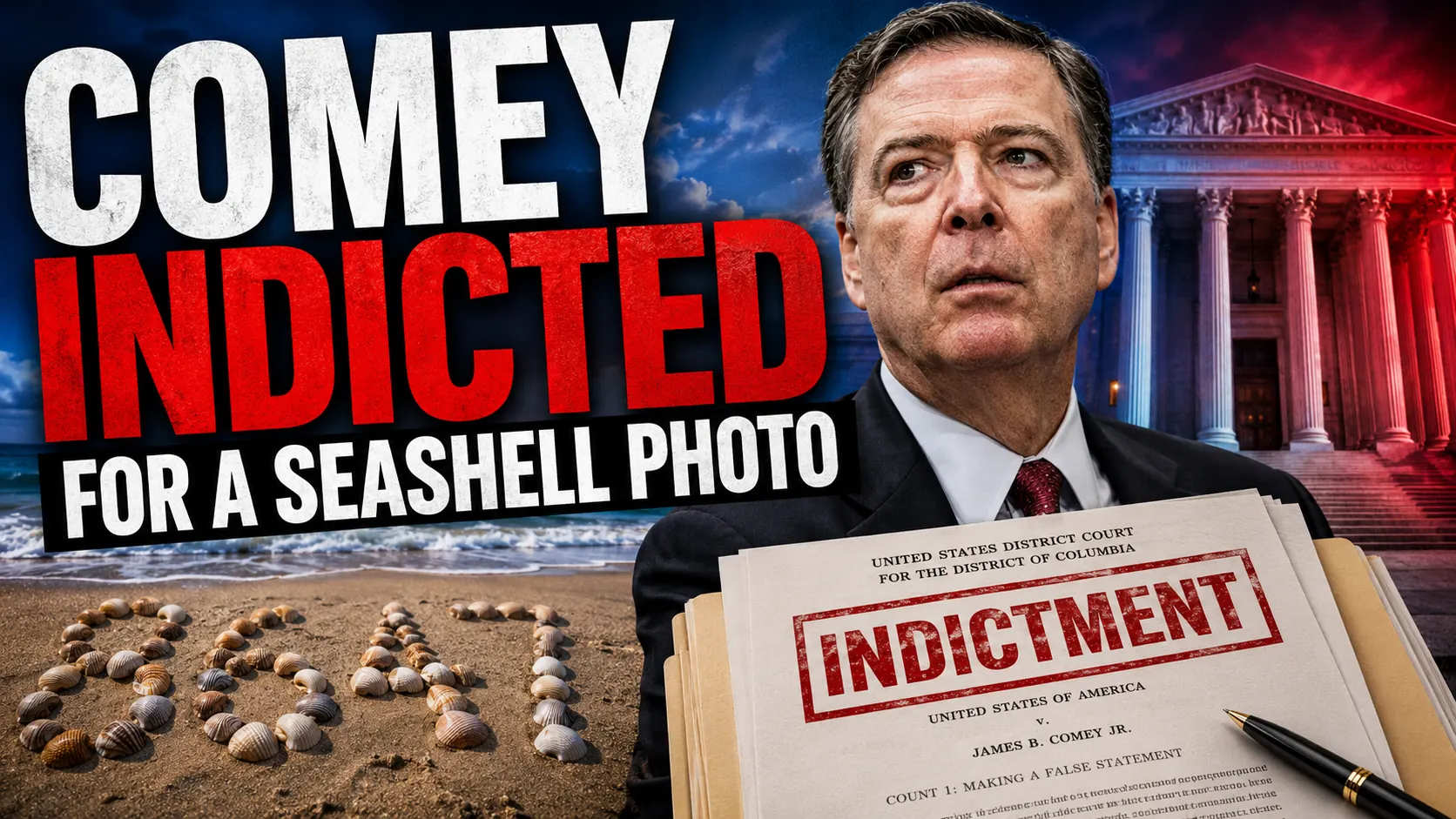

Three days after a gunman charged a security checkpoint at the White House Correspondents’ Dinner with a shotgun, the Department of Justice had former FBI Director James Comey indicted for posting a photo of seashells on Instagram.
The conservative instinct is to say: finally. Hold on for one minute, because the principled conservative answer to this story is more complicated, and more important, than a victory lap. Two weeks after the indictment, here are the facts and the questions every conservative should be asking.
What Happened: The Facts of the Comey Indictment
In May 2025, Comey posted a photo to his personal Instagram account showing seashells on a beach arranged to spell the numbers 86 47. He captioned it “Cool shell formation on my beach walk,” the BBC reported at the time. Eighty-six is restaurant slang for an item that is sold out, and it is also used informally to mean “cancel” or “get rid of.” Forty-seven refers to Trump as the 47th president.
Trump allies portrayed the post as a threat. Comey deleted it. In a later post, he said he assumed the shells were “a political message” and “didn’t realize some folks associate those numbers with violence,” adding that he opposed violence “of any kind,” according to NBC News. The Secret Service questioned him, and Homeland Security investigated the post.
Administration officials did not wait for a grand jury to pass judgment. Then-Homeland Security Secretary Kristi Noem called Comey “disgraced,” and Director of National Intelligence Tulsi Gabbard said he should be “put behind bars for this,” NBC reported.
On Tuesday, April 28, acting Attorney General Todd Blanche announced that a federal grand jury in the Eastern District of North Carolina, where Comey has a beach house, had indicted him on two counts. The charges allege he knowingly and willfully threatened the life of the president and transmitted that threat in interstate commerce. “Threatening the life of the President of the United States will never be tolerated by the Department of Justice,” Blanche said, according to CNBC. An arrest warrant was issued, but officials said Comey was expected to turn himself in to federal authorities in North Carolina rather than be arrested.
Comey’s Response
Comey said in a video that he was innocent and not afraid. “They’re back,” he said. “This time about a picture of seashells on a North Carolina beach a year ago. And this won’t be the end of it.” His attorney, Patrick Fitzgerald, said Comey “vigorously denies the charges” and would fight them to vindicate “Mr. Comey and the First Amendment.”
Comey also said it was important to remember that “this is not who we are as a country, this is not how the Department of Justice is supposed to be.” The White House referred questions to the Justice Department.
The Shooting Three Days Earlier
The timing is impossible to ignore. On April 25, Cole Tomas Allen ran through a security checkpoint at the Washington Hilton holding a shotgun, according to the Justice Department. A Secret Service officer wearing a ballistic vest was shot once in the chest. Allen was arrested and charged with attempting to assassinate the president. The officers who stopped him deserve the nation’s thanks.
Three Questions About the Comey Indictment
Question One: Is This a Crime?
The federal threat statute, 18 U.S.C. 871, requires that a person “knowingly and willfully” make a threat against the president. The indictment alleges that a reasonable person would see the shells as “a serious expression of an intent to do harm to the President of the United States,” NBC reported.
The First Amendment adds another layer. In Counterman v. Colorado in 2023, the Supreme Court held that prosecutors in a true-threat case must show the speaker at least consciously disregarded a substantial risk that his words would be seen as threatening violence. That is a real burden when the “threat” is an ambiguous beach photo that was quickly deleted and followed by a disavowal of violence.
At his news conference, Blanche offered no evidence that Comey knowingly made a threat, NBC reported. Pressed on intent, he said there had been a “tremendous amount of investigation” but declined to discuss the evidence. The post was reckless. Whether it is criminal is a genuine legal question that a court, and possibly a jury, will now decide.
Question Two: Is This Consistent?
This is Comey’s second indictment in less than a year. The first, filed last September for allegedly lying to Congress, was dismissed after a judge ruled that the prosecutor behind it, a former Trump lawyer, had been unlawfully appointed. That prosecutor, Lindsey Halligan, was the only one to sign the indictment, which is unusual for a federal case, NBC reported. The same ruling ended a case against New York Attorney General Letitia James.
Trump had publicly urged then-Attorney General Pam Bondi to take legal action against Comey. Trump fired Bondi on April 2 and named Todd Blanche acting attorney general, Reuters reported. Less than a month later, Blanche announced this indictment. That sequence demands an explanation.
Question Three: Why This Week?
Federal authorities had been looking at this post for nearly a year. Nothing about the shells changed in April. Three days after the most serious attempt on Trump’s life in his current term, the department announced a new indictment of the president’s most famous institutional enemy over a deleted post from the previous May. If the answer is coincidence, say so. If the answer is anything else, the American public deserves to know.
The Grand Jury Is Not the Finish Line
An indictment is an accusation, not a conviction. Prosecutors only need to show probable cause to a grand jury, a far lower bar than proof beyond a reasonable doubt at trial, NBC noted. Comey is presumed innocent, and the case will now face motions to dismiss on First Amendment and vindictive-prosecution grounds.
The Conservative Standard
The rule of law means the same standard applies no matter who holds the wheel. Conservatives rightly criticized the Obama-era IRS for targeting Tea Party groups. The same criticism applies here if prosecutions are driven by presidential preference rather than consistent prosecutorial judgment.
James Comey posted something reckless. He may have posted something criminal. But a Justice Department that operates as an instrument of presidential grievance, rather than as an independent enforcement body, cannot be trusted when it matters most. If Democrats regain power, they will inherit whatever precedent this administration sets.
Those are not easy words to write about a Republican administration. They are the right ones.
What to Watch Next
- Motions to dismiss. Expect Comey’s team to argue the post is protected speech and that the case is vindictive.
- The evidence of intent. Whether prosecutors produce anything showing Comey meant the shells as a threat.
- Consistency. Whether the department brings similar cases against other people who used “86 47,” or only against Trump’s critics.
Update (November 2026)
Added November 2026. In September, U.S. District Judge Louise Flanagan postponed Comey’s arraignment to January 2027 and declined to set a trial date while she weighs his motions to dismiss, NBC News reported. Comey’s lawyers argue the case is driven by the president’s “deep-seated animosity.” The lead prosecutor left the case in May. In October, the department charged Comey a third time in a separate leak case.
Correction (November 2026): An earlier version of this post said the indictment was announced on Monday, April 27. It was announced on Tuesday, April 28, 2026.
- Judge Says DOJ Illegally Fired Maurene Comey. Let the Supreme Court Settle It. (2026-10-26)
- James Comey Charged a Third Time. This Leak Case Has a High Bar. (2026-10-26)
Sources
- AP: Comey indicted over “86 47” seashell photo
- NBC News: James Comey indicted over seashell photo
- Politico: James Comey indicted over 2025 seashell post
- CNBC: James Comey charged with Trump threat in 8647 seashell post
- BBC News: Ex-FBI boss investigated for seashell photo seen as threat to Trump (2025)
- U.S. Department of Justice: Suspect in White House Correspondents’ Dinner shooting charged with attempt to assassinate the President
- Reuters: Trump says he fired Bondi, appoints Blanche as acting US attorney general
- Cornell LII: 18 U.S. Code § 871, Threats against President
- Cornell LII: Counterman v. Colorado (2023)
- NBC News: James Comey seashells case delayed until early 2027


