

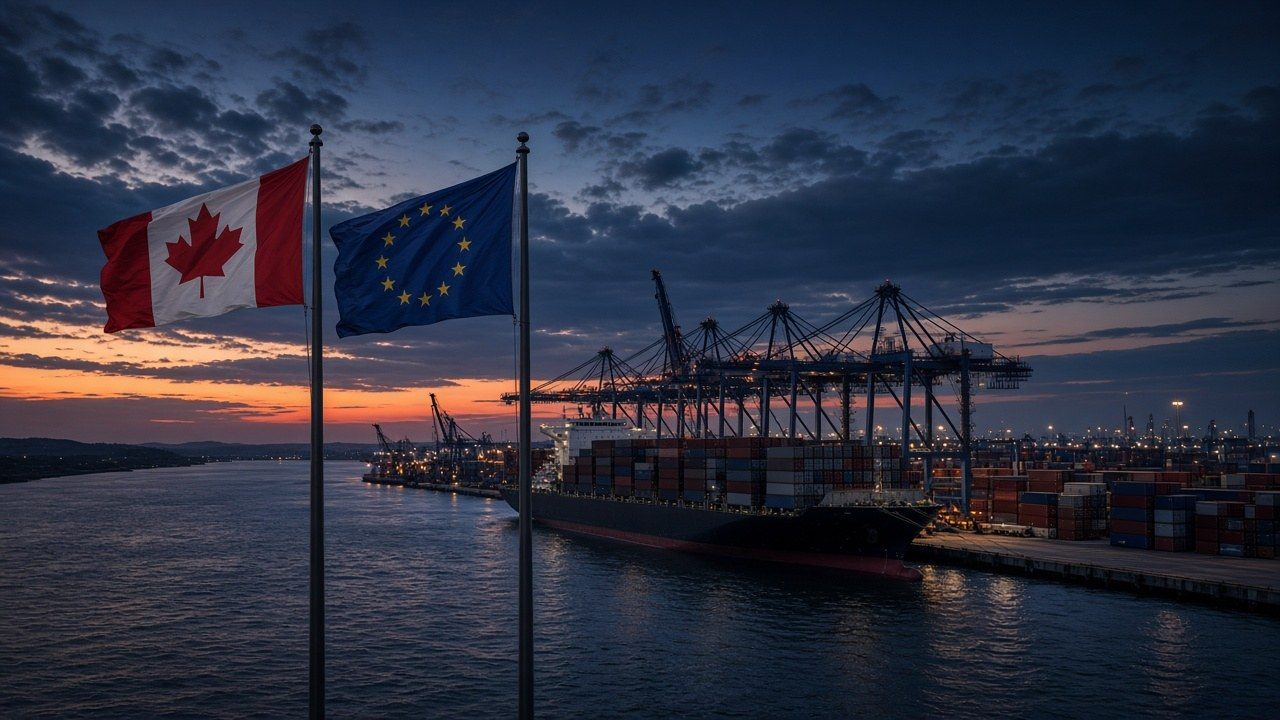
Canada just told the world it wants to get closer to Brussels than any country outside Europe ever has. At the end of a two-day summit in Montreal on Oct. 30, Prime Minister Mark Carney embraced Canada EU associate membership, calling it “the deepest possible partnership short of accession,” Politico Europe reported. However, there is one question he would not answer. What will it cost?
That question matters to Canadians, but it should matter to Americans too. Canada is our closest neighbor and one of our biggest trading partners. When it starts tying its future to Europe’s rulebook, Washington should pay attention. So should every taxpayer who has ever been handed a bill with no price on it.
Key Takeaways
- Carney says Canada is working to become the EU’s first associate member, with terms due by June 2027.
- The status does not exist in EU treaties, and Germany reportedly called the label a red line, so it was cut from the final joint statement.
- Neither Carney nor his finance minister would say what the new partnership will cost Canadian taxpayers.
- In 2025, 72% of Canada’s goods exports still went to the United States, according to Export Development Canada.
- The smarter path for both countries is a stronger North American trade relationship, not a symbolic pact with Brussels.
What Canada EU Associate Membership Actually Means
Honestly, nobody knows yet. European Commission President Ursula von der Leyen first floated the idea in her State of the Union speech in September. The status does not currently exist in the bloc, CBC News noted. One Canadian official put it bluntly: “It’s a concept.”
Still, the summit produced real agreements. The two sides finished a deal with the European Investment Bank to back Canadian critical minerals. They also wrapped up a digital trade agreement and gave Canadian researchers access to European supercomputers. In addition, Canada agreed to join an EU aid program for Ukraine called the Ukraine Support Loan.
Next, the European Commission and Canada’s federal cabinet plan to meet together in March. Carney then wants negotiations finished in June 2027, when he joins European Council meetings. “Canada is by far the most European of the non-European countries,” European Council President António Costa said.
Europe Couldn’t Even Agree on the Name
Here is the awkward part. Days before the summit, the EU backed away from formal talks on Canada EU associate membership, The Guardian reported. A draft statement offered only “an ever closer association of Canada to the EU, short of full membership itself.” EU ambassadors had raised concerns, and Germany argued the status should be saved for candidate countries such as Ukraine or Montenegro.
One diplomat summed up the mood. “This is all about fixing the plane while it is flying,” the diplomat told The Guardian. According to CBC’s sources, Germany called the term a red line, so the final joint statement left it out.
Even so, Carney and von der Leyen used the phrase at their closing press conference. In other words, the leaders announced a membership their own joint statement would not name.
Canada EU Associate Membership Has No Price Tag
According to Politico, the new alliance comes with a payment schedule. Yet when reporters asked how much associate membership will cost the Canadian public, Carney sidestepped. “We don’t view this as paying, personally,” he said. A day earlier, Finance Minister François-Philippe Champagne dodged cost questions and said Canadians should see only “opportunities.”
That answer would not survive a county board meeting, let alone a national budget. Every program has a cost. Somebody pays for the Ukraine loan, the research access and the new layers of meetings. Calling it “coming together,” as Carney did, does not change the math.
The process is murky too. Canadian officials told reporters that legislation won’t be necessary to make the status official. At the same time, Carney has said a new partnership will go to Canada’s Parliament for debate and a vote. Voters deserve to know which it is, and what it costs, before the deal is done rather than after.
Geography Still Wins
Carney himself admitted the limit. His goal stops “short of accession because of our geography,” he said. Even with Canada EU associate membership on the table, the trade numbers agree. In 2025, 72% of Canada’s goods exports went to the United States, down from 76% in 2024, Export Development Canada reported.
Meanwhile, most of that trade still crosses the border duty-free under the U.S.-Mexico-Canada Agreement. The U.S. effective tariff rate on Canadian goods jumped to 2.4% in 2025, compared with a historical average of 0.1%. However, the pain is concentrated in autos, steel and aluminum. Excluding those sectors, the rate falls to 0.7%.
Europe does offer upside. TD Economics estimates tens of billions of dollars in added trade if barriers come down in areas like defense, energy and critical minerals, The Guardian reported. That is real money. Still, Europe sits an ocean away, while the trucks, rail lines and power lines run south.

Brussels Exports Rules, Not Growth
Look closely at the fine print, and the old irritants are still there. Carney told reporters the two sides had agreed on carveouts from the EU’s anti-deforestation law. His own officials later walked that back, Politico reported.
Then there is the EU’s proposed Industrial Accelerator Act, which would steer public spending toward goods made in Europe. Von der Leyen said Canada would automatically qualify as a free-trade partner, but EU lawmakers and governments still have to approve it. So Brussels is pitching Canada EU associate membership while it decides whether Canadian companies may even bid on its contracts.
Canada’s opposition leader sees the trade-off clearly. “Does any of this lower your mortgage payments, rent, grocery bills or gas prices, back here in the real world? Of course not,” Conservative leader Pierre Poilievre posted on Oct. 30. He also warned against aligning Canada with Europe’s taxes, debt and anti-oil policies.
He has a point. We have covered France rioting over its own debt bill and Europe running low on natural gas this winter. A model that struggles to pay its own bills is a strange thing to import.
What Canada EU Associate Membership Means for America
President Trump called the idea “laughable” in September and warned the U.S. might stop trading with Europe “on many things” if he saw it as a hostile act. Leverage has its place, and America holds most of it. After all, no Canada EU associate membership deal can replace the market next door.
But leverage is a tool, not a destination. The best outcome for American families is a North American market with fewer barriers, more energy and minerals moving freely, and a neighbor that looks south first. Canadian politics is not one-note either, as Alberta’s recent referendum showed. Not every Canadian is cheering this pivot to Brussels.
There is also a lesson for voters here at home. Be wary of any leader who signs taxpayers up for a grand partnership and then refuses to name the price. Good intentions are not a budget, and a concept is not a plan.
Frequently Asked Questions
What is Canada EU associate membership?
It is a proposed new status that would tie Canada more closely to the European Union across trade, defense, energy, research and more, short of full membership. The status does not exist in EU treaties yet, so its terms still have to be defined.
Is Canada joining the European Union?
No. Carney has said Canada is not seeking full membership. He describes the goal as the deepest possible partnership short of accession, largely because of Canada’s geography.
When will the Canada-EU deal be finalized?
Carney wants negotiations finished by June 2027. EU member states would have to vote, and Carney has said a new partnership would face debate and a vote in Canada’s Parliament. The cost has not been disclosed.
What do you think? Should Canada tie itself closer to Europe, or should Washington work harder to keep its neighbor close? Tell us in the comments.
Follow World of Payne for More
For more conservative commentary on trade, foreign policy and the stories that hit your wallet, visit the World of Payne homepage. Then follow the World of Payne show on X, Facebook and Instagram for new episodes and daily takes.