
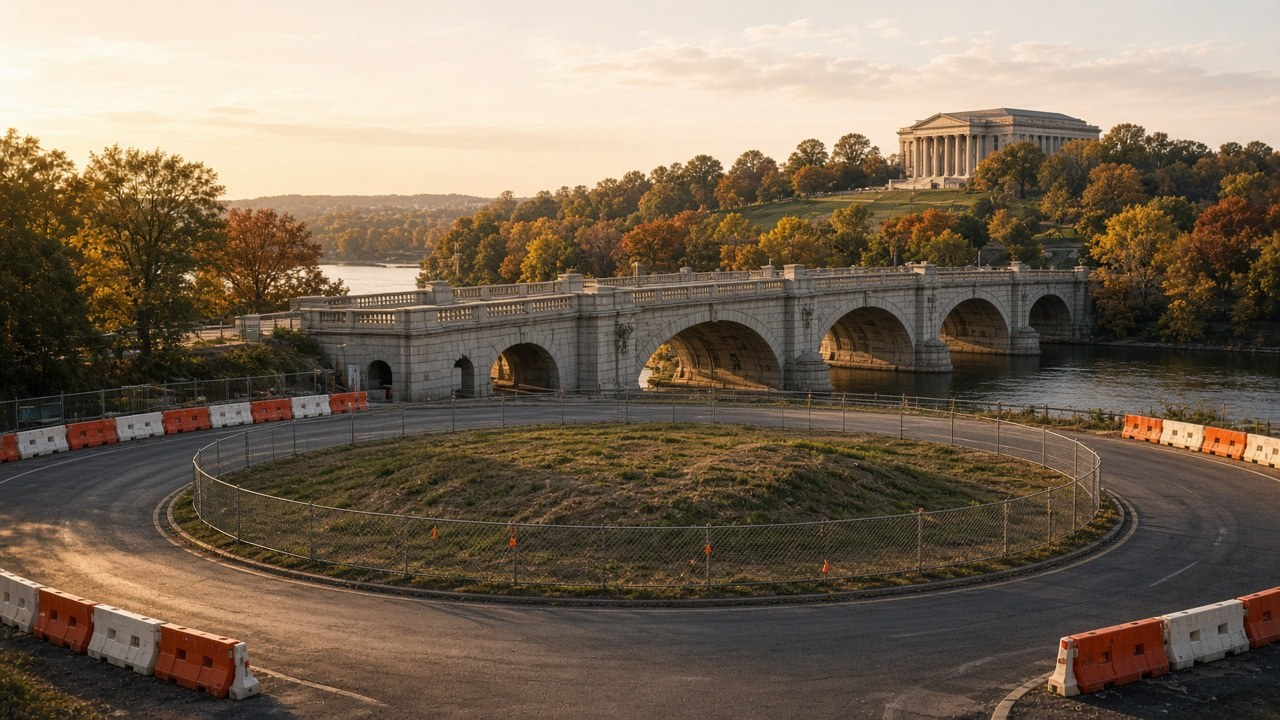
The fight over President Trump’s 250-foot arch just got a lot bigger. On Saturday, October 31, the District of Columbia and Virginia filed a joint Trump arch lawsuit in federal court, calling the planned monument at Memorial Circle “flagrantly unlawful,” Newsweek reports. Notably, the arch would rise between Arlington Memorial Bridge and the entrance to Arlington National Cemetery.
Here is our take: honoring America’s 250th birthday and the heroes buried at Arlington is a worthy goal. But a monument to the republic should follow the republic’s rules. So get Congress to vote on it, and then tell taxpayers what it costs.
What the Trump Arch Lawsuit Claims
D.C. Attorney General Brian Schwalb and Virginia Attorney General Jay Jones filed the 46-page complaint in the U.S. District Court for the District of Columbia, FOX 5 DC reports. It names the National Park Service, the Interior Department, Interior Secretary Doug Burgum and Park Service official Jessica Bowron.
First, it cites the Commemorative Works Act, which requires specific approval from Congress for covered memorials. It also cites a separate federal law that bars putting up a building or structure on federal land in the District without express approval from Congress. Next, it adds a Height of Buildings Act claim. That law generally caps buildings at 130 feet on a D.C. business street or avenue, and the arch would be 250 feet. Those claims have not yet been decided.
In total, the complaint brings eight counts, including claims under the Administrative Procedure Act, the National Environmental Policy Act and the National Historic Preservation Act. It asks the court to set aside federal approvals and to block construction and site preparation.
The two plaintiffs also accuse the administration of trying to beat the courts. “In their rush to break ground on the Arch, Defendants have made only half-hearted gestures at complying with these requirements,” the lawsuit reads, according to The Hill. It adds that the defendants will “attempt to outrun judicial review.” Elsewhere, the lawyers wrote, “The court should not allow this cynical gambit to succeed.”
Traffic, Airspace and the Arlington View
Local disruption is a big part of the case. According to Park Service material cited in the complaint, construction would take two to three years and run 20 hours a day. The south side of Memorial Circle would close, and westbound traffic from Memorial Bridge would drop to two lanes. More than 27,000 vehicles, 1,100 bicyclists and 1,200 pedestrians pass through Memorial Circle each day, the filing says. The states argue that could slow emergency responders and an evacuation route out of Washington.
The complaint also raises airspace concerns near Reagan National Airport, where construction cranes could reach about 320 feet. In addition, it says the arch would block the historic sightline between the Lincoln Memorial and Arlington House, a view meant to symbolize the reunited North and South after the Civil War.
Why This Trump Arch Lawsuit Is Different
D.C. Council Chairman Phil Mendelson sits on the National Capital Planning Commission, and he filed a declaration backing the suit. “This is not about whether one likes or dislikes the Arch,” he has said. “It is about following the law and respecting the responsibilities Congress assigned to the Commission.”
That framing matters because in August the Supreme Court found White House ballroom challengers likely lacked standing. In a separate case, three Vietnam War veterans and a historic preservationist sued over the arch, and the Justice Department argues they lack standing too. Arlington County has also sued. Now two governments say they will suffer concrete harm, from traffic to emergency response.
Of course, politics is part of this. Schwalb and Jones are Democrats, and Jones called the arch an “illegal vanity project.” Still, the legal questions in the Trump arch lawsuit stand on their own.

The Judge Asked the Question Taxpayers Should Ask
On Friday, October 30, U.S. District Judge Tanya Chutkan heard the veterans’ case. There, she pressed Justice Department lawyer Robert Stander on funding, which has stayed vague. “I don’t even know who is paying for this thing,” she said, CBS News reports. She also asked, “What is the rush to put this arch up?” Chutkan said she would rule “expeditiously.”
Chutkan also questioned the administration’s new national security argument. President Trump said in September that the arch would become, in part, a “Military Complex” housing drones and snipers. In declarations filed that week, Defense Secretary Pete Hegseth called it “a generational national defense opportunity.” Stander declined to give details. “We’re not talking about plans for a cafeteria,” the judge said.
We do not cheer every Chutkan comment. Even so, that funding question is fair. Washington already pays more in interest on the national debt than on defense. So before ground breaks on a 250-foot structure, Americans deserve a price tag and a clear answer on who pays.
For its part, the White House has defended the project. Spokesperson Davis Ingle told Newsweek the arch would be “one of the most iconic landmarks not only in Washington, D.C., but throughout the world” and a “gateway to Arlington National Cemetery” for veterans and families of the fallen. In response to Arlington’s suit earlier in October, Ingle said the administration was “fastidiously compliant with all procedural and legal requirements.” The Interior Department said it “continues to follow all laws and regulations.”
The November 5 Deadline
The timing is what makes this urgent. The National Capital Planning Commission is set to review the final plans on Thursday, November 5. The administration has told the court that if the commission approves, construction could begin that same day. The administration told the court on October 21 that it may begin construction the very day the commission approves.
That is why the plaintiffs filed now. The complaint predicts that once construction begins, the government will argue that halting it would harm the federal government, pose security risks and upset a status quo it created on its own. For that reason, D.C. and Virginia want the court to keep things as they are at Memorial Circle while the case proceeds. They also want to stop federal officials from authorizing, funding or permitting any construction or site preparation in the meantime.
The Bottom Line
In the end, the Trump arch lawsuit is about who decides. Conservatives believe Congress writes the laws and holds the purse. If the arch is a fitting tribute for the 250th, then make the case to Congress and win the vote. If federal reviews are too slow, fix them in law, as the Senate permitting reform bill tries to do. After all, racing to pour concrete before the courts can rule is not the conservative way. A monument built the right way would stand on firmer ground.
Update (November 2026)
Added November 2026. On November 5, the National Capital Planning Commission voted 8-4 to approve the arch after almost nine hours of public comment. Later that night, Chutkan issued a 14-day temporary restraining order barring any construction-related activity, CBS News reported. In a 33-page ruling, she found the plaintiffs likely to succeed in showing the government skipped required legal steps, and said D.C. and Virginia likely have standing. The White House said it is “confident we will be fully vindicated.” The cost, and who pays, is still unclear.
Sources
- Newsweek: DC, Virginia sue to block Trump’s 250-foot arch after judge questions plan
- The Hill: DC, Virginia sue to block Donald Trump’s proposed triumphal arch
- Complaint: District of Columbia and Virginia v. National Park Service, No. 1:26-cv-03838 (D.D.C.)
- FOX 5 DC: DC and Virginia file federal lawsuit to block proposed Triumphal Arch at Memorial Circle
- CBS News: Judge skeptical of administration’s defense of Trump’s proposed arch
- SCOTUSblog: Supreme Court allows construction on White House ballroom to continue
- CBS News: Judge blocks construction on Trump’s 250-foot arch for now


