

Four words on X changed the mood in Venezuela on Sunday. “I’m here. With you.” With that post, Nobel laureate María Corina Machado told the world she was home. After nearly 10 months in exile, Machado returns to Venezuela at a moment when nobody can say when Venezuelans will vote again.
Her ally Edmundo González confirmed it within minutes. “Venezuela! I am thrilled to announce to you that our leader, my dear María Corina, is on Venezuelan soil,” he wrote, according to the Guardian. He added that he will return soon too.
This is a good day for Venezuela and for everyone who cares about freedom in our hemisphere. But a homecoming is not an election, and the hard questions start now.
How Machado Returns to Venezuela After Months of Failed Tries
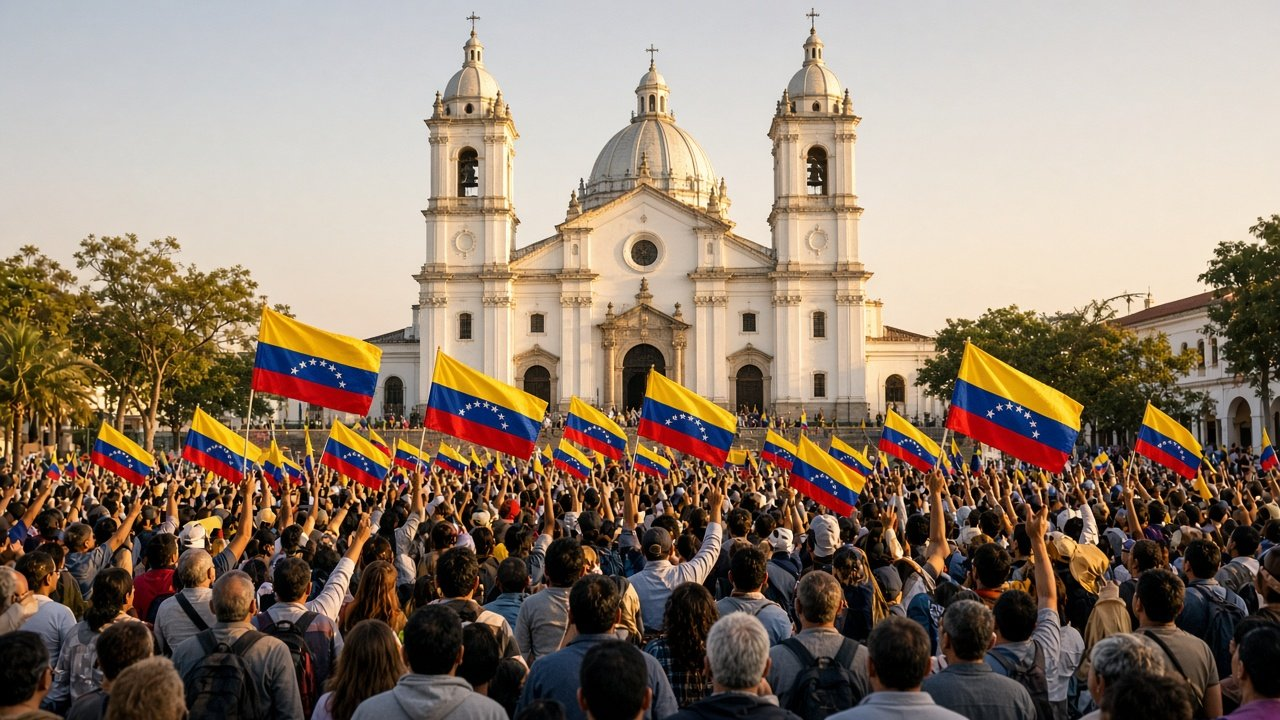
First, the setting. Footage showed Machado surrounded by supporters at the Sanctuary of the Divine Shepherdess in Barquisimeto, the capital of Lara state, about 220 miles west of Caracas. Hundreds of people gathered outside the church chanting “Freedom!” That is a fitting first stop for a woman who has risked everything for her country.
Getting there was not easy. El País reported at least seven attempts in three months, by boat, by commercial and private flights, and over land, from Virginia, Panama and Curaçao. Each one was blocked or cancelled at the last minute. Two of them came after the deadly June earthquakes, when she tried to return from Central America. It is still not fully clear how she got in this time.
The reporting on Washington’s role is mixed. The Guardian says the Trump administration had reportedly opposed her return. Spain’s ABC reported that several countries worked on the trip and the White House did not stand in the way. Secretary of State Marco Rubio said her return “is the direct result of the US-supported reconciliation talks,” which he said have freed hundreds of political prisoners. Asked about it, President Trump said, “I hope she’s safe. She’s a very nice woman.”
Either way, she is now on Venezuelan soil, and security services showed no sign of stopping her as she headed toward the capital.

Why It Matters That Machado Returns to Venezuela Now
Here is the backdrop. On January 3, the U.S. military seized dictator Nicolás Maduro and took him to the United States to stand trial. Conservatives were right to cheer. Maduro stole the 2024 election. Machado was banned from running, and an opposition count of the official tally sheets found that her stand-in, González, was the real winner.
Machado slipped out of Venezuela in early December 2025, after more than a year in hiding, to accept the Nobel Peace Prize in Oslo. She later gave President Trump her Nobel medal and has repeatedly praised him for removing Maduro.
After Maduro fell, many expected the president to back her. Instead, he embraced Delcy Rodríguez, Maduro’s vice president, the Guardian notes. In August, Trump announced what he called “the biggest oil deal in world history” with Venezuela. Critics now call the country a U.S. protectorate. That label should bother anyone who believes in self-government.
An Interim Government With an Expired Clock
Rodríguez now runs the country, and her legal footing is thin. Under Venezuela’s constitution, a vice president can fill a temporary absence for up to 90 days, which the National Assembly can extend by another 90. That 180-day period expired on July 3, the Associated Press reported, with no announcement of what would happen next. The Assembly, controlled by Rodríguez’s party, could trigger a snap election by declaring the presidency permanently vacant. It has not.
Talks between Rodríguez’s government and parts of the opposition since August have focused on renewing the Supreme Court and the National Electoral Council, both reforms Machado wants. But the roadmap also calls for governor and mayor elections before any presidential vote, a sequence Machado has rejected, according to El País. She wants a presidential election by July 2027.
In other words, the dictator is gone, but the people still have not had their say. And the longer the calendar stays blank, the more the interim arrangement starts to look permanent.
The Case for Waiting, and Why It Falls Short
To be fair, the administration has an argument. Before the June earthquakes, it said a vote would take place once Venezuela and its economy had been stabilized, according to the AP. The quakes killed thousands of people and caused an estimated $6.7 billion in physical damage, roughly 6% of the country’s economy, by a U.N. Development Programme estimate. Rodríguez has also overseen business-friendly reforms of the oil sector under U.S. pressure. A country rebuilding from disaster and a dictatorship does need some order before it votes.
Chavista leaders have their own story. They now say they never vetoed Machado’s return and that her presence may even help them, betting she will burn out quickly, El País reported. They also accuse her of having promoted the U.S. military action against her own country.
Neither argument justifies an open-ended delay. Stability without a timeline is just a holding pattern, and holding patterns tend to favor whoever already holds power. The best way to stabilize Venezuela is to give its government the one thing it lacks: a mandate from its own people.
Stability Is Not the Same as Freedom
Some in Washington seem to prefer a quiet deal with Rodríguez over a messy democracy. That is a mistake. A government that answers to Washington instead of its own voters is not a win for liberty. It is a lease.
America has real interests here, too. Oil just spiked past $116 a barrel on Middle East supply fears, and a free, stable Venezuela could help. The region is also watching how we handle Havana. Our credibility depends on standing with people who fight for freedom, not just with whoever holds the keys.
There is a political reality as well. Machado had 57.4% vote intention in an AtlasIntel survey for Bloomberg in August, El País reported, the highest of any leader in the country. A U.S. policy that sidelines the most popular democrat in Venezuela will not age well.
What Comes Next
- Her safety. Rodríguez’s government must guarantee Machado’s safety. Interior Minister Diosdado Cabello has hinted at a “surprise” for her, El País reported.
- A firm election date. Washington should press for a presidential election date with real international observers, not a vague promise.
- A renewed electoral council. Any vote run by the same officials who certified Maduro’s 2024 “win” will not be trusted.
- Opposition unity. The opposition must stay together as González prepares to come home as well.
Why should an American family care? Because a free Venezuela means fewer people fleeing north, fewer favors for Russia and China in our hemisphere, and a stronger partner on energy. Venezuela is still recovering from the June earthquakes, and a government with a real mandate will be better placed to rebuild. Freedom next door is good business for us too.
Machado has earned her place. Now Venezuelans deserve the vote they were promised.
Update (November 2026)
Added November 2026. On October 29, Rodríguez said in a televised address that “there will be elections” organized by “a renewed electoral authority,” but gave no date, Bloomberg reported. At a press conference the same day, Machado pressed for a presidential election in July 2027. As of early November, no date had been set, El País reported.
Sources
- The Guardian: Exiled opposition leader María Corina Machado returns to Venezuela
- El País: María Corina Machado regresa a Venezuela
- ABC (Spain): María Corina Machado regresa a Venezuela
- AP: María Corina Machado returns to Venezuela from exile, as doubts over democracy deepen
- Los Angeles Times (AP): As her 180-day mandate expires, Venezuela’s acting leader defends quake response
- The Japan Times (Bloomberg): Venezuela’s Rodríguez vows to hold election as Machado asks when
- El País English: Venezuela, 10 months later


