

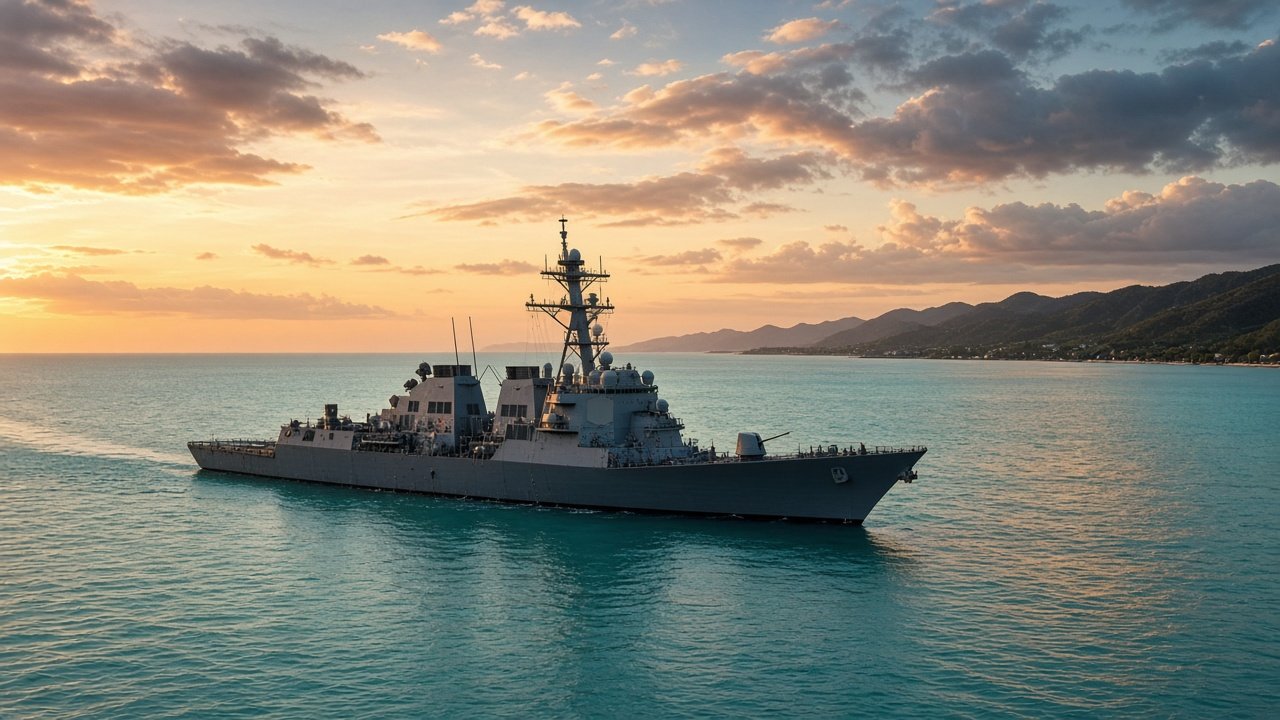
The Trump Cuba question is back. At a rally in Fort Myers, Florida, on Friday, October 23, President Trump said U.S. warships coming home from the Iran war could make a stop off the Cuban coast.
He was answering a shouted question from the crowd at Alico Arena on the campus of Florida Gulf Coast University, where he was campaigning for Republican candidates, including gubernatorial nominee Byron Donalds, WBBH reported. Moments later, Secretary of State Marco Rubio posted that “now is the time” for action on Cuba, the Associated Press reported.
What Trump Said About Cuba
Here is the full quote, so you can judge it yourself. “We’ll do a little stopover,” Trump said. “Actually, what we’re going to do with Cuba is, we’re going to come back from Iran. Those beautiful ships will pass Cuba. We’ll have one of them stop about 50 yards off the coast. They’ll raise up their hands. And then we’re going to send (Secretary of State) Marco Rubio in to finish up the deal.”
This is not a new idea. Trump first floated it earlier this year, although he had not mentioned it in recent months. He has also suggested Cuba would “be next” once the Iran war winds down, a wind-down he has long forecast but which has not yet happened.
The Raúl Castro Indictment
In May, Trump and Rubio raised the possibility of U.S. military intervention after the administration announced criminal charges against Raúl Castro, the island’s former leader. On May 20, the Justice Department unsealed a superseding indictment charging Castro, now 94, and five co-defendants over the February 24, 1996, shootdown of two unarmed Brothers to the Rescue planes. The Miami-based group flew humanitarian flights over the Florida Straits to look for Cuban migrants in distress. Cuban fighter jets fired missiles at the two Cessnas over international waters, killing four U.S. nationals, three of them U.S. citizens: Carlos Costa, Armando Alejandre Jr., Mario de la Peña and Pablo Morales.
The charges include conspiracy to kill U.S. nationals and four counts of murder. “If you kill Americans, we will pursue you. No matter who you are. No matter what title you hold,” then-acting Attorney General Todd Blanche said. An indictment is only an allegation, and Castro is presumed innocent, but it was the first time in nearly 70 years that senior Cuban leadership was charged in the U.S. over violence that killed Americans, the department said.
At the time, Trump said past presidents had weighed intervening in Cuba for decades, but “it looks like I’ll be the one that does it.”
Rubio said then that Cuba has been a national security threat for years because of its ties to U.S. adversaries. He said the administration wants to resolve differences peacefully, but he voiced doubt that a diplomatic deal is possible with the island’s current government.
Rubio Calls on Cubans to Act
Right after the rally remarks, Rubio went further. He addressed his post “to those who seek to create positive change” and urged them “to seize this opportunity to create the change you desire through a discrete partnership with the CIA,” according to PBS News.
Rubio, the son of Cuban immigrants, has long taken a hard line on the regime. He had not addressed Cuba in depth publicly for several weeks. In a September 29 interview with Fox News host Sean Hannity, he said “Cuba has already fallen. It doesn’t have a functional economy.” He also said the U.S. will “never” let Cuba become “a base of operation against American interests or pose a threat to our national security.”

Why the Trump Cuba Push Makes Sense
Cuba’s socialist leadership has kept close ties with America’s adversaries, right on our doorstep. That is exactly why Rubio has called the island a national security threat for years. Likewise, Trump told the United Nations General Assembly last month that he would “not allow a haven for foreign adversaries to threaten America on our own doorstep.”
Meanwhile, ordinary Cubans pay the price. Since 2020, the island has struggled with an economic and energy crisis. Its gross domestic product has shrunk, and its 10 million residents have endured blackouts, food shortages and inflation. There have been waves of protests, and hundreds of thousands of Cubans have left, many for the United States.
That is why peace through strength matters here. A regime that respects nothing else may respect a warship on the horizon. In fact, the best outcome is the one Trump himself described last month: a deal with no shots fired. “I don’t think we’ll need the military. Cuba is failing very badly,” he said.
There is also a moral case. A one-party government that has driven hundreds of thousands of its own people to leave, and is accused of shooting down unarmed civilian planes, has not earned the benefit of the doubt. Pressure on that regime is pressure on behalf of the Cuban people, not against them.
The Fair Caveats
Still, a rally line is not a plan. Trump was answering a question from the crowd, not announcing an order. Moreover, the Iran war is not over, as Mike Waltz warned on Friday when he said it could last another year. Trump also just put another Iran strike back on the table.
Rubio’s CIA post raises its own questions. Publicly inviting people inside another country to work with American intelligence is unusual, and it puts anyone tempted to answer at real risk from a regime that has punished dissent for decades. If there is a plan behind the post, Congress should hear it in a classified setting.
Voters are also watching their wallets. With the midterms only days away, many have voiced concern about how the Iran war has pushed up prices on everything from gas to groceries. Any new mission will need a clear goal, a clear exit and a clear case to the American people.
What Comes Next in the Trump Cuba Standoff
Diplomacy is still in play, at least on paper. Rubio and other top aides have met with Cuban officials in recent months. However, the U.S. side came away unimpressed, and more sanctions followed. At the U.N. last month, Trump said Rubio was “deep into negotiations with Cuba,” and days later he predicted the two countries “will make a deal.”
This week, the two countries also clashed at the United Nations as the administration again tried to build opposition to the annual vote condemning the U.S. embargo.
The pressure is building from every direction. Freedom for the Cuban people would be a historic win, and it would make our own hemisphere safer. The question is how to get there: military pressure, or continued sanctions and diplomacy. The answer should come from a clear strategy, not a rally crowd.
Update (November 2026)
Added November 2026. On October 28, the U.N. General Assembly again adopted a resolution calling for an end to the U.S. embargo, by a vote of 130 to 17 with 25 abstentions. That was a sharp drop in support from 187 to 2 in 2024, according to the U.N.. The U.S. representative urged a no vote and said a Cuban diplomat who allegedly assaulted an American diplomat during the debate would be expelled.
Sources
- AP: Trump revives idea of military intervention in Cuba after Iran
- PBS News (AP): Trump at GOP rally in Florida revives idea of military intervention in Cuba
- WBBH: President Trump headlines midterm rally at FGCU’s Alico Arena in Fort Myers
- U.S. Department of Justice: Superseding indictment charging Raúl Castro and five co-defendants
- U.N. Meetings Coverage: General Assembly adopts resolution to lift U.S. embargo of Cuba


