

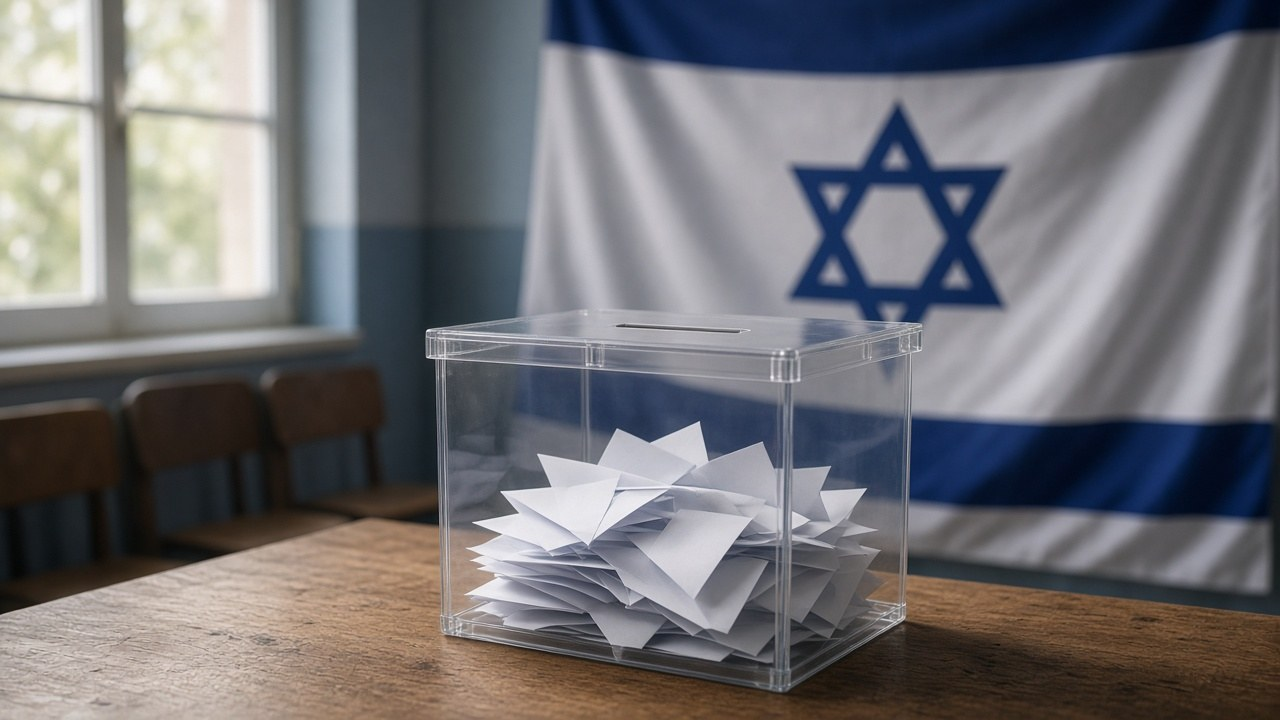
Israelis are voting today in their first national election since Hamas attacked on Oct. 7, 2023. This Israel election is widely seen as a referendum on Prime Minister Benjamin Netanyahu. His top rival is Gadi Eisenkot, a former military chief whose party leads the final polls.
Most polling stations opened at 7 a.m. Tuesday and close at 10 p.m. Israel time, which is 3 p.m. Central, according to JNS. About 7.33 million Israelis are eligible to vote. Results are not in yet, so we won’t guess. Instead, here is what is at stake and what to watch.
Key Takeaways
- Polls are open in Israel’s first national vote since the Oct. 7, 2023, Hamas attacks.
- Final TV polls put Eisenkot’s Yashar party ahead of Netanyahu’s Likud, but neither bloc reached 61 seats.
- President Trump endorsed Netanyahu on Oct. 18 and again on Sunday, and Netanyahu has touted that backing.
- Eisenkot also praised Trump as “a true friend of Israel.”
- Coalition talks will likely follow, since no party has ever won a Knesset majority alone.
Why This Israel Election Matters
Oct. 7 was the deadliest day in Israel’s history. Hamas killed nearly 1,200 people, most of them civilians, the Guardian notes. Since then, Israel has fought on several fronts. That includes a war on Iran, launched alongside the United States in February.
As a result, voters finally get to judge that record. For Netanyahu, the pitch is simple. He says he is the only leader tough enough to face down Israel’s enemies. His opponents, however, argue that his divisive politics have weakened the country, Reuters reports.
The stakes are personal, too. Netanyahu still faces an ongoing corruption trial. Even so, Reuters calls him “an unrivaled master of political survival.” Nobody should count him out.

What the Final Polls Show
The last three TV polls before the Israel election came from Kan 11, Channel 12, and Channel 13. All three put Yashar first, Ynetnews reports. Yashar drew 22 to 23 seats, while Likud drew 19 to 21.
Still, bloc math matters more than party math. Every poll gave Netanyahu’s right-wing and religious bloc exactly 50 seats in the 120-seat Knesset. Meanwhile, the opposition bloc drew 52 to 56. Neither side reached the 61 seats needed to govern. On top of that, Arab parties drew 14 to 16 seats and sit outside both blocs.
Small parties matter, too. A list needs 3.25% of the valid vote to enter the Knesset. Several parties hovered near that line in the final polls. If they fall short, their votes count for nothing, and that could tip the balance.
Trump’s Endorsement and the Alliance
President Trump first endorsed Netanyahu on Oct. 18. Then, on Sunday, he posted again: “Vote for Bibi Netanyahu for Prime Minister, we have to finish the job that we started!” Netanyahu hailed that support on the eve of the vote.
Notably, Eisenkot did not attack the president. Instead, he called Trump “a true friend of Israel.” He also said he was “confident that he will work in full cooperation with any leader chosen by the people.”
That is the real headline for Americans. Both leading candidates want a close bond with Washington. In fact, Reuters reports that nearly all Jewish-led parties, including Eisenkot’s, now oppose a two-state solution. In other words, the U.S.-Israel alliance does not hinge on one man. It rests on shared values and shared enemies.
Why the Israel Election Matters to Your Wallet
Fiscal conservatives should watch this Israel election closely. Here at home, the Iran war gets much of the blame for higher prices, especially fuel, Reuters reports. Meanwhile, the White House says the U.S. will not attack Iran before the Nov. 3 midterms. As we noted when oil hit $117, Tehran wants Americans to blame Washington for the pain at the pump.
A steady Israeli government makes a strong partner. On the other hand, months of stalled talks make planning harder for everyone, from the Pentagon to your local gas station.
What to Watch After Polls Close
First, watch the exit polls after voting ends at 10 p.m. Israel time. Next, watch which small parties clear the threshold. Then watch the coalition talks. Israel’s president taps the lawmaker with the best chance to form a government. That person must then win the Knesset’s approval.
Those talks could be long and difficult, and another election is possible if no majority emerges, Ynetnews reports. Netanyahu knows that road well. Last time, it took four inconclusive elections in two years to remove him. Then he was back 18 months later.
So here is our question for you: should America stay neutral in Israel’s vote, or was Trump right to back Netanyahu?
Sources
- Reuters via Al-Monitor: Netanyahu touts Trump endorsement on eve of vote (Oct. 26, 2026)
- Ynetnews: Final Israel election polls put Eisenkot’s Yashar ahead of Likud
- JNS: Israel heads to the polls to elect 26th Knesset (Oct. 27, 2026)
- The Guardian: Israel election live (Oct. 27, 2026)
Follow World of Payne for More
For more conservative commentary on world events, national security, and your wallet, visit the World of Payne homepage and follow the show on X, Facebook, and Instagram.