

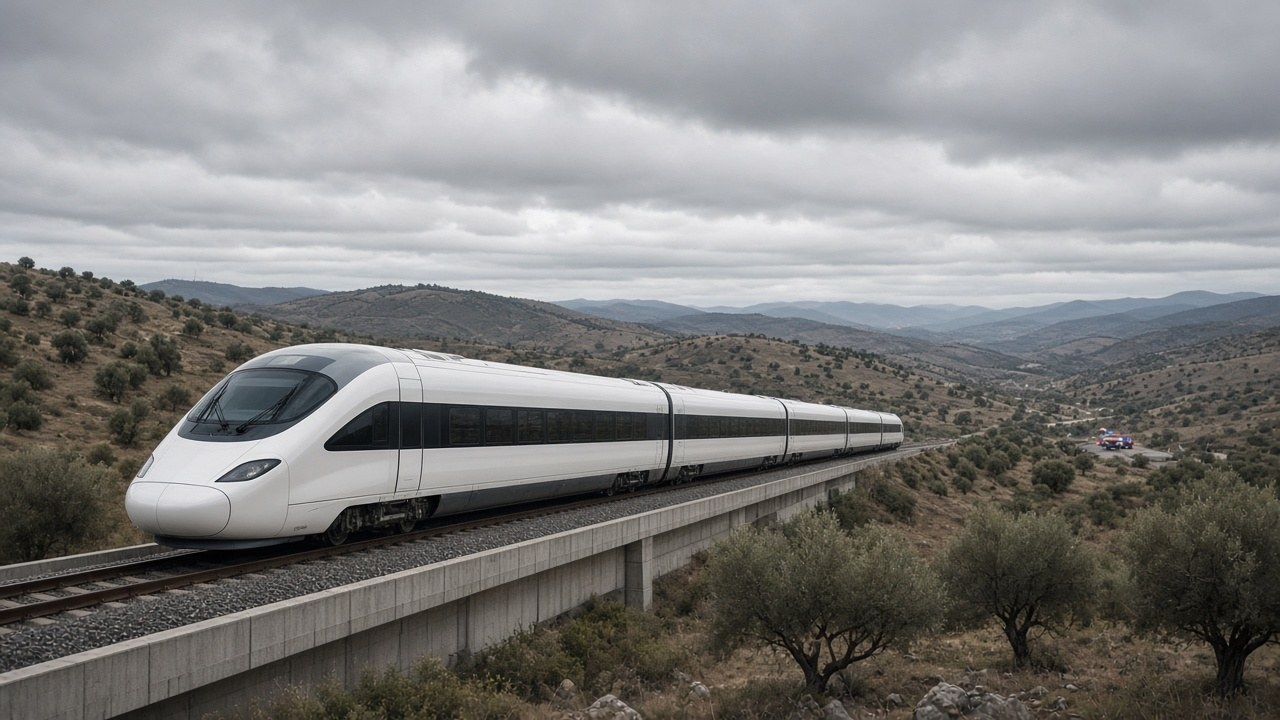
A Spain train crash killed dozens of people Wednesday morning when a high-speed AVE train slammed into the back of another train that was stopped on the tracks near Urda, in Toledo province. Civil Protection put the provisional death toll at 46, Sur in English reports. Officials warn the number will climb as rescuers work through the wreckage.
Our prayers are with the victims and their families. Even so, the early facts point to a failure inside a government-run system, and that deserves a hard look.
What We Know About the Spain Train Crash
The collision happened at 8:54 a.m. local time at kilometer 118 of the Madrid–Seville high-speed line, between the towns of Mora, Orgaz and Urda. Two trains were heading south from Madrid. One was a Renfe AVE carrying 397 passengers, and the other was an Iryo service carrying 147, according to Sur. The AVE hit the stopped Iryo train from behind. As a result, at least two of the Iryo’s cars went down an embankment.
The Renfe train, AVE 2080, had left Madrid at 8 a.m. bound for Seville, according to the Spanish daily El Español. Renfe says its train resumed its trip only after receiving authorization. Both Renfe and Iryo say they do not yet know why the Iryo train was stopped.
Renfe is Spain’s state-owned rail company, while Iryo is a private operator, The Guardian notes. Trains from the same two companies were also involved in the Adamuz disaster in January. Adif, the state-owned company that manages the tracks, has suspended high-speed service between Madrid and Andalusia indefinitely.
“The impact was tremendous,” Roberto Gómez Ramos, a passenger on the AVE, told Sur. He said passengers helped one another out of the car. Another passenger in the AVE’s last car, Miguel Ángel Pérez, told state broadcaster TVE that his group got out by breaking the windows, El País reported. Among the passengers was former Spanish labor minister Fátima Báñez, whose condition was not yet known.
The Emergency Response
Castilla-La Mancha raised its regional emergency plan to Level 2 and asked for the Military Emergency Unit, Sur reports. Crews deployed air ambulances and mobile intensive care units over difficult terrain, and Madrid, Andalusia, Navarre and Castilla y León sent reinforcements. A field hospital went up at the site, and Urda turned its sports hall into a reception center.
Renfe opened a helpline for families and a support center at Madrid’s Atocha station. Spain’s Congress suspended its scheduled business for the day.

A Signal Failure and a Human Error
The early explanation is troubling. Government sources told El País that “a human error by an Adif operator in response to a malfunction in the main signaling system is the likely cause of the accident.”
Here is how that reportedly unfolded. The line uses LZB, an automatic train protection and signaling system that is supposed to stop a train before it reaches an occupied stretch of track. That system failed Wednesday morning, so about eight trains in the area stopped, El País reports. Controllers then switched to manual operation and ordered the trains to move. However, the Iryo train could not move.
After the failure, trains were allowed to move under rules set by traffic controllers, relying on light signals beside the track instead of the automatic system, El Español reports. That backup method works only if every instruction from the control center is correct.
According to initial analyses, an operator at the Atocha control center in Madrid still told the AVE to proceed. Spain’s rail accident investigation commission, the CIAF, is now examining whether controllers cleared the AVE onto an occupied stretch without confirming the track was clear, Sur reports.
Rafael Escudero, a spokesman for the Railway Union, called the crash “very unusual.” He noted that traffic on the line is monitored in real time and that trains receive live information on track conditions. In other words, the system is supposed to stop a train before it reaches an obstacle like another train. That is exactly what did not happen.
Why This Spain Train Crash Demands Accountability
This is not the first disaster on Spain’s high-speed network this year. On Jan. 18, the Adamuz crash in Córdoba killed 46 people, El País reports. That was Spain’s worst rail accident since 2013, when an Alvia train derailed on a curve near Santiago de Compostela and killed 80. Now, just nine months after Adamuz, government sources fear Wednesday’s crash could be even worse.
Adif and Renfe are both state-owned, and Transport Minister Óscar Puente is the official ultimately answerable for them. When the state owns the tracks, runs the signals and operates one of the trains, it cannot easily point the finger at someone else. Therefore, the investigation has to be independent, public and fast. Families deserve to know whether this was one worker’s mistake or a system that keeps failing under pressure.
Prime Minister Pedro Sánchez said he is “in constant contact” with the transport minister and the regional government. The government and the opposition both canceled their schedules for the day. With a general election only weeks away, Spanish voters will rightly ask harder questions once the rescue is over.
Europe has seen what happens when infrastructure failures meet public distrust. In Serbia, a deadly station canopy collapse in Novi Sad in 2024 sparked two years of protests that reshaped the country’s politics, as we covered in the Serbia election this week. Spain is not Serbia, but the lesson about accountability travels.
A Lesson for American Rail Plans
Americans should pay attention, too. Spain is often held up as a model of government-built high-speed rail. Yet a modern network is only as safe as the people and systems running it. Shiny trains and big budgets do not replace basic accountability.
Automation helps, but it also creates a dangerous moment when it fails and humans have to take over. Any rail system needs clear, tested procedures for that handoff, and controllers trained to slow everything down rather than rush service back to normal.
After this Spain train crash, any U.S. lawmaker selling a grand rail project should answer a simple question first. When the signals fail, who is responsible, and how fast will the public learn the truth? Until that answer is clear, taxpayers should be skeptical.
What to Watch Next
- The final toll. Officials expect the number of dead to rise as rescuers reach the damaged cars.
- The investigation. Whether the CIAF and a court confirm human error at the Atocha control center, and why the signaling system failed.
- Political fallout. Whether Transport Minister Puente keeps his job ahead of the election.
- The corridor. How long the Madrid–Andalusia high-speed line stays closed.
For now, the focus belongs on the people of Urda, the rescuers and the families still waiting for news. For more on events abroad, follow our Foreign Policy coverage.
Update (November 2026)
Added November 2026. The death toll rose to 69, and authorities finished identifying all of the victims on Nov. 2: 54 Spaniards and 15 foreign nationals, Euronews reported. Sánchez declared three days of mourning. Puente later said the control center ordered trains to resume despite a stop signal and called it “clearly” a “wrong decision,” The Guardian reported. The operator who authorized the AVE was named a formal suspect and declined to testify. Puente offered his resignation, but Sánchez refused it.
Sources
- Sur in English: Toledo high-speed train collision on Madrid-Andalusia line
- El País English: High-speed rail crash in Spain
- El Español: Adif suspends high-speed service between Madrid and Andalusia after collision (Spanish)
- The Guardian: Spain’s Sánchez declares three days of mourning after Toledo train crash
- Euronews: Identification of the 69 victims of the Urda accident concludes (Spanish)


