

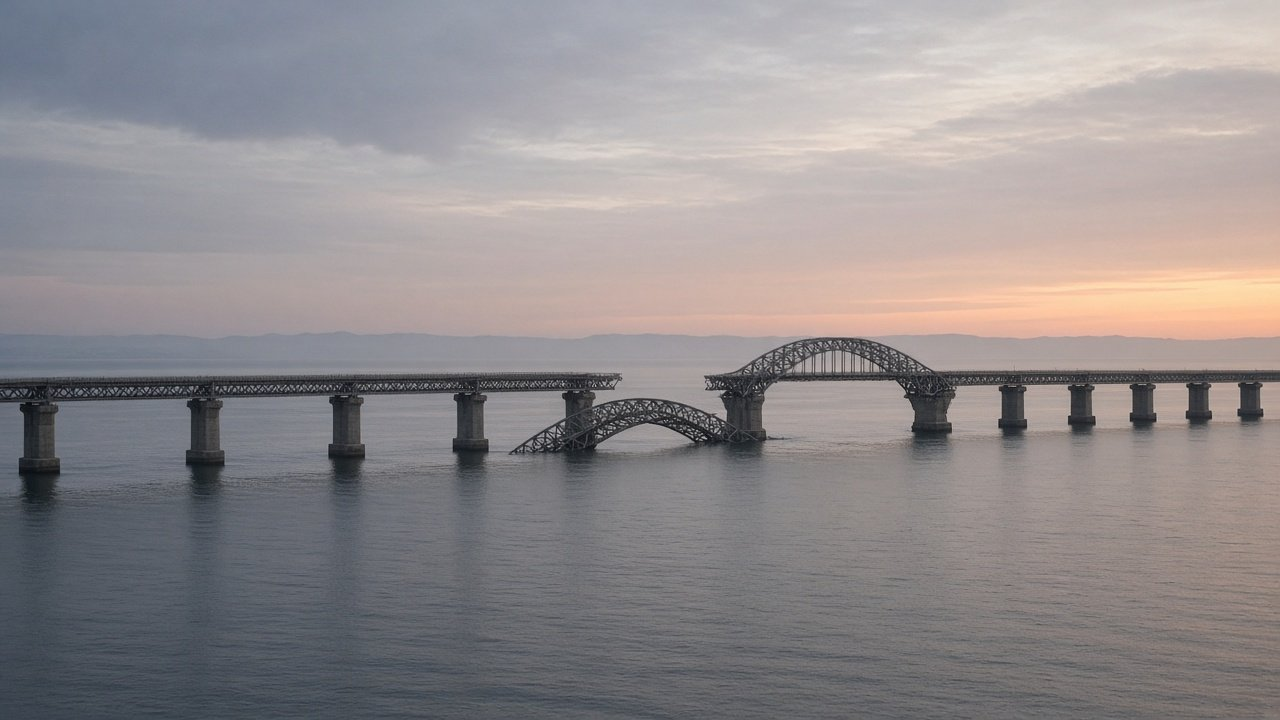
The Kerch Bridge, the 12-mile road and rail link Vladimir Putin built to tie occupied Crimea to Russia, lost a full road span overnight. On Nov. 17, 2026, a Ukrainian missile-and-drone strike brought down one of the bridge’s steel arches and the roadway beneath it. Russia’s Transport Ministry suspended all road and rail traffic, and the Kremlin promised to rebuild it “even better than before.”
My take is simple. This strike changes the leverage in the war two days before Putin sits down with President Trump and Xi Jinping. Ukraine did it with Ukrainian-made weapons, and that matters for American taxpayers. Washington should treat this as leverage for a verifiable deal, not as a reason to rush one.
What Happened at the Kerch Bridge Overnight
President Volodymyr Zelensky called it “an unprecedented operation.” He said it was the seventh phase of a campaign that ran for several weeks. In that campaign, Ukrainian forces first wore down air defense systems, radars and electronic warfare equipment along the route, according to the Kyiv Independent.
In the final phase, Palianytsia drones hit the road section. Meanwhile, Neptune missiles and Ruta and FP-5 weapons hit the rail section. Zelensky said the Flamingo system carried out a precision-guided strike. Ukraine’s Security Service, the SBU, said “one of the metal arches and the automobile span under it were completely destroyed.”
The rail bridge took hits too, but its arch is still standing. Ukraine’s military said the roadway is “out of action” and the rail section is damaged, the BBC reported. By Tuesday, the Russian-installed head of Crimea, Sergey Aksyonov, said some rail traffic had resumed. According to Politico Europe, Russia’s Transport Ministry said limited traffic would run on a single track.
On casualties, the reports don’t line up yet. The Transport Ministry said that, according to preliminary information, there were no casualties on the bridge. Aksyonov separately said two people were killed in a drone strike in a district close to the bridge, NBC News reported. I’m not going to blur those two claims together.
Why the Kerch Bridge Matters to Russia
Russia built the bridge after it seized Crimea in 2014. Putin opened the road section himself in 2018, and passenger rail followed in 2019. The price tag depends on who you ask. NBC puts it at about $2.7 billion, Politico at $3.7 billion and the Kyiv Independent at $4 billion. Either way, this was Putin’s signature project.
The military value is the bigger story. The bridge carries weapons, fuel, ammunition and troops into Crimea and on to southern Ukraine. Zelensky called it “the main military crossing” from Russia into Crimea. Russia’s Transport Ministry has said nearly 24 million vehicles crossed in the first five years after it opened.
Russia still has other routes, but each one is weaker. There is a land corridor through occupied parts of the Zaporizhzhia and Kherson regions. However, Ukraine has been hitting roads and bridges in northern Crimea, and Politico counts six other bridges near Crimea targeted since Oct. 10. The Kerch ferry has limited capacity, and one Ukrainian analyst says it was already out of service. Sea delivery runs into Ukraine’s naval drones.
There’s also a shipping problem. Debris from the arch may block the channel under the bridge, which connects the Black Sea to the Sea of Azov. That route serves Russian-held ports such as Mariupol and Berdiansk, as well as ships carrying grain, oil and gas.
How Long the Kerch Bridge Repairs Could Take
The Kremlin’s spokesman, Dmitry Peskov, said there is “no doubt that the bridge will be restored.” Experts are far less confident about the timeline.
Ukrainian military aviation expert Andrii Kharuk told the Kyiv Independent that restoring the section could take “a year or even longer.” He estimated the fallen structure weighs around 6,000 tonnes. It was built on shore over several months and then moved into place, he said. Emil Kastehelmi of Finland’s Black Bird Group went further, writing that the road bridge “won’t be repaired during this war.”
This is the third time Ukraine has hit the bridge in a big way. A truck bomb damaged it in October 2022, and naval drones struck it in July 2023. Neither attack took it out of commission, according to the Kyiv Independent. This time, an entire span is in the water.

What It Means for Trump’s Ukraine Peace Push
The timing is not an accident. Putin is due to meet Trump and Xi in Shenzhen, China, on Thursday. U.S.-brokered talks in Abu Dhabi ended last week without a significant breakthrough, according to NBC.
I’ve argued before that any Ukraine deal has to be verified before America signs off. I still believe that. I also think this strike strengthens Trump’s hand. A Russia that can’t protect its prized bridge has less room to demand that Ukraine give up the parts of Donbas it still holds. Poland’s foreign minister, Radoslaw Sikorski, put it bluntly on X: “Looks like Ukraine has cards.”
So the right move in Shenzhen is not to trade this leverage away for a quick photo. Instead, Trump should use it to demand terms Russia actually has to keep, with enforcement written in. I laid out the bigger picture for that Trump-Putin-Xi meeting on Saturday.
What It Means for U.S. Taxpayers
Here’s the part conservatives should notice. The SBU says Ukraine used a “wide range of Ukrainian-made weapons.” The list Zelensky gave includes Flamingo and Neptune missiles and a string of domestic drones. No American missile is named in it.
That matters because the money picture has shifted. Europe is now the largest donor of military aid to Ukraine, according to the Kiel Institute’s Ukraine Support Tracker. Still, Europe leans on American weapons. European donors bought at least 3 billion euros of military aid from U.S. defense companies in the first half of 2026. Moreover, U.S. stockpiles supplied more than 90% of the aid sent through NATO’s PURL program.
That’s the right model, as long as our own shelves stay full. When allies paid for Patriot interceptors for Ukraine, the real issue was how fast America can rebuild its own supply. Ukraine building long-range weapons at home means less pressure on ours.
Escalation Risks and What We Don’t Know
This didn’t happen in a vacuum. Russia began a bombing campaign against Ukrainian bridges on Oct. 1, according to Politico. Overnight, Russian missiles closed Kyiv’s Northern and Southern bridges over the Dnipro. Russia’s Investigative Committee has opened a terrorism case over the Kerch strike, and Moscow’s response could be harsh.
There is plenty we still don’t know. First, we don’t know how badly the rail bridge is hurt or how much weight it can carry now. Second, nobody has confirmed whether debris blocks the shipping channel. Third, Russia’s Defense Ministry claimed record Ukrainian drone attacks two days running, but the reported counts differ by outlet.
What to Watch Next
- Whether Russia’s Transport Ministry expands rail traffic or adds load limits on the rail bridge.
- Any official word on clearing debris from the Kerch Strait shipping channel.
- How Moscow retaliates against Ukrainian cities and power plants this week.
- What Trump, Putin and Xi say in Shenzhen on Thursday about Ukraine.
- Whether Europe keeps buying American weapons while U.S. production catches up.
I’ll keep watching the numbers. For now, the bridge Putin built as a symbol of permanence is missing a span, and that’s a fact no press release can rebuild.
Sources
- BBC News: Putin’s Crimea Bridge Partly Collapses as Zelensky Hails ‘Unprecedented’ Attack by Ukraine (Nov. 17, 2026)
- NBC News: Vladimir Putin’s Prized Bridge Is Partially Destroyed in Ukrainian Strike (Nov. 17, 2026)
- The Kyiv Independent: Entire Section of Crimean Bridge Collapses After ‘Seven-Phase Operation,’ Zelensky Reveals (Nov. 17, 2026)
- The Kyiv Independent: Russia Says It Will Rebuild Crimean Bridge ‘Even Better.’ Here’s Why They’ll Be Disappointed (Nov. 17, 2026)
- Politico Europe: Zelenskyy Gives Details on Ukraine’s Crimea Bridge Operation (Nov. 17, 2026)
- Kiel Institute for the World Economy: Ukraine Support Tracker: Europe Leads on Aid, US Weapons Remain Key (Aug. 13, 2026)


