

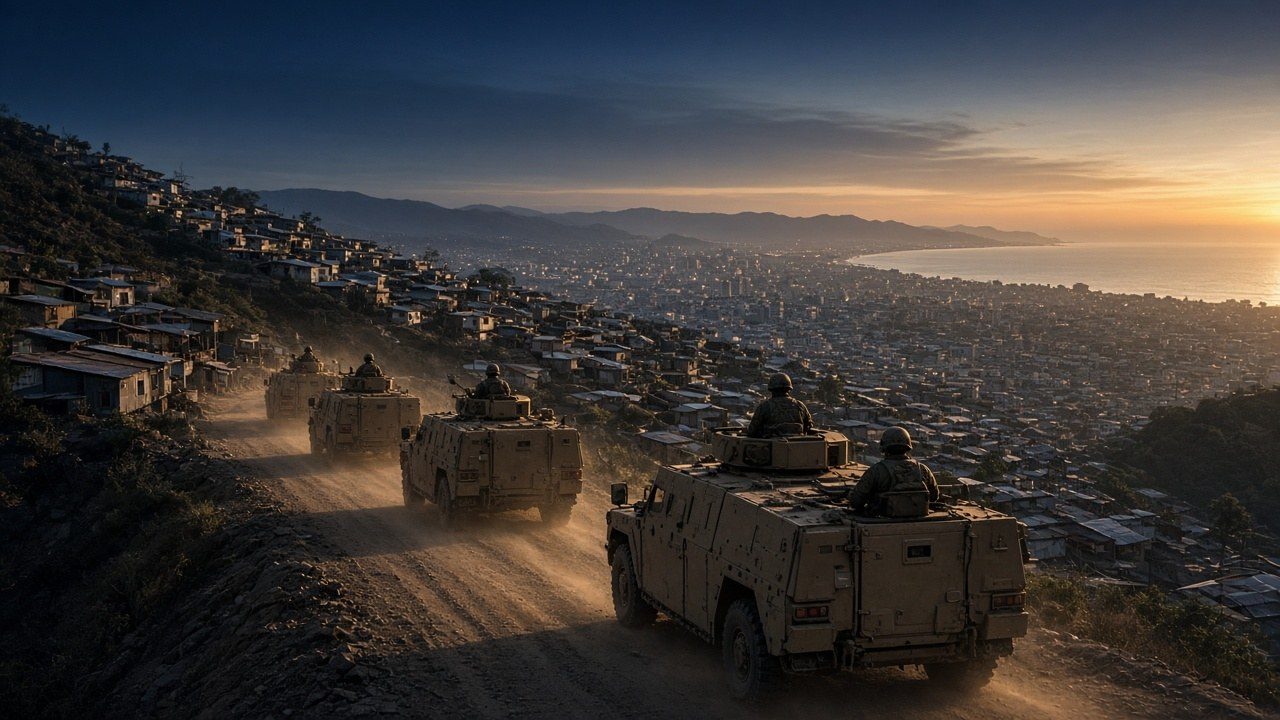
More than 2,000 Salvadoran troops in Haiti are now hunting the gangs that ambushed four of their own. El Salvador’s foreign ministry said President Nayib Bukele informed Haitian Prime Minister Alix Didier Fils-Aimé of a “robust deployment” earlier in the week, the BBC reported. The soldiers’ first job is to retrieve four aviation technicians missing since mid-October. They are also supposed to help Haiti’s fight against the gangs.
Haiti’s interim leader described a Wednesday phone call with Bukele about operational cooperation “within the framework of” the U.N.-backed Gang Suppression Force, CNN reported. Even so, the mission’s command structure had not been set, a source close to the matter told CNN. Notably, he is trying to do this without American soldiers on the ground.
Why Salvadoran Troops in Haiti Now
The trigger was personal. On October 18, four Salvadoran aviation technicians were ambushed in Croix-des-Bouquets, a gang-held area east of Port-au-Prince, the BBC reported. They were serving with the Gang Suppression Force in a noncombat role, according to Salvadoran officials cited by CNN. The BBC said they were traveling back to their base in an armored vehicle when they came under fire. No gang has claimed responsibility, and they have not been found.
Bukele did not wait. In the immediate aftermath, 100 special forces were sent to assist in search and rescue, CNN reported, a precursor to the larger force. By the time the scale became public, more than 2,000 Salvadoran soldiers were headed to Haiti. Meanwhile, Haiti handed over four bodies, claiming they were the missing men. Bukele said they did not match, and that one was a child and another was wearing a different country’s military uniform, the BBC reported.

Not an Invasion, Bukele Says
On Thursday evening, Bukele posted in Haitian Creole, announcing that the deployment was “nearly completed” and that “90% of the expenses” would be shouldered by El Salvador, CNN reported. “This is not an operation against the Haitian people nor an invasion of Haiti,” he wrote, in CNN’s translation. “Our only goal is to bring our four aviation technicians back home. Furthermore, we intend to teach a lesson to the gangs.”
He added, “Perhaps future generations of Haitians will remember us as friends who once came to help.” In other words, he wants to go in, finish the job and leave. Unfortunately, Haitians have heard promises like that before.
The Conservative Case for Salvadoran Troops in Haiti
Start with the record. Bukele took El Salvador from a murder capital to one of the safest countries in the hemisphere by treating gangs as enemies, not clients. That is the mindset Haiti has lacked for years. The BBC noted that he has already threatened to “wipe out” Haiti’s gangs and to replicate the campaign he ran at home if they do not release the Salvadorans.
Next, look at the map. Port-au-Prince sits about 700 miles from Florida, a short flight from the American mainland. CNN put the city at “just two hours from Florida’s coast.” A country run by gangs does not keep its chaos at home. It pushes people onto boats and gives smugglers room to work. As a result, a more stable Haiti is an American security interest, not charity. We made a similar case about the region in our take on Machado returning to Venezuela.
Finally, look at who is paying. Bukele says El Salvador is covering 90% of the costs with its own funds. For years, conservatives have asked allies to carry more of the load in their own neighborhoods. A partner that pays its way is a better model than another open-ended, U.S.-financed mission.
The humanitarian stakes are not abstract. More than 5,700 people were killed in gang-related violence in Haiti this year, the U.N. says, and armed gangs control much of the capital, the BBC reported. CNN added that years of brutal gang violence have driven over a million people from their homes, and that on Thursday Haitians learned long-deferred presidential elections had been postponed again until next year. The earlier U.N.-authorized force has struggled to penetrate areas where gangs hold sway. That failure is why a capable partner is attractive. It is also why a sloppy mission could make a bad situation worse.
The Fair Caveats
Still, cheering is not a plan, and the Salvadoran troops in Haiti face hard questions. First, the mandate is murky. CNN reported that El Salvador had been quietly sending troops for over a week before the scale was revealed, and that at the time of reporting the Salvadorans were not staying at the main Gang Suppression Force base in Port-au-Prince. Second, the rules of engagement are unclear. CNN said the force’s command structure had not been established. Bill O’Neill, the U.N.’s human rights expert for Haiti, warned that the situation “is volatile and could become more violent with innocent people being harmed.”
Third, the U.N. force’s track record is weak. Before this surge, that authorized mission had already struggled to penetrate gang-held areas. The Security Council approved expanded powers for the Gang Suppression Force last year, the BBC reported, but the force still could not break the gangs’ hold on large parts of Port-au-Prince. A new contingent that answers to a different chain of command can help, or it can add another armed faction to a crowded battlefield.
Critics also point to mass incarceration and abuse claims in Bukele’s crackdown at home. CNN quoted Haiti expert Romain LeCoeur warning that Haiti’s security response “no longer rests on a single strategy, but on a juxtaposition” of multilateral, national and other forces. Those concerns deserve real answers, not a wink. Sovereignty matters, too. Haiti has to own the outcome. Foreign troops can back a government. They cannot be a substitute for one.
The Bottom Line
The test for Salvadoran troops in Haiti is simple. Bring the four men home, break the gangs that took them, and then leave, as Bukele has framed the mission. If he pulls that off, he will have done what years of U.N. missions could not. A steadier Haiti would also be a better partner on migration, a fight we have covered in our look at deportation limbo.
Washington should watch closely, demand a clear command structure and stay honest about the risks. Burden-sharing is welcome. A vague mission is not. If the four men come home and the gangs lose ground, this will have been the right kind of allied help. If the operation drags on without rules, it will look like every other failed intervention in Haiti, only with a different flag on the vehicles.
Update (November 2026)
Added November 2026. The four technicians were still missing as of early November. The Guardian reported on November 7 that Bukele had sent more than 2,000 troops and special forces since the October 18 ambush, and that they were not operating under the command of the Gang Suppression Force. The paper said it was unclear how long they planned to stay, and that they were setting up a base near the U.S. embassy. It also quoted a researcher warning that drones, attack helicopters and heavy weapons had already changed the fight, with civilians paying the price. U.N. spokesman Stéphane Dujarric later clarified that the vast majority of the newly deployed Salvadoran personnel are not part of the Security Council-authorized force and therefore fall outside its monitoring mechanisms, Amnesty International reported. Amnesty said Haiti’s prime minister and Bukele must make the governing agreement public and explain the rules on the use of force, and that the fate of the four missing Salvadorans must still be established.
Sources
- BBC: El Salvador sends 2,000 troops to Haiti to rescue four missing soldiers
- CNN: El Salvador’s Nayib Bukele adds a wildcard to Haiti’s fractured security landscape
- The Guardian: Taking the war on gangs to Haiti poses risks for El Salvador’s leader (Nov. 7, 2026)
- Amnesty International: Haiti and El Salvador must ensure the deployment respects human rights (November 2026)
- Axios: Trump-Bukele Haiti troop surge (Oct. 30, 2026) — cited in the original post; this draft could not independently retrieve the page
- Miami Herald: Haiti coverage of the Salvadoran deployment — cited in the original post; this draft could not independently retrieve the page


