

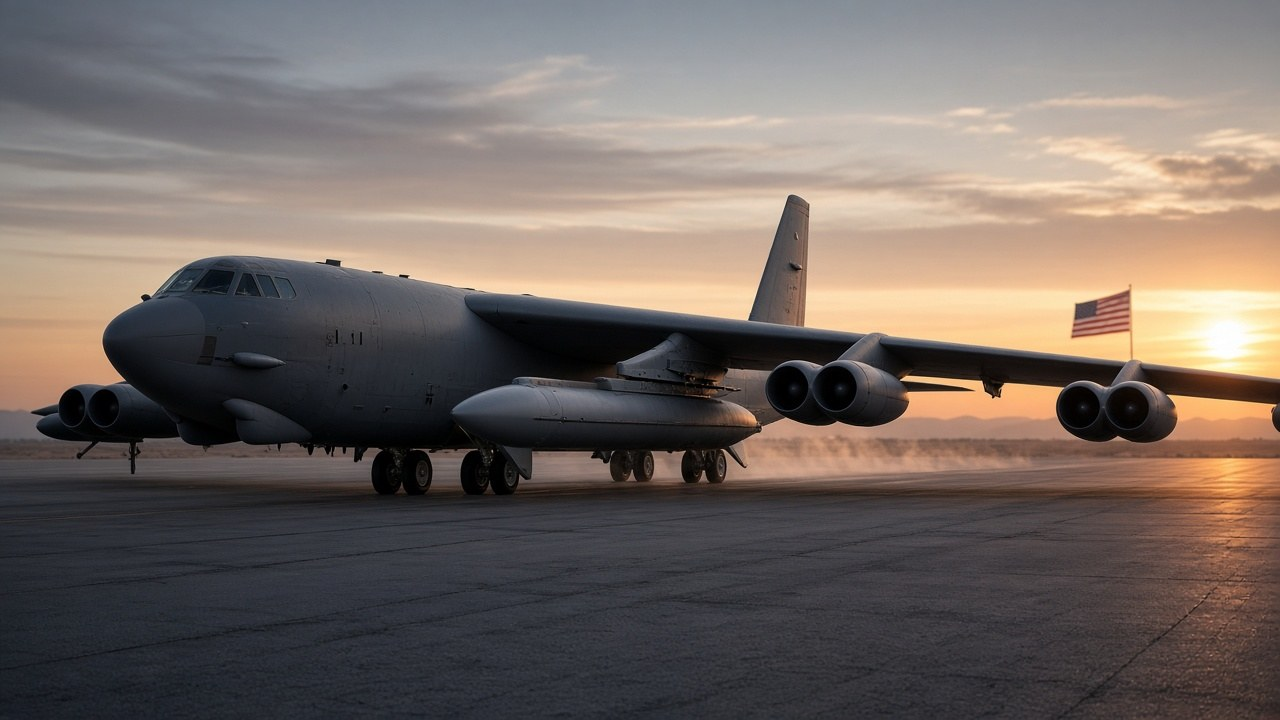
The Air Force finally has a hypersonic missile it is ready to buy. On Monday, Oct. 26, the service announced a $694 million contract with Lockheed Martin to produce the AGM-183A Air-Launched Rapid Response Weapon, known as ARRW and pronounced “arrow”. Notably, the deal was signed on Sept. 29 but kept quiet for nearly a month.
That is good news for deterrence. Still, this is the same program the Air Force said it would end without buying a single missile in 2023. So before anyone pops champagne, taxpayers deserve a straight answer. Did the weapon earn its comeback, and will Washington pay for it like adults?
Key Takeaways
- The Air Force awarded Lockheed Martin a $694 million contract to produce ARRW, its first-ever hypersonic missile, announced Oct. 26.
- ARRW flies faster than Mach 5, at least 3,800 miles per hour, and has a range of 1,000 miles, according to the Air Force.
- The program failed its first three launch tests in 2021 and was nearly canceled in 2023 before it was revived in 2025.
- Lockheed says it put $67 million of its own money into production facilities before receiving government funding.
- The Air Force wants $452 million for ARRW in its 2027 budget, but Congress has not passed that budget.
What the ARRW Hypersonic Missile Actually Does
First, the basics. ARRW is a boost-glide weapon. A solid-fuel rocket pushes it past Mach 5. Then the booster falls away, and a glide vehicle maneuvers toward its target at more than five times the speed of sound, the Air Force says. That works out to at least 3,800 miles per hour, or just over a mile per second, Air & Space Forces Magazine reports.
In addition, the missile does not need explosives to do its job. Its warhead uses kinetic energy, so sheer speed destroys the target on impact. Stars and Stripes reports the weapon has a range of 1,000 miles, according to the Air Force. Because it is too large for most fighter jets, it will be fielded first on the B-52 bomber, and testing will also include the B-1B.
Why does that matter? Simply put, a weapon this fast gives an enemy very little time to react. Air Force Secretary Troy Meink called it “a credible, high-speed strike weapon capable of penetrating the most advanced anti-access and area-denial systems”. Likewise, Chief of Staff Gen. Ken Wilsbach said it “enhances our ability to hold targets at risk anywhere around the world.”
This Hypersonic Missile Almost Didn’t Survive
Here is the part the press releases skip. ARRW development began in 2018, when Lockheed signed a design contract worth up to $480 million. A year later, the Air Force added a $988.8 million contract modification for critical design review. At the time, the plan called for a first operational flight test by the end of 2020 and initial operational capability in 2022.
Instead, the first launch test slipped to April 2021 and failed. Then two more failures followed. The first success did not come until May 2022. By then, Congress had already stripped funding for 12 missiles from the 2022 budget plan, and the Air Force zeroed out money for 2023.
In March 2023, the Air Force’s top civilian buyer, Andrew Hunter, said the program would end without purchases. The service shifted its focus to a smaller hypersonic cruise missile. Then, in 2025, then-Chief of Staff Gen. David Allvin told Congress the Air Force would buy ARRW after all. The 2026 budget set aside $362 million to do it.
To be fair, that reversal is not proof of waste. Weapons programs are supposed to test, fail, fix and test again. Moreover, Stars and Stripes reports the booster, glider and warhead have now secured approvals. Still, a program that went from “done” to “buy” in two years deserves a clear public accounting of what changed.
Lockheed Put Its Own Money on the Table
One detail stands out for fiscal conservatives. In its Oct. 27 announcement, Lockheed said it had already funded the efforts, materials and equipment needed to start production. That includes a $67 million company investment in ARRW facilities and equipment before it received government funding.
On Tuesday, the company also broke ground on an expansion in Troy, Alabama. It will add 47,000 square feet and triple the plant’s production space for ARRW. According to Lockheed, it will create new American jobs over the next four years.
That is how defense contracting should work. When a contractor risks its own capital, it has a reason to deliver on time. Taxpayers should not be the only ones holding the bag when a program stumbles.

Congress Still Hasn’t Paid for the Hypersonic Missile Plan
Now for the problem. The Air Force asked for $452 million for ARRW production in its 2027 budget. However, that budget is stalled in Congress, and the Pentagon is running on a continuing resolution at 2026 funding levels. Further out, the five-year plan calls for $556 million to $621 million a year from 2028 through 2031.
In other words, the military is trying to build a new hypersonic missile fleet on a budget that Congress will not finish. Continuing resolutions freeze last year’s priorities in place. They make it harder to start new production lines and lock in better prices. Above all, they let lawmakers avoid hard choices while the bills keep coming.
Meanwhile, the bigger fiscal picture is ugly. We have already reported that interest on the national debt just beat defense spending. Every dollar spent on interest is a dollar that cannot buy readiness. So, if Washington wants a stronger military, it needs to control spending elsewhere, not just pile new weapons onto the credit card.
Secrecy Has Limits
Of course, the Air Force will not say how many missiles it ordered or when they arrive. It labels quantities “controlled unclassified information” to protect operational security. That is reasonable for the public. But the committees writing the checks should get full numbers, including cost per missile, in closed briefings. Security is not an excuse to skip oversight.
Why Conservatives Should Back the Hypersonic Missile, With Conditions
Peace through strength is not a slogan. It is a budget line. Our rivals have been racing to field their own hypersonic weapons, and America cannot afford to fall behind. With the Iran war still testing US readiness, the need for fast, long-range strike options is not theoretical.
Therefore, the right answer is to buy ARRW, but buy it smart. Fund it through a real budget, not a stopgap. Demand cost and schedule numbers in writing. Keep rewarding contractors who invest their own money. And if the missile misses its targets in testing again, be willing to walk away.
FAQ
What is the ARRW hypersonic missile?
ARRW, the AGM-183A Air-Launched Rapid Response Weapon, is a boost-glide hypersonic missile built by Lockheed Martin. It flies faster than Mach 5 and has a range of 1,000 miles, according to the Air Force. It will launch first from B-52 bombers.
How much is the Air Force spending on ARRW?
The production contract is worth $694 million. In addition, the 2026 budget set aside $362 million, and the Air Force requested $452 million for 2027. However, Congress has not passed the 2027 budget.
Why was the ARRW program almost canceled?
Its first three launch tests failed in 2021, and the first success came in May 2022. As a result, Congress cut funding, and in 2023 the Air Force said it would end the program without purchases. It reversed course in 2025.
Want more straight talk on defense, your tax dollars and the decisions coming out of Washington? Read more at World of Payne, and follow the World of Payne show on X, Facebook and Instagram for new episodes and daily commentary.