

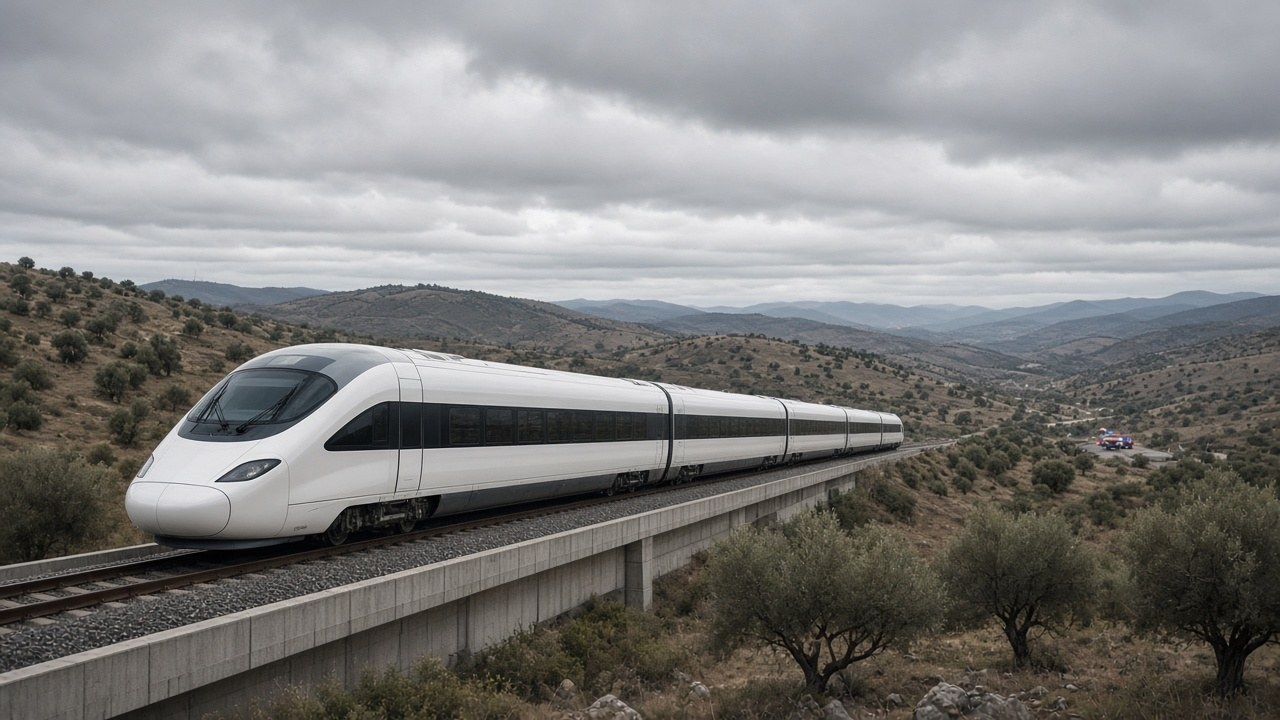
A Spain train crash killed dozens of people Wednesday morning when a high-speed AVE train slammed into the back of another train that was stopped on the tracks near Urda, in Toledo province. Civil Protection put the provisional death toll at 46, Sur in English reports. Later, the Spanish daily El Español reported that Civil Protection had raised it to at least 50, with more than 179 injured. Officials warn the number will likely climb.
Our prayers are with the victims and their families. Even so, the early facts point to a failure inside a government-run system, and that deserves a hard look.
What We Know About the Spain Train Crash
The collision happened at 8:54 a.m. local time at kilometer 118 of the Madrid–Seville high-speed line. Two trains were heading south from Madrid. One was a Renfe AVE carrying 397 passengers, and the other was an Iryo service carrying 147, according to Sur. The AVE hit the stopped Iryo train from behind. As a result, at least two of the Iryo’s cars went down an embankment.
Renfe is Spain’s state-owned rail company, while Iryo is a private operator, The Guardian notes. Trains from the same two companies were also involved in the Adamuz disaster in January. Adif, the state-owned company that manages the tracks, has suspended high-speed service between Madrid and Andalusia indefinitely.

A Signal Failure and a Human Error
The early explanation is troubling. Government sources told El País that “a human error by an Adif operator in response to a malfunction in the main signaling system is the likely cause of the accident.”
Here is how that reportedly unfolded. The line’s automatic safety system failed, so about eight trains in the area stopped. Controllers then switched to manual operation and ordered the trains to move. However, the Iryo train could not move. According to initial analyses, an operator at the Atocha control center in Madrid still told the AVE to proceed. Spain’s rail accident commission is now examining whether controllers cleared the AVE onto an occupied stretch of track, Sur reports.
Rafael Escudero, a spokesman for the Railway Union, called the crash “very unusual.” He noted that traffic on the line is monitored in real time. In other words, the system is supposed to stop a train before it reaches an obstacle like another train. That is exactly what did not happen.
Why This Spain Train Crash Demands Accountability
This is not the first disaster on Spain’s high-speed network this year. In January, the Adamuz derailment in Córdoba killed 46 people, El País reports. Now, just ten months later, government sources fear Wednesday’s crash could be even worse.
Both Adif and Renfe answer to Transport Minister Óscar Puente. When the state owns the tracks, runs the signals and operates one of the trains, it cannot easily point the finger at someone else. Therefore, the investigation has to be independent, public and fast. Families deserve to know whether this was one worker’s mistake or a system that keeps failing under pressure.
Prime Minister Pedro Sánchez said he is “in constant contact” with the transport minister. Opposition leader Alberto Núñez Feijóo said “the priority now is to attend to the victims and support their families.” Both men are right about today. Still, with a general election next month, Spanish voters will rightly ask harder questions tomorrow.
A Lesson for American Rail Plans
Americans should pay attention, too. Spain is often held up as a model of government-built high-speed rail. Yet a modern network is only as safe as the people and systems running it. Shiny trains and big budgets do not replace basic accountability.
After this Spain train crash, any U.S. lawmaker selling a grand rail project should answer a simple question first. When the signals fail, who is responsible, and how fast will the public learn the truth? Until that answer is clear, taxpayers should be skeptical. For now, the focus belongs on the people of Urda, the rescuers, and the families still waiting for news.