



Editor’s note, November 14, 2026: I have folded our earlier midterm posts — the early-vote warning, the final campaign speech, and the first read on why Republicans lost — into this living column. Later certified results, including Alaska’s ranked-choice tabulation, will be added here.
Six days after Republicans lost both chambers of Congress, President Trump posted a question about the midterm election results on Truth Social. “Does anybody really believe that this ‘Election’ was honest,” he wrote. He blamed the polls, early voting “dumps” and “the machines.” He offered no evidence.
That is a sharp turn. On election night, Trump told The New York Times he was “absolutely willing” to accept the midterm election results. Then, on 60 Minutes, he listed real reasons Republicans lost. Voters “didn’t like the war,” he said, and “they didn’t like that gasoline was up.”
I take election integrity seriously. That is exactly why this claim deserves a hard look. Trump named three culprits, and each one can be checked. Each one points the other way. The party should spend the next two years winning voters back, not blaming the machines that counted them.
What the 2026 Midterms Actually Delivered
The scale of the loss explains the frustration, and it should be stated plainly. Democrats won control of both the House and the Senate on November 3, the Associated Press reported. They flipped at least seven Senate seats, including Kansas, Iowa, Texas, Ohio, Maine, North Carolina and South Carolina. In the House, they flipped more than two dozen districts, some of which Trump carried by double digits in 2024. Later unofficial counts projected Democrats holding about 54 Senate seats and more than 250 House seats, with some races still uncalled.
Some of the losses came from candidates the president picked himself. Texas Attorney General Ken Paxton lost his Senate race to Democrat James Talarico by about 12 points, The Hill reported. A Texas Senate seat going blue should end any argument that this was a normal midterm swing.
Washington is now divided. Hakeem Jeffries is poised to become speaker of the House, and Chuck Schumer is expected to become Senate majority leader. John Thune moves to minority leader. I have written separately about Jim Jordan’s path in House leadership. Trump keeps the veto pen until January 2029.
Vice President JD Vance did not hedge. “The reason we lost is the war. The president himself said so last night,” Vance wrote on X, as quoted by NBC News. Trump’s own account was more mixed. He told The Wall Street Journal that “Iran was a piece of it,” and he said, “I did the right thing. I would have done it again.” He also named high fuel costs as the biggest factor, and he posted, “I wasn’t on the Ballot and if I was, we would have won IN A LANDSLIDE!”
“I wasn’t on the ballot” is not a strategy. Neither is blaming one foreign policy decision and pretending the rest of the record was fine.
What Voters Said
Look at what voters said, not at any politician’s spin. The AP Voter Poll surveyed tens of thousands of midterm voters in all 50 states.
- About 4 in 10 voters called the economy the most important issue facing the country. About 3 in 10 named the state of democracy.
- Roughly half said the cost of living and government corruption were “crucial” to their vote for Congress.
- About 8 in 10 said inflation had caused their household a “severe” or “moderate” hardship.
- About two-thirds said Trump’s tariff policies have hurt the national economy.
- About 6 in 10 voters said the U.S. made the “wrong decision” in taking military action against Iran. However, only about one-third said the war was “crucial” to their vote. That is well below the roughly half who said so about the cost of living.
Vance is half right. The war hurt Republicans, mostly through the gas pump. The bigger story is the grocery bill, the utility bill, and the sense that Washington was not working for ordinary families. Inflation is higher than it was when Trump returned to the White House, the AP reported. That is the record voters judged. It is also the one thing a party built on sound money and limited government should be best at fixing.
I made the same point in my Controller’s Desk look at where tax dollars go. A party that blames the machines will not fix grocery bills, war costs, or a nearly $2 trillion deficit. It will simply lose again.
What Trump Said About the Results
Here is the full post from the following Monday: “How could the Polls be so wrong??? Some early voting ‘dumps’ were so large that it was impossible to win, no matter how many people went to vote. It’s all about the machines, which are far more important than the voter!”
Later that day, a reporter asked whether he thought the midterms were rigged. “Well, I think the numbers were terrible in terms of those early votes,” Trump said. Then he pivoted to the uncalled Senate race in Alaska.
According to NBC News, the shift began Saturday. That day, Trump reposted an X user who asked how so many states could swing by 15%. It was also the day he replaced Susie Wiles with Stephen Miller. A White House official noted that Trump had promised to respect the results “if they’re honest elections.” Frustration is not evidence.
The Polls Missed, but Toward Democrats
Trump is right that the polls missed. However, they missed in Republicans’ favor.
The Pew Research Center compared final polling averages with unofficial counts in 27 Senate and governor races. Polls understated the Democratic margin by at least 2 points in 23 of them. On average, the miss was about 4 points.
The House results match. Democrats led the generic ballot by nearly 9 points in the RealClearPolitics average. As of November 5, the actual House vote showed a Democratic lead of about 12 points. The New York Times expected that lead to reach 13 points once West Coast counts finished.
So the polls caught the direction and underestimated the size. Pew also found Democratic supporters more motivated, and more willing to answer surveys. Before the election, Speaker Mike Johnson said polls were “grossly underestimating Republican enthusiasm.” The enthusiasm gap turned out to be real. It just ran the other way.
Pew adds useful context. In 2020, state presidential polls overstated Joe Biden’s margin by about the same amount. A polling miss is a polling problem. It is not proof of a crime, in either direction.

Early Vote “Dumps” Are How Counting Works
Many states process early and mail ballots before Election Day. Then they release those totals in one large batch soon after polls close. That first batch looks huge because it holds weeks of voting. Nothing about its size is suspicious.
More importantly, everyone could see what was coming. On October 28, more than 36 million Americans had already voted, CBS News reported, citing the University of Florida Election Lab. NBC News counted about 37.6 million mail-in and early in-person votes by midday that Wednesday, including 19.8 million in person and 17.7 million by mail. In the 27 states that track party, early voters were 45% registered Democrats and about 31% Republicans, with 24% unaffiliated. Texas alone had passed 5 million early votes. By Monday afternoon, November 2, more than 57 million Americans had cast ballots, easily topping the nearly 46 million who voted early in the 2022 midterms.
Michael McDonald, who runs the Election Lab, said this year’s early voting was on track to pass the 2022 total and looked “at least even to the 2018 election,” which he called “a high water benchmark.” Charles Stewart, who founded the MIT Election Data and Science Lab, told NPR that many early voters would have voted on Election Day anyway. A big early-vote number can simply shift ballots from one day to another. It does not always add new voters.
In other words, the early vote leaned Democratic because more Democrats voted early. That was a turnout problem, and Republicans saw it in plain sight. The party has spent years urging its own voters to bank ballots early, including the RNC’s “Bank Your Vote” push in 2024. Calling those totals “dumps” blames the scoreboard for the score. The fix is a better ground game, not a conspiracy theory.
The Machines Leave a Paper Trail
This is where the claim is weakest, because American elections are built to check machines.
A 2026 report by the center-right R Street Institute and the Institute for Responsive Government lays out the safeguards. About 96% of voters this year were likely to cast a ballot with a voter-verifiable paper trail. In addition, 49 states conduct post-election audits, often by hand-counting a sample of ballots. Federal law requires officials to keep ballots and records for 22 months. Every state lets the public or party designees watch the process.
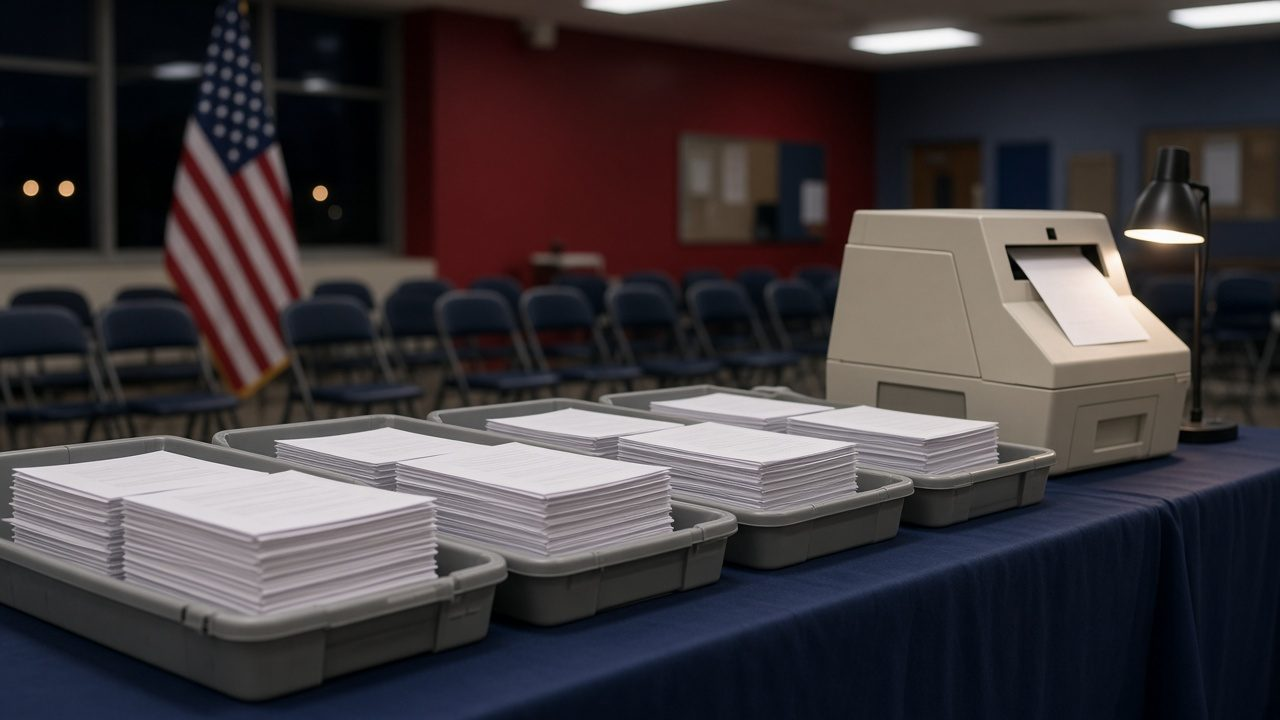
If a machine flipped votes, the paper would show it. Campaigns can request recounts where state law allows, and audits compare the paper to the machine totals. There were real problems on Election Day, as there always are. Machines malfunctioned in Westchester County, New York. Officials there switched to backup machines and said every vote would be counted. Arizona had bad weather. That is the system handling problems, not hiding them. The Associated Press observed that there was no day-after wave of court challenges.
There is another problem with blaming the machines. Democrats posted big gains in places like Texas, South Carolina, Iowa and Kansas. In Texas, South Carolina and Iowa, Republican governors and Republican legislatures write the election rules. A claim that the machines stole the midterms is really a claim against Republican-run states. No one has offered evidence of that.
This is also a federalism question. In February, Trump said Republicans “ought to nationalize the voting.” Senate Majority Leader John Thune disagreed. He said he is “a big believer in decentralized and distributed power.” Then he added, “It’s harder to hack 50 election systems than it is to hack one.” Thune had it right. Fifty separate systems, run by both parties, make a nationwide rigging scheme nearly impossible to pull off. That design is a conservative achievement. We should defend it, not smear it.
Why Doubting the Results Hurts the Right
On the same ballot that gave Democrats Congress, voter ID won. Ohio, North Carolina and Nevada passed voter ID measures. Four more states passed citizenship-to-vote amendments. I covered those ballot measures separately. Those wins came from concrete, popular reforms. Unproven fraud claims make those reforms easier to dismiss as sore-loser politics. Every time a leader cries wolf, the next real concern gets less of a hearing.
Some on the right already see it. Former Rep. Marjorie Taylor Greene, once a loud voice on 2020 fraud claims, asked why Trump’s Justice Department never prosecuted anyone from that election. Podcaster Megyn Kelly, a Trump backer, replied with two words: “Just Stop.”
History should have been a warning, too. On November 2, in a speech at the Lincoln Memorial Reflecting Pool, Trump said, “For some reason, the sitting president doesn’t win the midterms. But we gave this a very strong shot.” The president’s party lost House seats in 20 of the 23 midterms from 1934 through 2022, according to the American Presidency Project. The only gains came in 1934, 1998 and 2002. In Trump’s first term, Republicans lost 41 House seats in 2018. The same data set showed Trump’s Gallup job approval at 33% in late August. In every midterm in that table where the president’s approval was below 50% late in the campaign, his party lost House seats.
He also repeated a promise that adults will get $5,000 if Republicans won. I treat that like any other campaign spending promise. Ask what it costs and how it gets paid for. Fiscal conservatives should do that even when the promise comes from our own side.
What to Watch in Alaska, and What to Do Now
First, watch Alaska, the race Trump brought up. As of November 10, Democrat Mary Peltola led Republican Sen. Dan Sullivan by 2,517 first-choice votes out of 219,342 counted, the Alaska Beacon reported. Ranked-choice results were expected November 18, according to the Alaska Division of Elections. The slow count is not a red flag. Officials held back some absentee and early ballots to cross-check Election Day poll registers. I argued in October that the Justice Department should have to prove its case in Alaska without breaking the secret ballot. A judge agreed. The same standard applies here.
Second, watch whether Trump doubles down. If a campaign files a real challenge, with specific ballots and specific errors, courts and auditors can test it. That is how the system should work.
Election integrity is a conservative cause because it rests on evidence. Paper ballots, audits, ID at the polls and clean rolls were all in place this year. If someone has proof, take it to a court or an audit. If not, Republicans have a two-year window. Bring down what families pay for gas, groceries and power, and prove it with numbers they can check. Divided government can still slow Washington down, and slower is often better for taxpayers. Trump keeps the veto. Republicans in the minority can still block bad spending and force votes on energy and the border. What they cannot afford is to spend the next two years arguing about machines that left a paper trail.
Sources
- NBC News: Trump casts doubt on election results after saying he was “absolutely willing” to accept them (Nov. 9, 2026)
- Pew Research Center: A First Look at Polling Performance in 2026 (Nov. 6, 2026)
- R Street Institute and Institute for Responsive Government: United in Security, How Every State Protects Your Vote in 2026
- Alaska Division of Elections: 2026 General Election results (unofficial)
- The Independent: reaction to Trump’s midterm claims, including Marjorie Taylor Greene and Megyn Kelly (Nov. 9, 2026)
- Associated Press: Democrats win the House and Senate
- AP Voter Poll, via PBS NewsHour
- NBC News: Vance says the Iran war caused GOP midterm losses
- The Hill: Trump, Vance, and the midterm losses
- CBS News: early-vote totals citing the University of Florida Election Lab
- NBC News early vote tracker
- American Presidency Project: seats gained or lost by the president’s party in midterm elections
- CBS News: Trump’s November 2 Reflecting Pool remarks


