

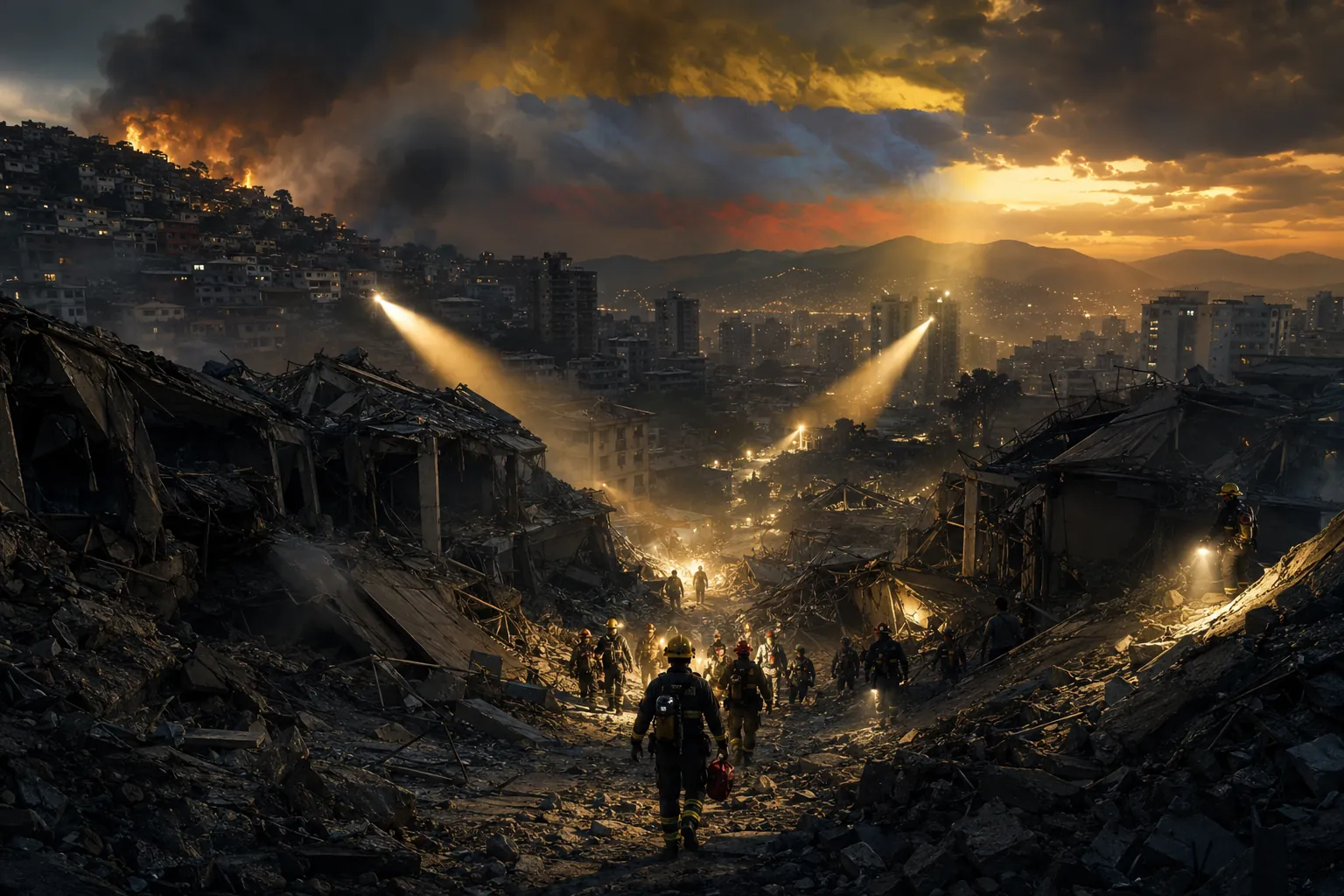
On June 24, 2026, Venezuela was hit by two massive earthquakes in quick succession. First, a magnitude 7.2 foreshock struck near San Felipe, the capital of Yaracuy state, just after 6:04 p.m. Eastern, CNN reported. Then, about 40 seconds later, a 7.5 mainshock followed. It struck some 23 kilometers, or about 14 miles, southeast of Yumare, also in Yaracuy. The U.S. Geological Survey called the pair a “doublet.” In addition, CNN described it as the country’s biggest earthquake event in more than a century.
The result was catastrophic. Buildings collapsed in Caracas. Meanwhile, the coastal state of La Guaira was declared a disaster zone. By June 30, the official toll stood at 1,943 people dead and 10,571 injured, according to U.N. OCHA Situation Report No. 7. Authorities also reported 15,866 people affected and 6,461 rescued. However, these figures were still under review as operations continued.
The Scale of the Venezuela Earthquake Destruction
The confirmed damage is grim enough without inflating it. OCHA said that as of June 28, 2,501 infrastructure assets had sustained some degree of damage. That tally included 38 health facilities and 855 affected buildings. Up to seven states were hit. Those states included La Guaira, Miranda, the Capital District, Falcón, Carabobo and Yaracuy. In particular, La Guaira recorded the highest impact.
In Catia La Mar, videos showed several collapsed buildings and badly damaged high-rises, CNN reported. Nearby, in Macuto, a large waterfront hotel was reduced to rubble.
The USGS issued a red alert for shaking-related fatalities and economic losses. It said high casualties and extensive damage were probable. Its PAGER model estimated about 53,700 shaking-related deaths. It also put the chance of more than 100,000 deaths at about 38%. Estimated economic losses were 5% to 20% of Venezuela’s GDP, according to the PAGER one-pager cited in the original post.
Those numbers are a model, not an official count. Still, the official count, at the end of June, was already terrible. A red alert of that kind is the USGS saying a national or international response was likely to be needed. As a result, the United States, and a long list of other countries, treated it that way. CNN also noted that June 24 was a public holiday. Therefore, many people may have been at home or at public events when the shaking began. That may have changed who was still indoors at that hour.
America showed up. The State Department announced that the United States would provide $150 million in aid. CNN reported the pledge after President Trump voiced his support. Secretary of State Marco Rubio said the United States had a “whole-of-government response.” That account comes from ShareAmerica, a State Department publication. He also said the Department of War was helping land equipment in hard-to-reach areas and survey damage from the air.
Urban search-and-rescue teams deployed as part of the department’s Disaster Assistance Response Team. They came from Fairfax County, Virginia, Los Angeles County, Miami-Dade County and the city of Miami. Other countries also sent rescue crews, state media told CNN. Those countries included Chile, the Dominican Republic, El Salvador, Mexico, Spain and Switzerland.

What Socialism Left Behind
But this story cannot be told honestly without the political context. Venezuela did not just suffer an earthquake. Instead, it suffered one after decades of socialist mismanagement. That record left infrastructure weak, hospitals strained and institutions too hollowed out to respond well.
CNN reported that images showed overwhelmed hospitals, with improvised wards in hallways and even on the street. The network said this was “reflecting Venezuela’s long-suffering health system, which has faced years of deterioration and lack of investment.” Experts also told CNN many buildings were more likely to collapse. That risk was higher than in places with stronger building-code enforcement. In fact, many had not been retrofitted to modern earthquake standards.
Acting President Delcy Rodríguez took charge after U.S. forces captured Nicolás Maduro earlier in the year. She then declared a state of emergency and announced an initial $200 million reconstruction fund, CNN reported. That is the right impulse. However, it does not erase years of decay.
Residents told CNN that there was not enough aid to meet people’s needs. They also said that first responders were struggling to cope. Meanwhile, thousands in Caracas and La Guaira slept outdoors or in their cars, fearful of unstable buildings and aftershocks. Disruptions to power and telecommunications also hindered rescue work and the flow of information.
Conservatives should say both things at once. Natural disasters test every government. Yet some governments already cannot keep the lights on, stock a hospital or enforce a building code. Those governments will fail that test in the worst way. The Venezuela earthquake was natural. Even so, the depth of the suffering was not only natural.
That distinction matters for American policy, too. Aid should go to rescue and recovery. It should not become a propaganda victory for the same system that left buildings unreinforced and hospitals bare. The interim government is entitled to accept help. But it is not entitled to a pass. Years of price controls, expropriation and corruption made ordinary Venezuelans so vulnerable.
This shock could still yield some good. That would mean a rebuild with stronger codes, open markets and honest institutions. If, instead, it becomes only another emergency decree, the next disaster will look like this one.
The Deportation Dimension
There is a related American debate, and it should be handled carefully. This site has already written about the enforcement realities around deaths in ICE custody. It has also covered the end of DACA as a shield and Tren de Aragua. A disaster of this scale will affect migration whether Washington admits it or not.
You can believe in sovereign borders and the rule of law, as we do. At the same time, you can still want deportation logistics and humanitarian policy to deal with facts on the ground. Those are not opposites. Rather, they are the difference between serious enforcement and slogans. The Secure America Act debate is about tools and funding. In contrast, a ruined coast in a neighboring country is about whether those tools are used with eyes open.
The Venezuela earthquake is a human story, a geopolitical story and a policy story at once. America’s initial response was swift, and it was right. The question now is how that help is used. It should save lives and support a political transition that can actually rebuild. Otherwise, it may disappear into the same broken institutions that left so many Venezuelans exposed when the ground started shaking.
None of that requires turning a rescue mission into a lecture. Instead, it requires honesty. Socialists say the state will provide. Then the state cannot find a hospital bed or a working excavator. The lesson is not subtle. America sent search teams, aircraft and aid. That is national character. It is not a blank check for the old regime. Keep the border secure. Also keep the aid targeted. And tell the truth about why this disaster cut so deep. Then the next reconstruction plan can be built on something sturdier than slogans.
Update (November 2026)
Added November 2026. Venezuela’s government reported on July 14, 2026, that the official death toll had risen to 4,734. That figure appeared in a Ministry of Planning statement published July 15. The same report said 16,740 people were injured and 6,462 were rescued. That same official balance listed 856 buildings affected and 190 collapsed, with 17,907 people left without housing.
Those are the government’s figures, not an independent census. Even so, they still show a disaster far larger than the first week’s count, and far from a finished accounting. Independent tallies may never fully match the official ones. What can be said with confidence is this. The Venezuela earthquake was one of the deadliest natural disasters in the country’s modern history. And the first official numbers understated the loss.
Sources
- CNN: What we know about Venezuela’s biggest earthquake in more than a century
- UN OCHA: Earthquakes in Venezuela, Situation Report No. 7 (June 30, 2026)
- USGS PAGER: M7.5 Venezuela loss estimate (one-pager, product us6000t7zp)
- ShareAmerica: Expert search and rescue teams save lives in Venezuela (June 30, 2026)
- Venezuela Ministry of Popular Power for Planning: official toll update, July 15, 2026


