


Washington’s diplomats have spent years failing to stop the killing in Ukraine. On Friday, the first lady got a piece of it done. The White House announced a Melania Trump ceasefire for Oleshky, a starving front-line town in southern Ukraine, with the truce set to take effect next week.
It is a small truce in a big war. Still, for a town that has gone months without a regular food delivery, it could mean the difference between life and death. That deserves credit, not a shrug. Here is what the deal covers, why Oleshky needed it so badly, and what should be watched before anyone calls it a success.
What the Melania Trump Ceasefire Covers
According to the White House statement, Russia and Ukraine both agreed to temporarily stop all military action in Oleshky. The pause is meant to let humanitarian aid reach the town and to prepare a civilian evacuation through a designated safe passageway.
The plan is hands-on. Non-military civilian leaders from both countries will visit residents in their homes and decide what help each family needs. Residents who want to leave will get transportation to the destination they choose. “I anticipate some will want to go to Russia, and some to Ukraine,” the first lady said in the statement.
She also said she had secured “an impartial American media organization” to document the work on the ground. Newsmax said its cameras would have “exclusive access to document the effort,” NBC News reported. The statement did not say how long the truce will last.
Two Start Dates, One Agreement
There is one detail to watch. The White House said the localized ceasefire will begin on October 29. Russia and Ukraine gave an earlier date. Gen. Valery Gerasimov, chief of Russia’s general staff, said Russian troops would halt fire from 4 a.m. local time on October 27, and Ukraine’s human rights ombudsman, Dmytro Lubinets, also said the ceasefire would start that day, Reuters reported. Lubinets said the operation would involve demining roads into the town, food deliveries and civilian evacuations.
A two-day gap is not a scandal. It may simply reflect demining before teams go in. But the people of Oleshky need one clear timeline, and the sooner all three governments say the same thing in public, the better.
Both sides said the first lady played an important role in coordinating the agreement. Reuters also reported that Pope Leo had spoken with President Zelensky and with Vladimir Putin about the town in the past week.
Why Oleshky Needed Help
Oleshky sits across the Dnipro River from the Ukrainian-held city of Kherson. Russian forces have occupied it since the first days of the 2022 invasion. Before the war, about 24,000 people lived there. The White House now estimates only 1,700 to 2,000 remain. Most are older residents who could not leave, along with about 50 children.
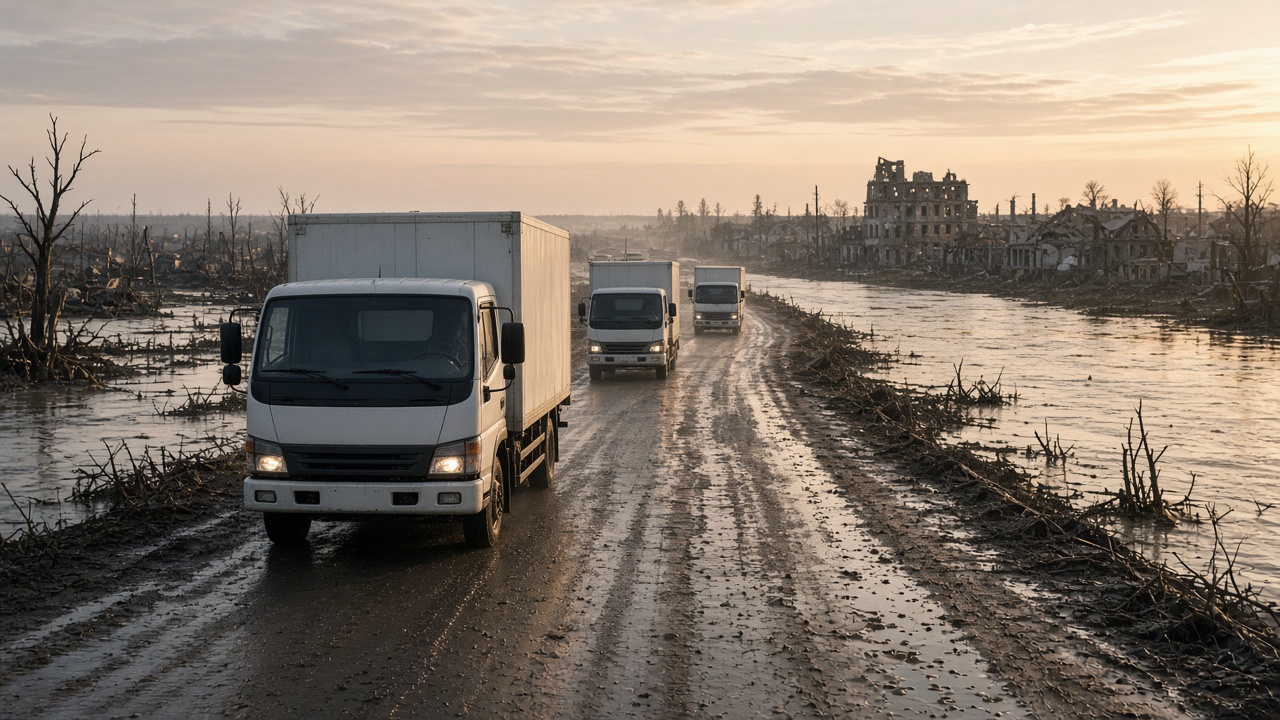
Life there is brutal. Roughly 90 percent of the town flooded after the Kakhovka Dam was destroyed in 2023. Residents have limited electricity, mined roads and regular attacks, according to the first lady’s statement.
The United Nations has documented the same picture. In June, the UN Human Rights Monitoring Mission in Ukraine said at least 29 civilians had been killed and 54 injured in Oleshky and nearby Hola Prystan in 2026 alone, most of them by short-range drones. On March 5, a drone struck people waiting in line for food. The last grocery store in Oleshky had closed its regular operations in January, and as of June 24 there had been no food deliveries to the town since May 26. A humanitarian convoy hit a landmine at the entrance to the city on June 2.
By October, residents were eating once a day, the town’s exiled mayor told Al Jazeera. “There’s no flour, no meat, no oil, no sugar, no salt,” she said. People who tried to walk to the nearest working shop, about 12 miles away, risked drones and mines along the way.
The Washington Post called the first lady’s involvement an unusual direct intervention by someone who rarely gets involved in policy. For the people living in those conditions, who brokered the deal matters far less than whether trucks get in.
How the First Lady Built This Channel
This did not come out of nowhere. The White House said the first lady learned about Oleshky during a private discussion at her Fostering the Future Together event in New York during the United Nations General Assembly in September. She then used a communication channel with Russia and Ukraine that she and her representative had already built through six reunifications of 34 children separated by the war.
That matters. Quiet, narrow, humanitarian diplomacy is often where trust between enemies starts. Both governments promptly assigned teams to handle the details, including demining, according to the statement.
The Conservative Take on the Melania Trump Ceasefire
First, results matter more than résumés. The foreign policy establishment has held summit after summit on this war. Yet a first lady who rarely steps into policy just got both sides to sign on to something concrete. That should humble the experts who mock this White House at every turn.
Second, the focus is right. Her work has stayed on the most helpless people caught in the fighting: children taken from their families, and elderly residents trapped in a town that has run out of food. Protecting the weak and judging a policy by whether it actually helps people is a deeply conservative instinct.
Third, small wins can build toward bigger ones. The same day, Zelensky said negotiators from Ukraine, Russia and the United States had agreed to technical-level talks in the first half of November, and the two countries swapped 270 servicemen each in a prisoner exchange, Reuters reported. A truce that holds in one town shows the two sides can still agree on terms and keep them.
Fourth, it costs American taxpayers essentially nothing. No new aid package, no troops and no open-ended commitment. Diplomacy that saves lives at no cost to the Treasury is the kind conservatives should want more of.
Trust, but Verify
A truce on paper is not a truce on the ground. Putin’s record on ceasefires is poor, and this war has killed more than 19,000 Ukrainian civilians, including 762 children, according to Ukraine’s acting prosecutor as cited by Reuters. Russia has every reason to want credit in Washington, and it should not get that credit until the work is done.
There are fair questions about the media plan, too. Handing one outlet exclusive access is not the same as open access for independent reporters. Americans already saw with the release of Stephen Hubbard that Moscow’s humanitarian gestures come with an agenda. The best test of whether families’ wishes are respected is more cameras, not fewer.
What to watch next:
- The start date. Whether firing actually stops on October 27, as Moscow and Kyiv say, or on October 29, as the White House said.
- Aid volume. How many trucks get in, and whether food and medicine reach residents who cannot walk to a distribution point.
- Free choice. Whether residents who want to go to Ukrainian-held territory are actually allowed to, and whether anyone is pressured to go to Russia.
- The bigger talks. Whether the November technical meetings happen, and whether this model can be used in other front-line towns.
Saving a few thousand elderly people and children from hunger is worth doing, and doing well. If it works, this first lady deserves real credit. More of our Trump Administration coverage follows the wider peace effort.
Update (November 2026)
Added November 2026. The ceasefire took effect on October 27 and ran through November 1. Ukraine’s ombudsman said both sides kept their commitments, which allowed aid deliveries and the evacuation of civilians who wanted to leave, Interfax-Ukraine reported. Residents had a four-hour window on October 30 to board a convoy of 25 buses with room for up to 750 people, and several hundred chose to stay, the BBC reported. Russia said it had prepared dozens of tonnes of aid for those who remained. For the wider fight over Ukraine’s air defenses, see our take on the Patriot missile sale.
Sources
- White House: First Lady Melania Trump secures ceasefire localized to Oleshky
- Reuters via The Globe and Mail: Ukraine, Russia agree to Oleshky ceasefire
- AP: Melania Trump forges ceasefire deal in Russian-occupied Ukrainian city
- The Washington Post: Melania Trump brokered ceasefire at besieged Ukrainian town
- NBC News: Russia, Ukraine agree to ceasefire for one city brokered by Melania Trump
- UN Human Rights Monitoring Mission in Ukraine: Desperate situation for civilians trapped in frontline areas
- Al Jazeera: In Russia-occupied Oleshky, Ukrainians face hunger, drones and landmines
- Interfax-Ukraine: Humanitarian ceasefire in Oleshky ends after aid delivery
- BBC News: Hundreds evacuated from Russian-occupied Oleshky during rare ceasefire


