

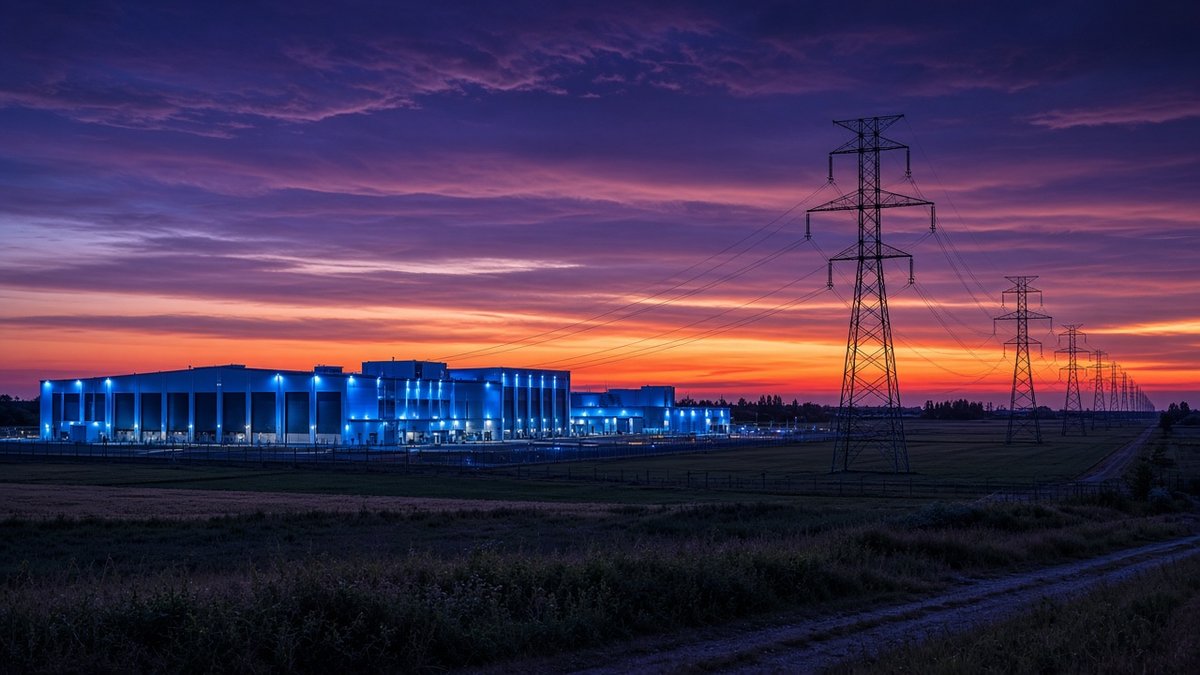
Big Tech wants more power than America has ever built. That part is fine. The fight is over who pays for it. Right now, families in Michigan, Illinois, and Georgia are asking the same question about data center electricity bills. Will they get stuck paying for grid upgrades built to serve some of the richest companies on earth?
This week, three separate reports showed how real that risk is. Together, they make data center electricity bills one of the biggest pocketbook stories of the fall. The answer should be simple for anyone who believes in free markets. If you use it, you pay for it. Families should not pick up the tab for someone else’s business plan.
Michigan: Data Center Electricity Bills Could Hit $6.4 Billion
Start in Michigan. DTE Energy, the state’s largest utility, wants regulators to approve a long-term plan that includes 2.1 gigawatts of new gas plants in 2031 and 2032. According to The Guardian, Michigan customers may pay $6.4 billion for those two plants. Much of that demand comes from data centers.
DTE has already contracted with Google and Oracle for a combined 2.4 gigawatts. That is enough electricity to power more than 1.8 million homes. Moreover, DTE could sign roughly 6 gigawatts of data center deals by the end of the year. About 2.3 million electric customers in southeast Michigan could feel the effects.
Here is the catch. DTE’s plan includes some analysis of what it means for residential bills. However, regulators will not set the actual protections for households until later cases. In other words, DTE is asking customers to trust the process first and see the bill later.
Illinois: Data Center Electricity Bills Could Leave a $3 Billion Gap
Next, look at Illinois. ComEd expects to spend about $3.1 billion to connect 30 large power users to its grid, WBEZ Chicago reported on Thursday. Consumer groups believe those users are data centers. Yet so far, ComEd has collected only about $721 million in deposits from the developers. That is roughly one-fourth of the cost.
ComEd pushes back. The utility says new agreements require large customers to cover transmission costs even if they go out of business. It also says the deposit amount may still increase. To its credit, ComEd says it supports the principle that large-load customers should pay their own costs.
Still, words are not deposits. Meanwhile, the Citizens Utility Board says ComEd’s electricity supply price is up about 50 percent compared to two years ago. Illinois families are already stretched. They should not also carry the risk that an AI project falls through and leaves data center electricity bills on their doorstep.
Georgia: Who Pays for Data Center Electricity Bills When the Bet Goes Bad?
Georgia tells a similar story. According to Georgia Public Broadcasting, Georgia Power is expanding its grid by nearly 10 gigawatts. The utility says 80 percent of that new generation is for hyperscale data centers. It also says it expects data centers to pay their own way on an estimated $16 billion in upfront costs.
That is the right goal. Even so, there is a wrinkle. Most of the new plants will burn natural gas. As a result, more demand could push fuel prices higher for everyone. Public Service Commissioner Peter Hubbard said staff modeling shows fuel costs rising 5 to 11 percent for all customers once the large data center loads join the system.
Georgia voters get a say, too. Georgians elect the members of the state’s Public Service Commission, and two seats are on the ballot on Nov. 3. Those races deserve far more attention than they usually get.

Why Stranded Costs Put Data Center Electricity Bills at Risk
Some will say these worries are overblown. After all, tech companies have deep pockets. But deep pockets can close fast. On Thursday, the Nasdaq fell 2.6 percent, and the main chip index dropped 6.7 percent. CNBC reported that investors kept asking questions about the billions being spent to build AI networks.
That does not mean the AI boom is over. It does mean nobody knows how the bet ends. If a data center deal collapses, the power plants and power lines are still there. Someone still has to pay them off. Utility regulators call this the stranded asset problem. Families call it a higher bill. In fact, stranded costs are the fastest way for data center electricity bills to become everyone’s problem.
The Monopoly Problem
There is also a deeper issue. Most electric utilities are regulated monopolies. They earn a set return on what they build. So the more they build, the more they can earn. That is not a free market. Consequently, regulators have to act as the customer’s watchdog, because customers cannot shop around.
The Conservative Fix for Data Center Electricity Bills
Conservatives should not oppose data centers. America needs to win the race in artificial intelligence, and that race runs on electricity. Besides, these projects can bring jobs and a bigger local tax base. The goal is not to stop growth. Instead, the goal is to make growth pay for itself.
First, make data centers put real money down before they connect. Deposits should match the actual cost of the grid work, not a fraction of it. Second, lock in long contracts with exit fees, so a company that walks away still pays its share. Third, keep the books open. Ratepayers deserve to see exactly which costs come from large customers.
Finally, build more supply. Higher demand without new supply means higher prices for everyone. That is basic economics. Therefore, states should welcome new generation, from gas to nuclear, as long as the companies driving the demand cover the cost.
Accountability Starts Locally
Above all, pay attention to the people who regulate your utility. In some states, you elect them. In others, your governor appoints them. Either way, they decide what lands on your bill. Ask them a simple question about data center electricity bills: who pays? For more commentary on the economy and your wallet, visit the World of Payne homepage.
Key Takeaways
- Michigan customers may pay $6.4 billion for two DTE gas plants driven largely by data center demand.
- ComEd expects about $3.1 billion in grid costs for 30 large users in Illinois but has collected only about $721 million in deposits.
- Georgia Power says 80 percent of its nearly 10-gigawatt expansion is for hyperscale data centers.
- Regulator modeling in Georgia shows fuel costs could rise 5 to 11 percent for all customers.
- The fix is simple: data centers should pay the full cost of the grid built to serve them.
Frequently Asked Questions
Do data centers raise electricity bills?
They can. When utilities build new plants and power lines for data centers, those costs can spread to all customers unless regulators assign them to the data centers. Higher fuel demand can also raise the fuel charge on everyone’s bill.
What is a stranded asset?
A stranded asset is a power plant, power line, or other equipment that loses its customer before anyone finishes paying for it. If a data center leaves early, other customers could end up paying for that equipment.
How can states protect households?
States can require full upfront deposits, long contracts with exit fees, and clear cost reporting. Illinois lawmakers are weighing the POWER Act, which would require data centers to pay 100 percent of their costs before connecting to the grid.
Follow World of Payne for More
Your power bill is a kitchen-table issue, and it deserves straight talk. On the World of Payne show, we break down the money behind the headlines from a conservative point of view. Follow World of Payne so you never miss an episode, and share this post with a neighbor who just opened a higher electric bill.