

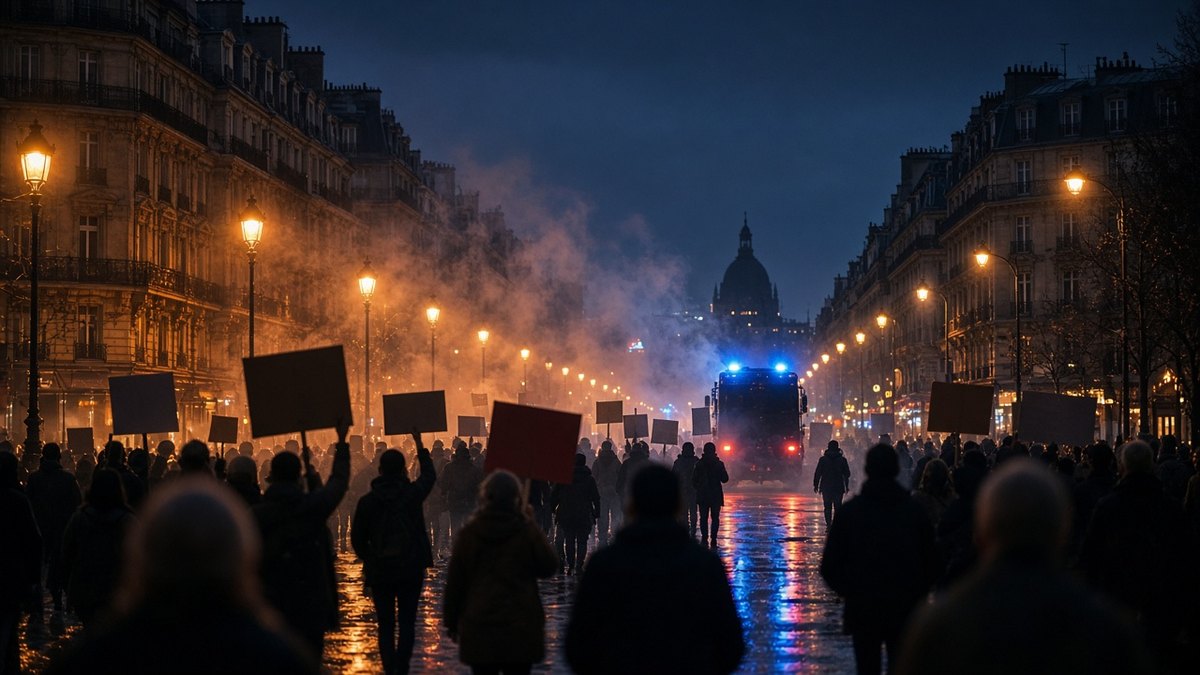
Hundreds of thousands of people marched across France on Saturday, and the night ended with tear gas, water cannons, and nearly 1,000 arrests. The France protests are about real pain: fuel prices, grocery bills, and crumbling schools. However, the deeper story is about a bill that finally came due. France spent decades borrowing to avoid hard choices. Now every choice is hard, and the streets are paying for it.
Americans should watch closely. This is not a story about the French being French. Instead, it is a preview of what happens when a government runs out of easy money and asks its people to absorb the shock all at once.
Key Takeaways
- France’s Interior Ministry counted 410,000 protesters nationwide on Oct. 24, while organizers claimed nearly 800,000.
- Police made nearly 1,000 arrests, a week after protests saw widespread rioting and looting.
- France’s own budget documents put public debt at 119.3% of GDP in 2026, rising to a projected 121.7% in 2027.
- Interest costs are projected to reach €91.2 billion in 2027, up from €79.2 billion in 2026.
- Two prime ministers have already fallen over cost-cutting, and the pension reform that raised the retirement age was scrapped.
What Happened at the France Protests
According to the Associated Press, the Paris march began peacefully. Near its end in eastern Paris, though, masked protesters hurled objects and fireworks at police. Officers answered with tear gas, sound grenades, and water cannons.
Also, the numbers were large. The Interior Ministry told AFP that 410,000 people marched across France, including 110,000 in Paris, according to France 24’s live coverage. Organizers put the total near 800,000. Meanwhile, clashes broke out in Lyon, Nantes, Bordeaux, Marseille, and other cities. In Lyon, authorities had banned gatherings in the city center after shops were looted the week before.
Interior Minister Laurent Nuñez said arrests had reached nearly 1,000, and he expected the figure to “increase significantly.” The government had deployed 70,000 security forces nationwide. That is what a country looks like when anger has nowhere left to go.
Why People Join the France Protests
Let’s be fair to the marchers. Much of their frustration is legitimate. The wave started with high school students protesting poor conditions in their classrooms. Then it grew into a broader revolt over the cost of living, as the war with Iran pushed fuel prices sharply higher. We covered that energy shock in our post on oil prices hitting $117.
Still, legitimate anger does not excuse looting a shop or throwing fireworks at police. A free country protects the right to protest. But it also protects the shop owner who did nothing wrong. Both principles matter, and the rioters tossed the second one aside.
The Real Cause Behind the France Protests: Debt
Here is the part the slogans leave out. France is broke in a slow-motion way. According to the government’s 2027 budget presentation, public debt reached 119.3% of GDP in 2026. Moreover, interest costs are expected to climb to €91.2 billion in 2027, up from €79.2 billion this year.
Sadly, that interest money buys nothing. It does not fix a single classroom or lower a single fuel bill. In fact, it is the price of yesterday’s spending, and it crowds out everything French families actually want from their government.
Even the French government admits the danger. Its own budget document warns that delaying the effort would force a sharper fix later, “over a shorter period, and in a brutal way” (our translation). That is a remarkable thing for a government to put in writing. It is also exactly right.

Every Reform Attempt Before the France Protests Failed
So why hasn’t France fixed it? Because every serious attempt has cost someone their job. France 24 reported that two prime ministers have been toppled over cost-cutting since 2024. Prime Minister Sébastien Lecornu only passed the 2026 budget after agreeing to scrap the reform that raised the retirement age from 62 to 64.
Now the 2027 plan calls for a €54 billion fiscal effort. It would stop fully indexing pensions above 1,260 euros a month to inflation and ask retirees to contribute 5.5 billion euros. Yet even after all that, analysts at ING said the package would not stabilize public debt. In other words, France is cutting and still falling behind. That cycle of delay, then panic, is what fuels the France protests.
The Lesson for America
As a fiscal conservative, I take no joy in watching France struggle. After all, the French people did not ask for this mess. Their leaders built it one popular promise at a time, and the bill landed on students, workers, and retirees all at once.
America is not France. Our economy is larger, more dynamic, and backed by the world’s reserve currency. Even so, that advantage is not a permission slip. We already wrote about how interest on the national debt now tops defense spending. That is the same trap, just at an earlier stage.
The lesson is simple. Reform is cheapest when it is voluntary and gradual. Wait too long, and the market decides for you. Then the cuts arrive during a crisis, people feel blindsided, and trust in government collapses. Therefore, Washington should rein in spending now, while it can still choose the pace.
What Conservatives Should Push For
First, protect the core functions of government: defense, public safety, and the rule of law. Second, slow the growth of spending instead of waiting for a crash. Third, grow the economy through energy production and lighter regulation, because growth makes every debt easier to carry. Finally, tell voters the truth early. France shows what happens when politicians hide the bill until the last minute.
FAQ
Why are the France protests happening?
They began with students protesting poor school conditions. They then widened into anger over the cost of living and rising fuel prices, as the government pushes spending cuts to control its debt.
How big is France’s debt?
France’s budget documents put public debt at 119.3% of GDP in 2026, rising to a projected 121.7% in 2027. That is more than double the 60% level EU members are supposed to target.
Could the United States face something similar?
Not tomorrow, because the U.S. has major advantages. Still, rising interest costs are a warning sign. The earlier Washington controls spending, the less painful the fix will be.
Follow World of Payne for More
The France protests are a warning written in tear gas. Debt always comes due, and someone always pays it. For more commentary on spending, the economy, and freedom, visit the World of Payne homepage and follow the World of Payne show on X, Facebook, and Instagram so you never miss an episode.