

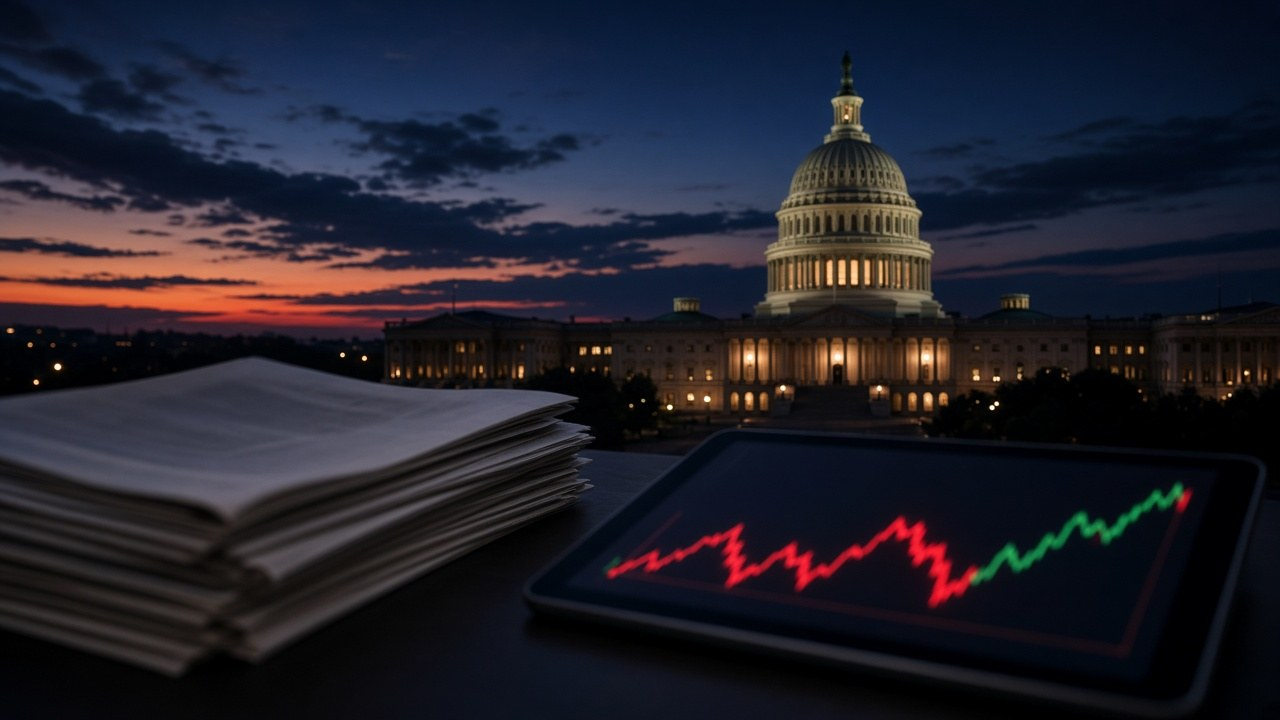
The stock market correction that hit on Friday was the loudest number of the week, but it was not the only one that matters. The S&P 500 fell 8.6% in five sessions. Meanwhile, Congress stared down a Dec. 11 shutdown deadline, the Senate took its first war powers vote since the midterms, and a fight over Venezuelan TPS got a quiet reprieve in court.
My take up front: markets are finally pricing what Washington still won’t admit. Money is no longer cheap, and the bill for years of easy borrowing is coming due. Here is how I read the week, one story at a time, with links to the full columns I wrote along the way.
How the Stock Market Correction Unfolded
Friday was the worst day. According to CNBC’s closing coverage, the S&P 500 dropped 3.7% to 6,910.39, and the Nasdaq Composite fell 5.28% to 22,617.73. The Dow lost 949.73 points, or 1.93%, to 48,147.33. Both the S&P 500 and the Dow finished 10% below their closing records, which is the textbook line for a correction. The Nasdaq is now down 2.7% for the year.
For the week, the Dow fell 8%, its worst week since March 2020. The S&P 500 lost 8.6%, its worst week since the tariff shock of April 2025. The Nasdaq dropped about 10%.

On Wednesday I wrote that this stock market selloff was a warning, not a crash. Two days later, it became a correction. My view hasn’t changed, though. A 10% drop after a long run is painful, but it is not a collapse. What concerns me is where the damage is concentrated.
The AI Trade Cracked
The trigger was the artificial intelligence trade. Anthropic’s IPO jumped 17% in its Thursday debut, then gave back 8.5% on Friday. Nvidia fell about 14% after Reuters reported the SEC is exploring possible accounting issues at the company. AMD and Micron each fell more than 13%.
When one theme carries an entire market, a single bad headline can pull everything down. That is not a free-market failure. Instead, it is what happens when investors pay any price for a story.
Why the Fed Won’t Ride to the Rescue
Investors used to count on the Federal Reserve to calm things down. Not this time. Traders are pricing a 100% chance of at least a quarter-point hike at the Dec. 8-9 meeting, according to CME FedWatch data cited by CNBC. Fed Governor Lisa Cook warned on Friday that “inflation has been above target for more than five and a half years.”
She’s right, and I’d rather see the Fed finish the job than bail out a crowded trade. As I explained in how the Fed raises interest rates, the central bank sets one short-term rate. It does not set your mortgage or your car loan. Markets do that, and markets are now charging more.
The Real Economy Beneath the Stock Market Correction
So is the economy breaking? Not yet. The data this week looked more like a slow squeeze than a cliff.
Jobs Held Steady
First, the labor market held. The Labor Department’s weekly report showed 203,000 initial jobless claims for the week ending Nov. 14, up just 1,000. A year earlier, that number was 222,000. However, continuing claims rose 70,000 to 1.763 million. Layoffs are still low, but people who lose a job are taking longer to find the next one.
Spending Is Mostly Gas
Next, the retail numbers. The Census Bureau’s October report showed sales of $748.2 billion, up 6.8% from a year ago. In my Controller’s Desk on October retail sales, I found that about 33 cents of every new dollar went to gas stations. Take fuel out, and sales rose 4.9%. That is not a boom. It is families paying more at the pump.
If you want the longer story behind the pump price, I traced it in why gas prices are so high, from crude oil to refining to taxes.
Housing Froze, and Beef Didn’t Budge
Housing tells the same story. The National Association of Realtors reported October sales at a 3.75 million annual pace, the lowest since August 2010. The average 30-year mortgage rate was 7.33% in October, up from 6.25% a year earlier.
I argued that existing home sales won’t recover with $1,000 down payments. The problem is the monthly payment, not the entry fee. And as I laid out in why housing is so expensive, we simply haven’t built enough homes for years.
At the grocery store, the White House’s 90-day plan to admit an extra 300,000 metric tons of beef trimmings ends on Nov. 30. My view in the beef prices column still stands: let it expire and focus on rebuilding the cattle herd.
Washington’s Week: A War Vote and a Shutdown Clock
Now to the Capitol, where Congress spent the week arguing about who should make the hard calls.
The Senate Said No on War Powers
On Thursday, the Senate rejected an Iran war powers resolution 48-51, according to Roll Call. Republicans Susan Collins, Lisa Murkowski and Rand Paul voted for it. Democrat John Fetterman voted against it.
At least that was a real vote, held in the open, with names on the record. That is how war decisions should be made.
The Shutdown Threat Is Real
The harder fight is the Dec. 11 funding deadline. Sen. Tammy Duckworth vowed to vote against any stopgap bill that doesn’t cut off money for the war. Sen. Michael Bennet offered his own amendment modeled on the 1973 cutoff of funds for the bombing in Cambodia.
Last Sunday I wrote that a government shutdown over Iran war funding is the wrong tool. I still believe that. If senators want to end the war, they should vote on the war. Furloughing federal workers two weeks before Christmas proves nothing except that Congress can’t do its basic job.
Medicaid Expansion Comes Back
Meanwhile, the midterms reopened an old debate. Incoming Democratic governors in Georgia, Kansas, Texas and Wisconsin campaigned on Medicaid expansion. My advice to those states: don’t sign an open-ended deal while Washington is still rewriting the terms. For a refresher on how the two big health programs differ, see my explainer on the difference between Medicare and Medicaid.

Abroad: A Bridge, an Island and a Declaration
Overseas, three stories mattered.
First, on Tuesday, Ukraine dropped a road span of the Kerch Bridge, the link Putin built to Crimea. Ukraine did it with its own weapons, and that strengthens its hand without adding to the American bill.
Second, the same day, U.S. jets struck an IRGC missile launch site on Qeshm Island after Iranian drones targeted a U.S.-operated radar in Bahrain. I updated my Qeshm Island column with the details. A narrow, proportional answer to a direct attack is the right call.
Third, Trump, Xi and Putin met in Shenzhen on Thursday and signed a four-point “Declaration toward Peace.” As I noted in my Trump-Putin-Xi meeting update, it contains no warhead caps, no timeline and no verification. It is a promise to keep talking, and nothing more yet.
The Courts: Venezuelan TPS Stays on Hold
At home, the Venezuelan TPS fight took a turn. On Wednesday, the government asked the Supreme Court to block a lower-court order that would have restored protected status on Friday. Hours later, the Ninth Circuit extended its pause until seven days after it issues a ruling.
So on Thursday, Solicitor General D. John Sauer withdrew the application. His letter warned that restoring the program could have required releasing about 1,800 Venezuelans from detention. He also said the government will “immediately return” to the justices if it loses.
I made the case in my Venezuelan TPS column that temporary should mean temporary. That remains the law after the Court’s June ruling. Still, Congress should fix the statute so these fights stop landing in emergency courtrooms.
Worth Your Weekend: The Explainers
Not every post this week chased a headline. If you have time this weekend, start with how the Electoral College works. It turns one national choice into 51 state decisions, and I think that design is worth keeping.
After that, read the housing, gas and Fed explainers linked above. Each one covers a cost that lands on every household budget, and each one matters more after a week like this.
What the Stock Market Correction Should Teach Washington
Put the week together, and one pattern shows up. Markets, home buyers and shoppers are all adjusting to expensive money. They are cutting back, paying more or waiting.
Washington is the only player not adjusting. It is still debating whether to shut itself down rather than settle a war vote, and still writing open-ended health care promises. A stock market correction is how investors reprice risk when the facts change. Congress needs its own correction, and it should start with a budget that assumes interest rates will stay high, not one that hopes they will fall.
Sources
- CNBC: S&P 500 and Dow close in correction; Nasdaq erases 2026 gain as AI rout picks up steam (Nov. 20, 2026)
- U.S. Department of Labor: Unemployment Insurance Weekly Claims, week ending Nov. 14, 2026
- U.S. Census Bureau: Advance Monthly Retail Trade Report, October 2026
- National Association of Realtors: Existing-Home Sales Decreased 5.5% in October
- Roll Call: Iran resolution blocked in first war powers vote since midterms (Nov. 19, 2026)
- Office of the Solicitor General: Letter withdrawing stay application, Mullin v. National TPS Alliance, No. 26A714 (Nov. 19, 2026)


