

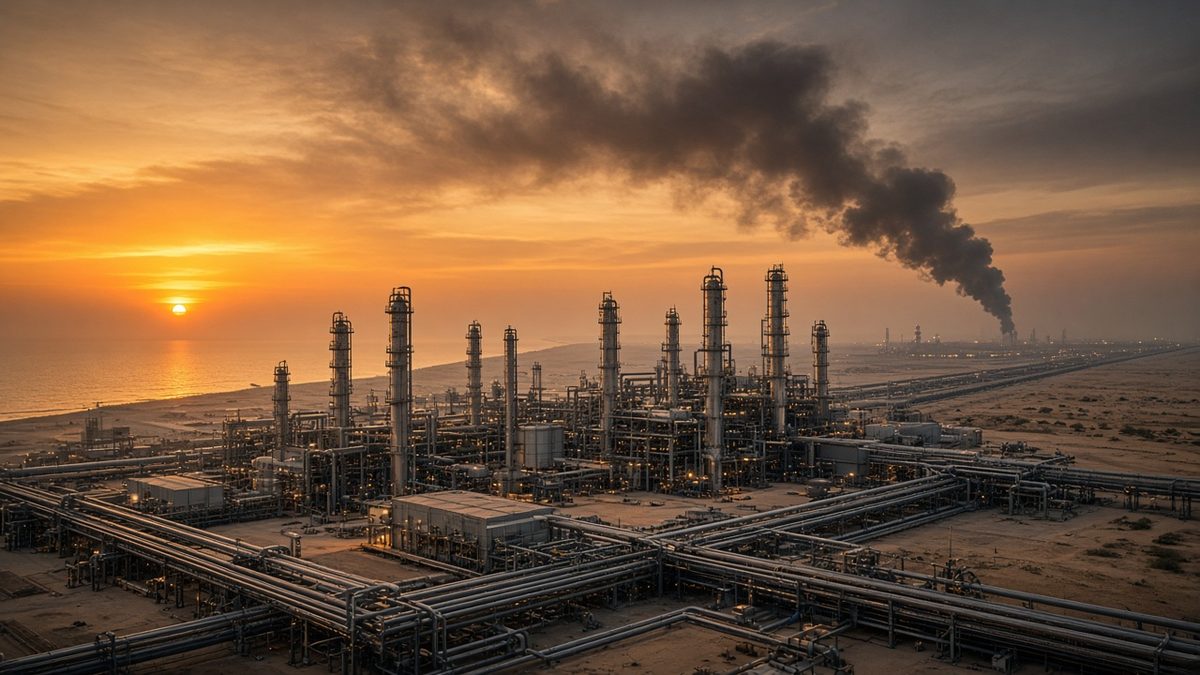
Saudi Aramco just told its staff to get out of headquarters. That has not happened once since the Iran war began. Reuters first reported the Aramco evacuation in Dhahran on Thursday. It came a day after deadly Houthi attacks in Saudi Arabia’s eastern oil hub. It also came just hours after Washington ordered some American diplomats out of the kingdom.
This is not a far-off story. When the nerve center of Saudi oil goes dark, Americans feel it. We feel it at the pump, the grain elevator, and the heating oil tank. Here is what we know, and why it matters.
What We Know About the Aramco Evacuation
According to Reuters, as published by TimesLIVE, six people with knowledge of the matter said Aramco instructed staff to leave the Dhahran headquarters and work remotely. Aramco did not immediately respond to a request for comment.
That building is not just office space. It hosts an operations center for Aramco’s rigs, refineries, and export terminals. That center also helps oversee thousands of kilometers of pipelines. Earlier this month, Yemen’s Iran-aligned Houthis struck the headquarters, and fire spread across several floors, Reuters reported.
The latest wave hit close to home for Aramco. On Wednesday evening, an attack hit King Fahd International Airport in Dammam, roughly 15 kilometers north of Dhahran. Saudi Arabia’s civil aviation authority said two people were killed and eight injured, Reuters reported. Separately, Saudi air defenses intercepted a drone aimed at a facility at Aramco’s Shaybah oilfield.
Washington Pulls Diplomats From Saudi Arabia
Meanwhile, the State Department issued an ordered departure for non-emergency U.S. government employees and their families in Saudi Arabia. A department spokesperson told the BBC that “Iranian-supported Houthis have increasingly engaged in hostilities against Saudi Arabia.” The spokesperson also warned that “the hostilities have the potential to escalate rapidly.”
An informal ceasefire between the Houthis and Saudi Arabia held for about four years. However, it fell apart in July, the BBC reported. That is when the Houthis declared a “maritime embargo” and began hitting Saudi airports, oil facilities, and Red Sea tankers.
Why the Aramco Evacuation Hits Your Wallet
Here is the part of the Aramco evacuation that should worry every family budget. The U.S.-Israeli war with Iran effectively closed the Strait of Hormuz. Since then, Saudi Arabia has leaned on the Red Sea to move its oil, according to the BBC. As a result, the Houthi embargo near the Bab al-Mandab Strait is squeezing one of the last open lanes for Gulf crude.
Markets noticed. Reuters reported early Thursday that Brent crude rose to $110.11 a barrel, while U.S. West Texas Intermediate climbed to $98.12. In addition, the Department of Energy is offering to loan up to nearly a third of the 1-million-barrel emergency heating oil reserve. The goal is to contain prices that have surged on diesel shortages tied to the wars in Iran and Ukraine.

Diesel is what plants and harvests our food, hauls it to market, and keeps rural America running. So when diesel gets scarce, farmers and truckers pay first. Then everyone else pays at the grocery store.
The Conservative Take: Tehran’s Proxies, America’s Answer
First, let’s call this what it is. The State Department itself describes the Houthis as “Iranian-supported.” Tehran does not need to fire a missile at Riyadh to choke the world’s oil supply. Instead, it lets its proxies do the work and then claims clean hands.
Second, the administration is right to protect American lives first. Pulling non-essential staff and families out before a rapid escalation is prudent, not weak, and so is the Aramco evacuation. According to Reuters, Washington has so far also rebuffed Saudi efforts to pull it directly into the war against the Houthis. Americans who are tired of open-ended Middle East commitments should see that restraint as a feature, not a bug.
Finally, this week is the strongest argument yet for American energy independence. Every barrel we produce at home is a barrel a terrorist militia in Yemen cannot hold hostage. Washington should be clearing the way for more domestic drilling, refining, and pipelines, not leaning on emergency reserves.
What to Watch Next
Watch three things. Will Aramco confirm the Aramco evacuation and say how long it lasts? Will oil push higher as more Houthi strikes land on Saudi soil? And will Washington’s caution hold, or will pressure grow to step in? We covered the earlier turns of this conflict, including Trump’s canceled Iran strike and Russia’s intel support for Iran. We’ll keep updating as this story develops.