

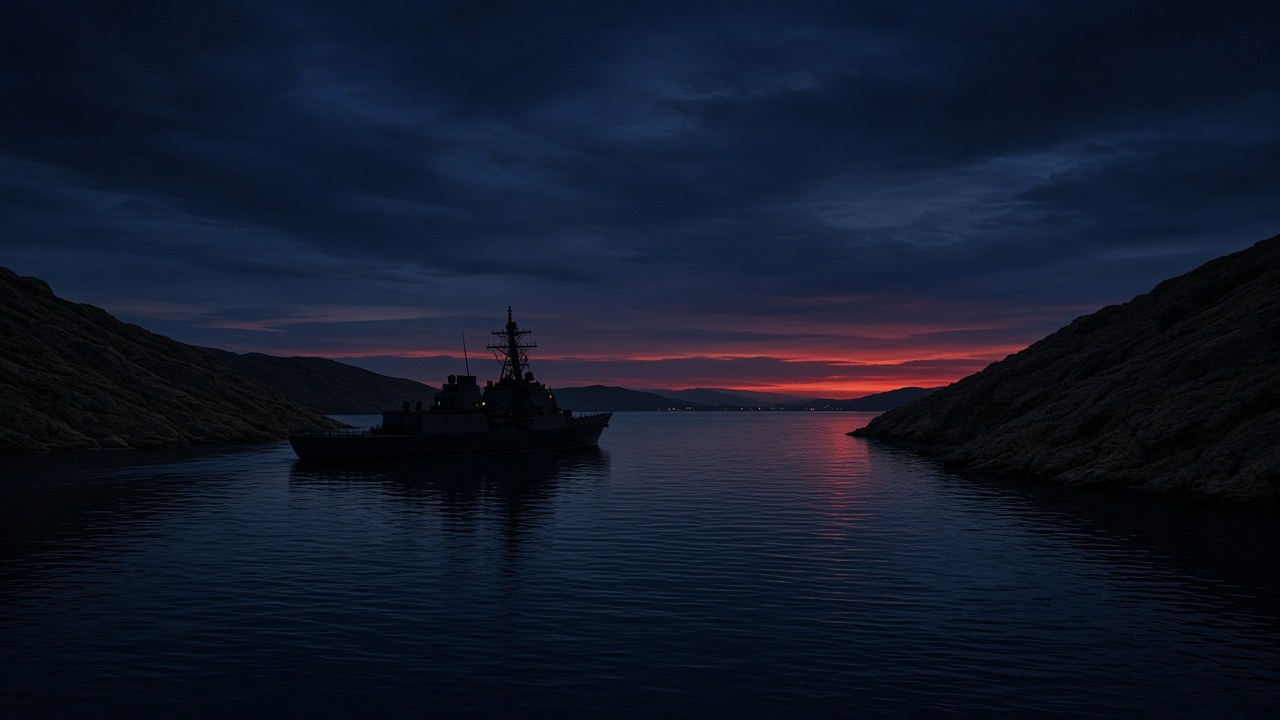

Editor’s note, November 14, 2026: I have folded our late-October and early-November Hormuz posts into this living column, from the post-midterm strike warnings through the November 2 Qeshm Island strikes. Later developments will be added here. Our November 12 column on Iran’s enriched uranium and the blockade remains a separate chapter.
The Qeshm Island strikes came on the eve of Election Day. On Monday, November 2, U.S. forces hit Iranian targets on Qeshm Island in the Strait of Hormuz, U.S. officials told ABC News and CBS, the BBC’s U.S. partner. Officials called the strikes limited and defensive. The Wall Street Journal first reported them.
My view is simple. When Iran fires at American forces, America should answer. At the same time, Americans deserve a clear account of what our military is doing in their name.
What We Know About the Qeshm Island Strikes
Two U.S. officials told ABC News the strikes were limited in scope and did not signal a return to major combat operations against Iran. One of them said Monday’s airstrikes answered an Iranian attack on a U.S. aircraft. Officials told CBS, as the BBC reported, that Iran’s Islamic Revolutionary Guard Corps had fired on an American aircraft. Senior U.S. officials later confirmed to RFE/RL that the operation was intended to protect U.S. assets in the region after Iranian fire was directed at a U.S. aircraft.
Iranian state media reported explosions on the island. The IRGC did not comment on the U.S. strikes themselves, the BBC added. Earlier Monday, Iran claimed it had shot down U.S. drones. A U.S. official told ABC News that a claim it had downed two RQ-170 reconnaissance drones was false. The BBC, citing Iranian statements, also reported that the IRGC said its forces had shot down two U.S. drones south of the island and another east of the strait. Those remain Iranian claims, and they have not been independently verified.
The Pentagon referred questions to U.S. Central Command. CENTCOM did not respond to ABC News, and it did not immediately respond to RFE/RL.
On November 9, Iran International reported that a Hormozgan deputy governor told state media about the U.S. action. The same report said Washington had already acknowledged limited November 2 strikes against Iranian air defenses on Qeshm, describing them as a defensive response to Iranian surface-to-air missile activity against U.S. assets. That is still not the clear public account I think the country is owed.
Why Qeshm Island Matters
Qeshm sits at the mouth of the Strait of Hormuz, one of the world’s most important routes for energy shipments. A fifth of global oil and gas shipments usually pass through the strait, the BBC noted. According to the Journal, as cited by RFE/RL, the island holds a large underground missile facility and a naval base, as well as a major desalination plant. A missile crew there can threaten ships and aircraft across the strait.
The danger to shipping is real. On November 2, International Maritime Organization Secretary-General Arsenio Dominguez would not confirm that mines had been cleared from the strait, Xinhua reported. Speaking in London, he repeated the organization’s advice against transiting it, citing conflicting Iranian and U.S. accounts of the mine threat. The BBC also noted that the waterway was effectively closed after the war began, because of Iranian attacks on commercial vessels and a U.S. naval blockade, and that a June preliminary agreement to reopen it later collapsed.
How We Got to November 2
This war did not start last week. The U.S. and Israel launched it on February 28, and Tehran answered with missile and drone attacks across the region. It also effectively closed the strait. A June memorandum of understanding was supposed to lead to a final peace deal. It collapsed over disagreements that included navigation in the strait. I have written about that Islamabad memorandum as its own chapter, and about the strike that President Trump called off earlier. This column is about the late-October and early-November sequence that ended in the Qeshm strikes.
In late October, The Wall Street Journal reported that the U.S. had told several Gulf Arab countries to be ready for a “short, intense military campaign” once the November 3 elections were over, according to contemporaneous accounts by Anadolu Agency and Iran International. The Pentagon, those reports said, was moving a Patriot missile defense system from Texas to the region, pulling troops off vulnerable bases, restocking munitions, and preparing bombers and fighter jets. An additional aircraft carrier strike group and a Marine expeditionary unit were expected to join roughly 20 U.S. warships in the Middle East. The White House declined to comment on “sensitive military plans that may or may not exist.” It said that “President Trump keeps all options on the table to ensure that Iran can never have a nuclear weapon.”
That is the right goal. It is not, by itself, a war plan the public can inspect. At a rally in Lubbock, Texas, Trump told the crowd, “You’ll see Iran in a couple of weeks, if you don’t mind,” Anadolu reported. Strength is the right posture. Voters still deserved to know what “short” meant.
The pressure was building at sea, too. In late October, a tanker in Hormuz was targeted with hull-mounted explosives, Splash247 reported. Brent crude for December rose $1.71 to $116.59 a barrel early that Friday, and U.S. crude climbed to $103.45, Reuters reported. Brent was on track for a monthly gain of nearly 13%. AAA said the national average for regular gas fell 5 cents in a week to $4.22, but also warned that crude above $100 a barrel was limiting further declines. A Saudi-led coalition said it downed a Houthi drone over the Mecca region, while the group denied involvement, Anadolu reported. Yemen’s Houthis also claimed a ballistic missile strike on Saudi Arabia’s Ras Tanura refinery; Saudi authorities did not immediately confirm that strike.
Iran’s Two-Day Offer, and Netanyahu’s Push
By November 2, Tehran was saying it could reopen Hormuz in two days if its conditions were met, Euronews reported. Qatari mediators had held two rounds with Iranian officials the previous week, with more talks planned, officials told the Associated Press. The mediators were trying to advance a framework: Iran stops attacking ships in the strait, and the United States lifts its blockade of Iran’s ports. Brent crude fell $4.79, or 4.2%, to $108.64 a barrel that Monday morning on hopes for a deal, Reuters reported, and later reports put the drop as deep as 7.4% to $105.03. The national average for gas fell 17.1 cents in a week to $4.12 a gallon, according to GasBuddy data. That was still $1.13 more than a year earlier. Diesel averaged $6.281.
I would like a deal that actually stops the threat. Reopening the strait is not enough if Iran can close it again next month, and if the nuclear file is left hanging. On the eve of the midterms, Trump told Axios he was in “no rush” to ramp up strikes. “One way or the other, we will do something, but there is no rush. We crippled them financially,” he said. “They have no money, no gasoline and their people are getting very tired of it.” In a Fox News interview, he also said the United States “might need to go after Pickaxe [Mountain],” an underground site linked to Iran’s nuclear program, and that it could be done in “one hour.” Those are significant statements. The public should not have to piece them together from anonymous leaks about strikes that already happened.
Israeli Prime Minister Benjamin Netanyahu was pushing for a new round of strikes after the midterms, two regional officials and a third person familiar with the matter told the AP, according to CBS News. One official said Netanyahu was working with senior U.S. officials to persuade Trump to launch a quick but extensive air campaign, and that the president did not appear to have made a decision. Israeli U.N. Ambassador Danny Danon said, “Prime Minister Netanyahu is not pressing President Trump.” Those two accounts cannot both be fully right. I take the reporting seriously, note the denial, and still want the decision made in Washington. America First means our leaders weigh our interests first. An ally’s coalition math, after an Israeli election that left no clear majority, should never set the clock for American military action.
Vice President JD Vance said November 2 that “we’ve certainly made some progress” in talks with Iran, Anadolu reported. He said he and President Trump felt “pretty good” about the prospects for a negotiated settlement, added that the president “retains kinetic options,” and said Washington had not set a deadline. Hours later, U.S. officials were describing defensive strikes on Qeshm. Iran talks peace while, U.S. officials say, its forces fire at American aircraft. I think firm answers to that fire make a real deal more likely, not less.
Peace Through Strength, and a Clear Public Account
I have argued this from the start of this war. Weakness invites more of the same. A blockade only works if the sea lanes behind it stay safe, and if American forces can defend themselves when they are fired on. The November 2 strikes, if the official account is right, fit that standard: limited, defensive, and aimed at the island that sits at the mouth of the strait. A U.S. official told reporters the United States was aiming “to degrade Iranian capabilities to threaten the Strait of Hormuz” and to “blind and deprive the Iranian regime from harassing commercial ships.”
What I will not do is pretend a limited strike settles the war, or that Congress can look away. A return to major combat still needs a clear goal, a clear exit, and honest numbers for taxpayers. I made that point in my column on why the Hegseth impeachment fight aimed at the wrong man: Congress owns this war too. The later chapter on Iran’s enriched uranium and the blockade is where I take up what came after this sequence.
The long-term shield is also at home. Every barrel America pumps, refines and ships is a barrel Iran cannot hold hostage. Washington should speed up permits, protect pipelines, and stop treating domestic energy as a problem. Tehran would like Americans to blame Washington for the pain at the pump, even as it threatens the waterway that carries so much of the world’s fuel. I will not accept that trade.
Americans can support a defensive strike and still demand a briefing that does not have to be reconstructed from ABC, the BBC, and a deputy governor in Hormozgan. If we are going to use force in the strait, we should be able to say, in public, what we hit, why we hit it, and what would count as success. That is not weakness. It is how a serious country fights a limited war and keeps the public on its side.
Sources
- ABC News: U.S. carries out defensive airstrikes on Iran’s Qeshm Island, officials say
- BBC: U.S. officials describe limited, defensive strikes on Qeshm after IRGC fire on a U.S. aircraft
- RFE/RL: U.S. confirms limited strikes on Qeshm Island; Journal cited on the island’s military facilities
- Xinhua: IMO secretary-general says Hormuz shipping lanes remain unsafe
- Anadolu Agency: Vance says the U.S. and Iran have made progress toward a negotiated settlement
- Anadolu Agency: contemporaneous account of the Journal report on a possible post-midterm campaign
- Wall Street Journal: U.S. warns Gulf of a possible short, intense renewal of the Iran war after midterms
- Splash247: tanker targeted with hull-mounted explosives in Hormuz
- Anadolu Agency: Saudi-led coalition says it downed a Houthi drone over the Mecca region
- Al-Monitor: Houthis claim a missile strike on Ras Tanura
- Euronews: Iran says it can reopen Hormuz in two days if conditions are met
- CBS News: live updates on Iran talks, midterms, and the Netanyahu reporting
- Reuters, via Yahoo Finance: oil slips on talks
- Iran International: November 9 report on the Qeshm strikes
- Associated Press and USA Today contemporaneous accounts of the November 2 strikes, cited in the original Qeshm post


