

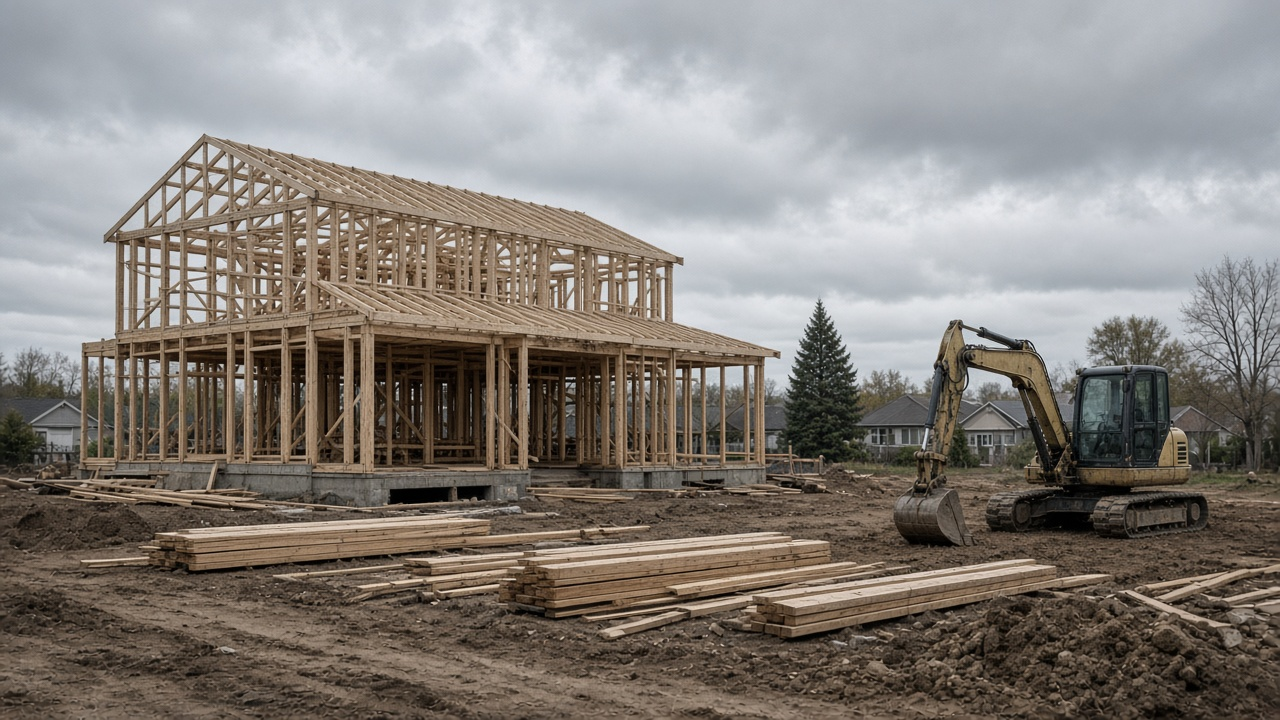
Monday’s construction spending report was a gut punch. Builders spent 1.9% less in September than in August, while economists had expected a small gain. Strip out one booming corner of the market, and the picture gets worse. Data centers and power plants are carrying the whole industry, and almost everything else is shrinking.
That matters for every family that wants a new kitchen, a bigger house, or a better road to drive on. It also matters for Washington, because a large share of the pain comes from costs that policy makers can actually control. Here is what the numbers say and what should happen next.
Key Takeaways
- Construction spending fell 1.9% in September to a $2.186 trillion annual rate, according to the Census Bureau. It was also 2.7% lower than a year earlier.
- Private residential spending dropped 5.5% in one month, led by a 13% plunge in home improvement spending.
- Data center construction jumped 8.6% for the month and 90% from a year ago, the contractors’ trade group reports.
- Outside data centers and electric power, private nonresidential categories fell 7.8% over 12 months.
- Builders blame high material costs, tariffs, and a tight labor market. Those are policy problems, and they have policy fixes.
What the September Construction Spending Report Showed
The Census Bureau’s monthly release puts total construction spending at a seasonally adjusted annual rate of $2,186.1 billion for September. That is down from a revised $2,227.4 billion in August. Through the first nine months of the year, builders spent $1,649.6 billion, which is 2.9% less than the same stretch of 2025.
Private construction fell 2.4% for the month. Meanwhile, public construction barely moved, slipping 0.1% to a $546.8 billion rate. Highway work came in at a $149.2 billion rate, essentially flat.
The miss was not small. According to Reuters, economists had forecast a 0.3% increase. Instead, the decline nearly erased August’s upwardly revised 2.0% gain. Reuters also noted that high materials costs likely depressed spending on residential renovation projects.
Homeowners Stopped Remodeling
The biggest hole came from houses. Private residential construction fell 5.5% to an $848.8 billion annual rate. However, new homes were not the main problem. Single-family construction was unchanged from August, and multifamily inched up 0.1%.
Instead, the drop came from remodeling. The Associated General Contractors of America found that residential improvements tumbled 13% from August and 18% from a year earlier. In plain English, families looked at the price of lumber, cabinets, and labor and decided the new deck could wait.
Mortgage rates add to the squeeze. Reuters reports that the average 30-year fixed rate has climbed by at least 125 basis points since the war with Iran began in late February, citing Freddie Mac data. When people can’t afford to move, they usually fix up what they have. This time, many are not even doing that.

Data Centers Are Propping Up Construction Spending
On the other side of the ledger, private nonresidential construction rose 1.1% in September. That sounds healthy until you look inside the number. According to AGC chief economist Ken Simonson, two project types accounted for the gains: data centers and electric power.
Data center spending soared 8.6% for the month and 90% year over year. Private electric power investment climbed 1.3% from August and 14% from a year earlier. Meanwhile, all other private categories combined fell 0.2% for the month and 7.8% over 12 months.
Anirban Basu, chief economist at Associated Builders and Contractors, said data centers accounted for “virtually all” of September’s nonresidential growth, as reported by Modern Distribution Management. He added that data center spending has grown at a 217% annualized rate since May.
To be clear, the AI building boom is good news. Private companies are putting their own money at risk to build the future here instead of overseas. That is exactly how a free market should work. Even so, one hot sector can hide a cold economy underneath, and the rest of construction is cooling fast.
The Costs Washington Can Actually Control
Builders are not shy about naming the culprits behind weak construction spending. Simonson pointed to “high tariffs and international conflicts” straining supply chains and costs. The AGC also urged Washington to do three things: pass a new highway and transit funding bill, lower high tariffs, and give contractors a way to add skilled workers.
Fiscal conservatives should take the tariff point seriously. A tariff is a tax, and Americans pay it. When it lands on lumber, steel, and cabinets, it lands on the family remodeling a bathroom and the small contractor bidding the job. Using tariffs as leverage in trade talks can make sense. Leaving them on basic building materials for the long haul raises the cost of the very homes this country needs.
Labor is the second fix. Contractors need a legal, orderly pipeline of skilled workers, and more trade schools and apprenticeships here at home. That means rewarding work and training, not loosening the border.
Finally, there is regulation. Permitting delays and local zoning rules add months and dollars to nearly every project. Cutting that red tape costs taxpayers nothing. On the other hand, a bigger federal spending bill should come with discipline, not blank checks. Every dollar Washington spends on roads should buy actual pavement, not paperwork.
Why This Matters for Your Wallet
Construction is not just an industry statistic. It means jobs for electricians, framers, and equipment operators in small towns across the country. It also decides whether young families can find a starter home they can afford.
When remodeling falls 18% in a year, the local contractor feels it first. Next comes the lumber yard, the hardware store, and the family that owns both. Therefore, the September construction spending report is a warning worth heeding, even with the broader economy growing.
The answer is not another government program. Instead, Washington should get out of the way: lower the taxes on building materials, clear the permitting backlog, and let builders build. For more conservative takes on the economy, visit World of Payne.
FAQ
How much did construction spending fall in September 2026?
The Census Bureau estimated a 1.9% drop from August, to a $2.186 trillion annual rate. Spending was also 2.7% lower than in September 2025.
Why did residential construction drop?
Home improvement spending fell 13% in a month. Reuters said high materials costs likely held back renovations, while new single-family construction held steady.
What is holding up nonresidential construction?
Data centers and electric power projects. Data center spending rose 8.6% in September and 90% from a year earlier, according to the AGC.
Want the conservative take on the stories that hit your wallet? Follow the World of Payne show on X, Facebook, and Instagram, and subscribe so you never miss an episode.