

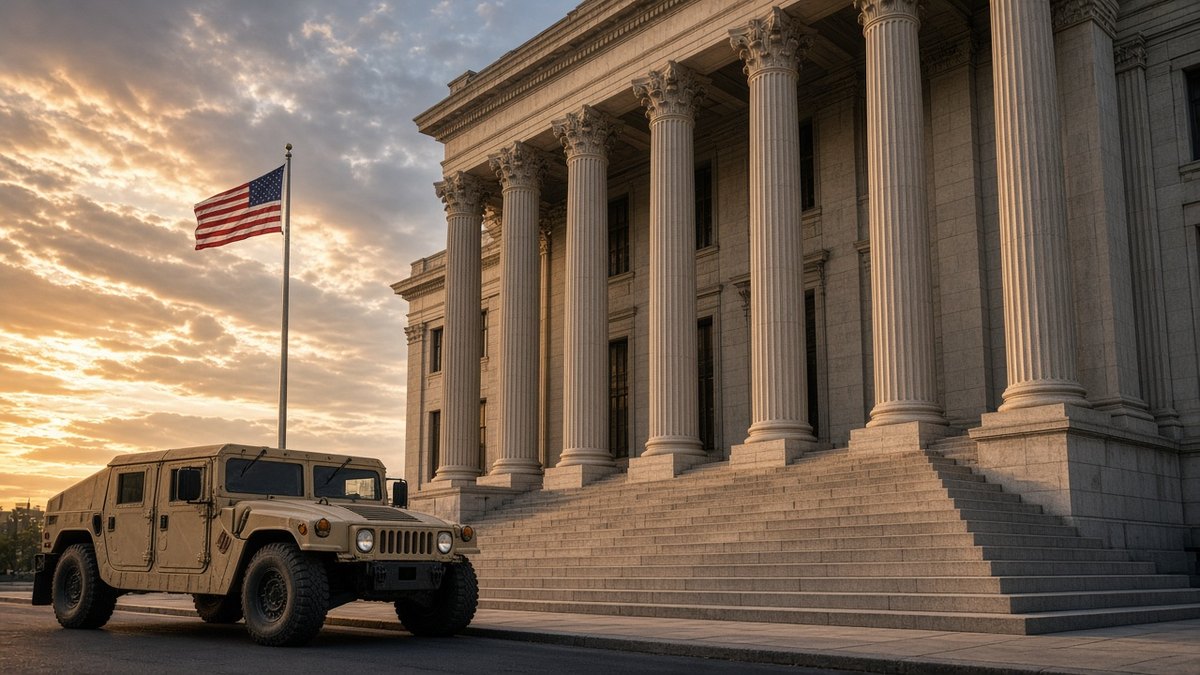
The Trump administration asked to walk away from its own appeal. The Ninth Circuit said no. Then it ruled against the President anyway. In a 2-1 National Guard ruling on Friday, October 23, the court held that President Trump unlawfully federalized about 4,000 California Guard troops during the 2025 Los Angeles immigration protests.
Naturally, Governor Gavin Newsom is celebrating. However, the bigger story is how the court got there, and what it means the next time federal officers come under attack.
What the National Guard Ruling Says
In June 2025, protests broke out in Los Angeles over federal immigration raids. In response, the President invoked a federal law, 10 U.S.C. 12406, to put 4,000 Guard members under federal control for 60 days. Their mission was to protect federal property and personnel, according to the court’s opinion. California sued, and U.S. District Judge Charles Breyer ordered control of the Guard returned to the governor.
Judge Jennifer Sung wrote for the majority, and Judge Eric Miller joined her opinion in full. The court affirmed Breyer’s order and found that neither provision the administration relied on applied.
First, it leaned on the Supreme Court’s December 2025 order in Trump v. Illinois. There, the justices said a president can federalize the Guard to execute the laws only after two showings: that he has authority to use the regular military for that job, and that he is unable to do it with those forces. The panel said the administration made neither showing.
Next, it rejected the claim that Los Angeles faced “a rebellion or danger of a rebellion” on June 7, 2025. That determination, Sung wrote, did not reflect “a colorable assessment” within a “range of honest judgment.” Because neither part of the statute applied, the court said the order intruded on Congress’s power to call forth the militia and was unconstitutional.
Notably, the same panel had sided with Trump in June 2025. Back then, it put Breyer’s order on hold and said the President “likely acted within his authority.” The Supreme Court’s Illinois order changed that math, The Hill reported.
Even that earlier win was contested. In October 2025, the full Ninth Circuit declined to rehear the stay order, but Judge Marsha Berzon wrote a statement, joined by 10 colleagues, arguing the panel gave the President too much deference.
The Appeal Trump Tried to Drop
Above all, this is the part conservatives should watch closely. After the Illinois decision, the government moved on January 23, 2026, to dismiss its own appeal. Normally, courts grant those requests as routine. In fact, the panel’s order admits that “in the normal course, we routinely grant such motions.”
This time, the majority refused. It gave three reasons. First, a ruling still mattered, because it could stop a similar federalization in the future. On that point, it quoted the President’s own post that “we are removing the National Guard from Chicago, Los Angeles, and Portland,” but “we will come back, perhaps in a much different and stronger form.” Second, the case was fully argued, and the judges had already begun drafting an opinion. Finally, it said denying dismissal would “curtail strategic behavior” and prevent a party from manipulating the formation of precedent.
The court did split the difference in one respect. It let the government drop a second appeal, over Breyer’s order blocking an extension of the deployment, because no one had briefed it and it carried less risk of strategic manipulation.
In other words, the government tried to step back, and the court stepped forward to write binding law against it.
Judge Bennett’s Dissent
Judge Mark Bennett, a Trump appointee like Miller, disagreed. “I also see no signs of gamesmanship,” he wrote. He added that “there is nothing wrong or improper about changing one’s litigation strategy based on intervening authority from the Supreme Court.”
He also pointed to Oregon v. Trump. There, the full Ninth Circuit let the government drop a similar appeal. “In my view, nothing distinguishes that motion from this motion,” Bennett wrote. The majority answered that in Oregon, the state itself agreed to dismissal and merits briefing had not even begun.
In a separate dissent on the merits, Bennett warned that the majority was “relying primarily on outdated briefs prepared amid a shifting legal landscape.” The case could have gone back to the trial court to work through the Illinois decision first, he argued. Instead, the panel issued a published opinion at an early stage that “will bind future three-judge panels.” He quoted Chief Justice John Roberts: “If it is not necessary to decide more to dispose of a case, then it is necessary not to decide more.”
The Question of Who Can Sue
There is a quieter fight inside this case that matters for conservatives. California sued on an “ultra vires” theory, meaning the President acted beyond the power Congress gave him. Bennett, quoting the Supreme Court, argued that “prescribing a cause of action is a job for Congress, not the courts,” and that no statute gives a state a right to sue the President over this Guard law.
Miller agreed with the majority but flagged the same concern. He noted the Supreme Court has called an ultra vires claim “a Hail Mary pass” that “rarely succeeds,” and said there is “room to debate” whether the circuit’s own precedent fits that view. He went along because that precedent binds the panel and because the government did not raise the argument in time. That is a roadmap for the Supreme Court if it takes the case.

Why This National Guard Ruling Matters Beyond California
To be fair, Los Angeles was not a peaceful afternoon. The district court record, quoted in the opinion, describes protesters in Paramount and Compton throwing rocks and a Molotov cocktail, burning a vehicle and looting a gas station. One officer was briefly trapped in her vehicle while a crowd shook it and threw stones. Even the majority conceded the government has “a legitimate interest in protecting federal personnel and property.”
The same record cuts the other way, too. Breyer found it “beyond debate” that some people used the protests as an excuse for violence, but also that “most protesters demonstrated peacefully.” As of his June 12 hearing, he found no evidence of protesters carrying firearms or of organized violence.
Still, the court stressed that the Constitution gives Congress the power to call forth the Guard. In other words, the President gets only the slice Congress hands him. Under this ruling, protecting federal officers is not enough on its own. That matters for every ICE agent and federal building in the West, especially as immigration enforcement continues.
There is a fair conservative answer here. If the law is too narrow to protect federal officers, Congress should rewrite it. Judges should not be left to guess at the line one riot at a time. Bennett’s point about restraint deserves a hearing too. Courts that reach out to decide big questions they could have left alone invite exactly the kind of politics this case now carries.
What Comes Next
The deployment is already over. The President announced the Guard was leaving Los Angeles, Chicago and Portland, as the court’s order notes. Even so, the opinion now binds future Ninth Circuit panels. Next, the administration could seek rehearing by the full court or petition the Supreme Court. The White House did not immediately comment on Friday.
Newsom, for his part, called the decision “a crucial day for the rule of law” in a statement. He also tied it to next month’s elections, saying the ruling puts the President “on notice” ahead of the vote. Clearly, that tells you how much politics now rides on this fight. As we saw in the New Hampshire student ID case, the Supreme Court often gets the final word on these battles.
For now, judicial restraint lost a round. The question is whether the Supreme Court will want the last word.
Sources
- U.S. Court of Appeals for the Ninth Circuit: Newsom v. Trump, No. 25-3727, opinion (Oct. 23, 2026)
- U.S. Court of Appeals for the Ninth Circuit: Newsom v. Trump, Nos. 25-3727 and 25-7781, order on motions to dismiss (Oct. 23, 2026)
- U.S. Court of Appeals for the Ninth Circuit: Order denying rehearing en banc of the stay order (Oct. 22, 2025)
- The Hill: Appeals court rules Trump’s Los Angeles Guard deployment unlawful
- Office of the Governor of California: Statement on the Ninth Circuit National Guard decision


