
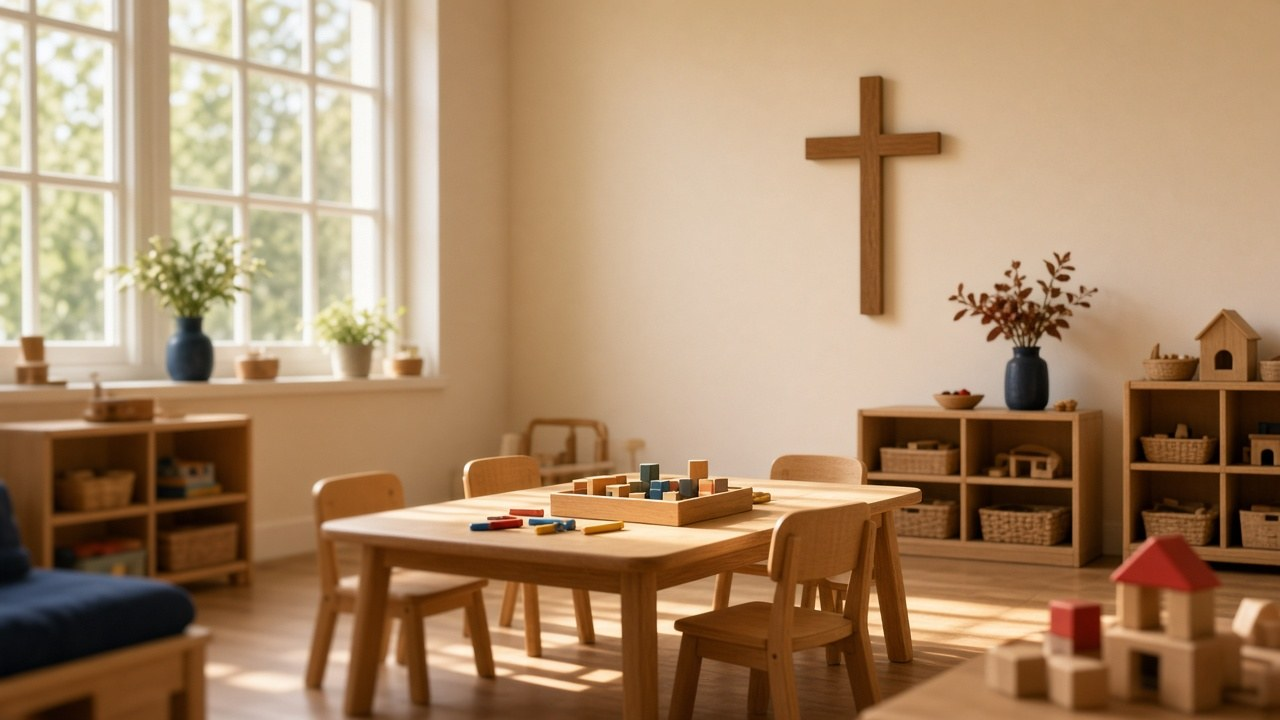
Colorado calls its preschool program universal. However, two Catholic preschools in the Denver suburbs found out the word comes with fine print. On Nov. 3, Election Day, the U.S. Supreme Court will hear their case, St. Mary Catholic Parish v. Roy.
The stakes reach far beyond one state. Today, more public money than ever flows to private religious schools through preschool and voucher programs. So the justices must decide a simple question. Can a state open a program to everyone and then write the rules so that faithful Catholic schools cannot join? We think the answer should be no.
Key Takeaways
- Colorado’s universal preschool program pays for 4-year-olds to attend public, private, or faith-based preschools that sign its nondiscrimination agreement.
- Two Catholic preschools asked for a religious exemption from the rules on sexual orientation and gender identity. The state said no, and the parishes sued.
- A federal district court and the 10th Circuit both sided with Colorado. The Supreme Court agreed to hear the case on April 20, 2026.
- The Justice Department backs the Catholic preschools and will share argument time on Nov. 3.
- A ruling is expected by late spring 2027, and it could shape school choice programs across the country.
What the Catholic Preschools Case Is About
Colorado launched its Universal Preschool Program in 2023. According to Becket, the law firm representing the families, the program offers about $6,300 per child for 15 hours of preschool a week. Families can use it at public, private, or faith-based schools.
There is a catch, though. Every participating school must sign an agreement not to discriminate on eight characteristics, including sexual orientation and gender identity, Chalkbeat reported. Dozens of religious preschools signed on.
Two did not. St. Mary Catholic Virtue School in Littleton and Wellspring Catholic Academy in Lakewood wanted to join. Yet they asked for an exemption, because the rule conflicts with Catholic teaching on marriage and sex. Colorado refused. As a result, the parishes, the Archdiocese of Denver, and Catholic parents Dan and Lisa Sheley took the state to court.
Becket says more than 1,500 children across over 30 Catholic preschools lost access to the funding. In addition, Lisa Sheley testified that her family would have saved about $4,700 a year. “Obviously with inflation, everything is extremely expensive, but even more so for a family of eight,” she told the court.
Why the Catholic Preschools Say the Rule Is Not Neutral
Under a 1990 case called Employment Division v. Smith, a law can burden religion if it is neutral and applies to everyone. Colorado leans on that rule. The state says it funds religious schools all the time, as long as they follow the same rules as everyone else.
But here is the problem. Colorado’s rule does not actually apply to everyone in the same way. Head Start preschools keep strict income limits. Some programs serve only children with disabilities. Other schools may give priority to siblings or to the children of staff, Chalkbeat noted.
In fact, the Catholic preschools’ petition to the Supreme Court says Colorado lets some providers admit only “children of color,” “gender-nonconforming children,” or “the LGBTQ community.” Meanwhile, it shuts out Catholic schools that ask families to support the Church’s teachings. That is not a neutral rule. Instead, it is a rule with exits for some beliefs and a locked door for one faith.
Becket attorney Nick Reaves put it plainly. “I think what we’re seeing is that states are trying to find ways to keep the religious schools out without saying the word religion,” he told Chalkbeat.

Universal Should Mean Universal
The Supreme Court has already settled the big principle. In Trinity Lutheran, Espinoza, and Carson v. Makin, the justices ruled that a state cannot exclude religious schools from a public benefit because they are religious. Carson went further. A state also cannot exclude a school because it would use the money to teach the faith.
Colorado says its program is different, since it never bans religious schools by name. Still, a door with a lock that only one key fits is not an open door. If a state can achieve through conditions what it cannot do openly, then Carson means very little.
Notably, the Catholic preschools do not run a closed club. According to Becket, the Archdiocese’s schools ask families to show a positive and supportive attitude toward the Church and its mission. Any family willing to do that is welcome. Reaves also said Colorado has not identified actual families who oppose Catholic teaching but want a Catholic preschool.
There is a fiscal point here too. Catholic families pay Colorado taxes like everyone else. Those taxes fund a program the state markets as universal. So when the state tells those families to pay twice, once in taxes and again in tuition, it is placing a tax on their faith.
The Other Side Deserves a Fair Hearing
To be fair, the other side raises real concerns. Patrick Cremin of the Education Law Center warned that if the preschools win, “the state is going to be forced to fund that type of discrimination.” Others point to small towns with few preschool choices, where an LGBTQ family could have limited options.
Those worries are sincere. Even so, shutting out Catholic preschools is the wrong fix. The better answer is more choice, not less. Colorado already has hundreds of public and private providers. A diverse system serves every family best when it makes room for schools with strong convictions. After all, pluralism is the whole point of school choice.
This case also fits a pattern. Since 2018, Colorado has lost three religious freedom cases at the Supreme Court, Becket notes: Masterpiece Cakeshop, 303 Creative, and Chiles v. Salazar. Similarly, our recent look at Maryland’s school admissions case showed how states dress up policy choices in neutral language.
What Comes Next for the Catholic Preschools
The justices took the case on narrow grounds. Specifically, they declined to reconsider Smith itself. Instead, they will decide two questions: what kinds of exemptions make a law less than generally applicable, and whether Carson applies only when a state excludes religion explicitly.
Even a narrow win, however, would matter. As Erwin Chemerinsky wrote at SCOTUSblog, the conservative majority could use the case to expand free exercise protections. For parents, the bottom line is simple. A ruling for the Catholic preschools would tell every state that parents, not bureaucrats, choose the values their children learn. That theme runs through our coverage of parental rights as well.
Frequently Asked Questions
Why are Catholic preschools suing Colorado?
Two Catholic preschools asked for a religious exemption from parts of the state’s nondiscrimination agreement. Colorado refused, so they could not join the universal preschool program. They say that violates the First Amendment.
When will the Supreme Court hear the case?
Oral argument is set for Nov. 3, 2026. A decision is expected by late spring 2027.
Does the Trump administration support the Catholic preschools?
Yes. The Solicitor General filed a brief arguing that Colorado’s program violates the Free Exercise Clause. The Court also granted the federal government 10 minutes of argument time.
So here is our question for you: should a state be able to call a program universal and still keep faith-based schools out?
Follow World of Payne for More
For more conservative commentary on faith, family, and freedom, visit the World of Payne homepage. Then follow the World of Payne show on X, Facebook, and Instagram.