

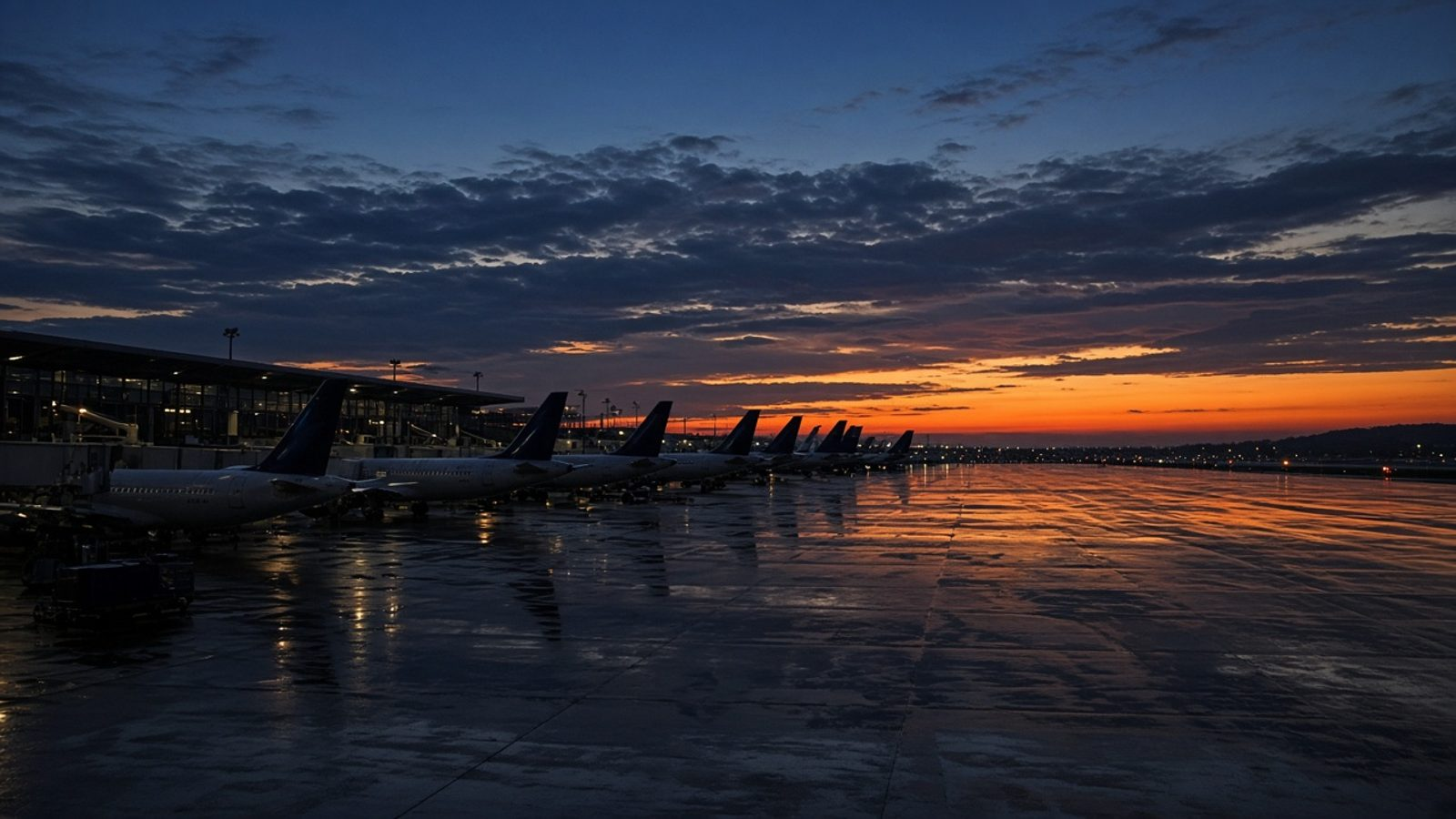
Every departing flight in the United States was ordered to stay on the ground Friday afternoon. The FAA ground stop took effect at 2:54 p.m. Central, and the agency’s national advisory gave only one reason: “extraordinary circumstances” and “reasons of safety.” Planes already in the air were allowed to land.
Officials blame a telecommunications outage, not an attack. That is good news, if it holds. Still, it raises a harder question. How does the busiest airspace in the world go dark because of a communications failure, after years of warnings and billions of dollars in repair money?
What Happened in the FAA Ground Stop
Transportation Secretary Sean Duffy posted on X a little after 3 p.m. Central that a “communication issue” was hitting all of the nation’s Air Route Traffic Control Centers. There are 22 of these centers. They handle planes at cruising altitude, between the airports. FAA technicians were investigating, Duffy said.
Later in the afternoon, the FAA called it “a temporary telecommunications outage.” The agency said it halted all flights “out of an abundance of caution” and that every flight was accounted for. According to Jon Ostrower of The Air Current, as cited by The Verge, the FAA told airlines the stop was due to “several impacts to ATC Frequencies and/or Radar capabilities.”
Then the numbers started to pile up. When the order hit, 4,042 flights were airborne and bound for U.S. airports, Flightradar24 reported. Two hours later, only about 1,000 were still in the air. By about 5:15 p.m. Central, FlightAware counted 10,494 delays and 2,201 cancellations within, into or out of the country.
What We Know and What We Don’t
Here is what officials have said so far. Homeland Security Secretary Markwayne Mullin told reporters there was “no indication” of a threat “as of right now.” He also said, “This isn’t another 9/11.” Multiple officials told NBC News they had seen no signs of a cyberattack. Even so, they warned it was early.
At the same time, Mullin would not close the door. Asked whether a cyberattack or AI intrusion was possible, he said, “That’s not known,” Politico reported. He also saw no reason to link it to Friday’s separate Microsoft outage.
As of the FAA’s latest advisory at 4:46 p.m. Central, the stop remained in effect. Flights would be released in tiers as the centers recover, with the next update expected by 10 p.m. Central. In short, we do not yet know the cause, how long recovery will take, or whether backups worked as designed.
Was the New AI System a Factor?
One question is already hanging over the agency. This week, the FAA said its new SMART platform was active nationwide. Duffy unveiled the system in September. It uses AI to help recommend routes and schedules by pulling about 200 data streams into one platform.
Critics raised flags early. The controllers’ union, NATCA, said it was not involved in the system’s design, testing or rollout. Democratic lawmakers asked the FAA in an Oct. 9 letter to pause the changes.
However, there is no evidence yet tying SMART to Friday’s failure. Air Space Intelligence, the vendor behind it, said the ground stop “is not based on or a result of” its system. Meanwhile, the FAA told airlines the problem hit radio frequencies and radar. SMART, by the FAA’s own description, analyzes schedules, weather and capacity to predict traffic flows. Mullin said only that “you just can’t rule out anything.”
Fairness cuts both ways here. Nobody should blame new technology before investigators finish. But a big system change that controllers say they never tested deserves a hard look. Answers should come with evidence, not talking points.
Decades of Patchwork Behind the FAA Ground Stop
Friday’s failure did not come out of nowhere. The last nationwide stop came in January 2023, when the NOTAM system for pilot notices crashed. That stop lasted about 90 minutes and affected more than 10,000 flights. Before that, the last one followed 9/11.
The warnings since then have been loud. In September, a circuit failure at a Philadelphia facility and a fiber cable cut by a construction crew in New Jersey snarled thousands of flights in the Northeast, Reuters reported. The FAA still relies on decades-old computers and parts bought on auction websites. It only recently promised to replace floppy disks at more than 400 facilities by the end of 2028.

Washington has started paying for fixes. Congress approved $12.5 billion in July 2025 to upgrade air traffic control. The FAA says it has moved 68% of its old copper telecommunications network to fiber. This week, Duffy and budget director Russell Vought renewed their request for $30.1 billion more, including $2 billion for cloud computing and telecommunications.
Yet a September GAO report found the FAA had no full life-cycle cost estimate or master schedule for the overhaul, AvWeb reported. That should worry every taxpayer. A plan without a schedule or price tag is a blank check.
Why the FAA Ground Stop Matters to Taxpayers and Families
The cost lands on regular people first. Families missed weekend trips. Travelers sat on tarmacs, and some airports ran out of room to park jets. A source told NBC News that Reagan National was at capacity and Chicago O’Hare was close.
Airlines will likely feel it beyond Friday. Crews and planes end up in the wrong cities, and that can ripple into Saturday. American Airlines said it expected disruption for the rest of the day.
Businesses pay, too. Air cargo, sales trips and supply chains all run on this system. So when air traffic control fails, the whole economy takes the hit.
There is also a security lesson. This time, officials say, it was not an attack. But an enemy studying Friday now knows exactly how much one outage can do. We saw the same risk when hackers hit Europe’s grocery freezers. Critical systems need real backups that can keep traffic moving, not just keep planes safe.
Conservatives should demand both things at once. First, fund the core mission that only Washington can do. Second, hold the agency to a schedule, a budget and real results. Taxpayers already hand Washington trillions, and where those tax dollars go matters. Keeping planes moving safely should rank near the top.
What to Watch Next
- The cause: Watch for the FAA to name the failed equipment or vendor, and to explain why backups did not keep the centers fully running.
- The restart: The FAA’s next update is due by 10 p.m. Central. A tiered restart means delays will likely last into the weekend.
- The AI question: Expect demands for a full review of SMART’s rollout, even though no link has been shown.
- Congress: The White House wants the $30.1 billion passed before the year ends. Democrats take control of Congress in January, so oversight hearings are likely either way.
The goal is simple. One communications failure should never be able to shut down a nation’s airspace. Congress should get its answers, fund what works and refuse to keep paying for what doesn’t.
Sources
- FAA Air Traffic Control System Command Center: Advisory 111, National Ground Stop (Nov. 13, 2026)
- FAA Air Traffic Control System Command Center: Advisory 120, Nationwide Ground Stop update (Nov. 13, 2026)
- NBC News: Live updates, FAA grounds flights nationwide because of communication issue (Nov. 13, 2026)
- Politico: Mullin doesn’t rule out cyberattack in unprecedented nationwide passenger plane grounding (Nov. 13, 2026)
- The Verge: FAA ground stop shuts down flights nationwide (Nov. 13, 2026)
- Flightradar24: Nationwide ground stop issued for United States (Nov. 13, 2026)
- Reuters (via Investing.com): White House urges Congress to provide $30.1 billion for aviation reform (Nov. 13, 2026)
- AvWeb: White House Renews Push for $30 Billion ATC Plan (Nov. 2026)
- FlightAware: Total flight cancellations and delays (live data, accessed Nov. 13, 2026)


