

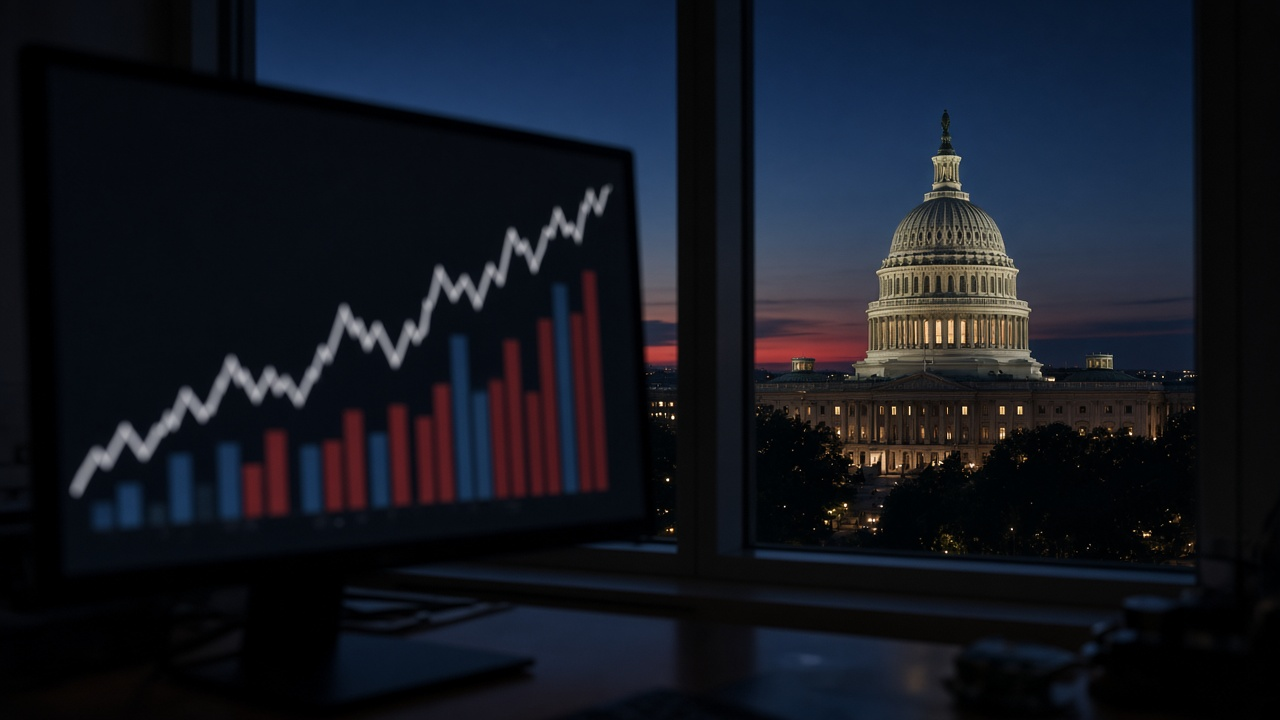
Treasury yields just delivered a message that Washington would rather not hear. Two days after a hot inflation report, the 10-year note is back above 5%, and the government is now paying that rate to borrow fresh money for a decade.
The selloff started Tuesday. October consumer prices rose 0.4%, and core prices rose 0.3%, a third straight month at that pace. By the close, Treasury’s own data showed the 2-year yield at 4.73% and the 10-year at 4.98%. On Thursday the 10-year pushed to about 5.07% in early trading, CNBC reported.
Most coverage treats this as a story about the Fed. It is really a story about two institutions. The Fed has to finish its inflation fight. Meanwhile, Congress has to stop making that fight so expensive for taxpayers.
How Far Treasury Yields Moved in Two Days
The numbers moved fast. The 2-year yield, which tracks expected Fed policy, jumped 17 basis points on Tuesday to 4.73%. That was its biggest one-day climb since the tariff shock of April 2025. The 10-year rose 10 basis points to 4.98% and briefly traded above 5%.
Bond markets were closed Wednesday for Veterans Day. On Thursday, though, the selling resumed. The 2-year added roughly 11 basis points to about 4.84%, and the 10-year cleared 5% again.
Futures traders now treat a December rate hike as a done deal. CME’s FedWatch tool shows essentially no chance that the Fed holds at its December 8-9 meeting. The open question is size. As of Thursday, the odds of a half-point hike stood at about 13%. A quarter-point move is the base case.
Wall Street forecasters are adjusting too. Goldman Sachs added another quarter-point hike to its outlook on Wednesday and now expects a move in March as well. Markets, in short, no longer see December as the last step.
The dollar told the same story. On Tuesday the dollar index rose to its highest level in roughly 19 months. Higher yields pull money into dollar assets, and global investors noticed.
For context, our October CPI breakdown explains why the monthly math worried markets. The short version is that inflation is not cooling on its own.

The Fed Is Finally Talking Like an Inflation Fighter
The Fed raised its target range to 3.75% to 4% in September, then held in October. Two officials dissented in favor of another hike. Now the hawks are setting the tone.
Fed Governor Christopher Waller spoke in London hours before the CPI release. He said he leaned toward a quarter-point hike in December regardless. He added that if core inflation came in around 0.3% or higher, a half-point hike “should be considered.” In his prepared remarks, he warned that “hiking only 25 basis points would put our credibility at risk.”
Core inflation came in at 0.3%. In other words, his test was met.
Dallas Fed President Lorie Logan went further. She said the Fed’s range is at least half a point below the level needed for “modest restriction.” She also said current policy is “adding to inflationary pressures,” Reuters reported. That means at least two more quarter-point hikes.
Not everyone agrees on speed. Cleveland Fed President Beth Hammack still wants higher rates, but in smaller, steadier steps. That is a fair debate about pace. It is not a debate about direction.
That consensus matters. A year ago, the conversation was about how fast rates could come down. Now even the cautious voices at the Fed agree that rates need to go up.
Why conservatives should back the hawks
Inflation is a tax nobody voted for. It hits fixed incomes, savers, and working families first, and it rewards the biggest debtor in the country. That debtor is the federal government.
Higher rates are painful. Still, a Fed that blinks now would buy a few good months and a much worse 2027. Waller’s point about credibility is the right one. If markets stop believing the Fed, long-term yields climb anyway, and the Fed loses the one tool that works.
Higher Treasury Yields Land on Taxpayers
Here is the part of the story that gets too little attention. When yields rise, the largest borrower takes the biggest hit. That borrower is Washington.
On Tuesday the Treasury sold $42 billion of new 10-year notes. According to TreasuryDirect results, the sale cleared at a high yield of 5.020% with a 5% coupon. Bids covered the offering 2.46 times, and traders called the demand soft. Taxpayers will pay 5% a year on that money until 2036.
The rollover math
Now compare that with what the government pays on its existing debt. Treasury’s Fiscal Data series puts the average interest rate on all marketable debt at 3.57% at the end of October. That is up from 3.10% three years earlier.
So every maturing note refinanced near 5% costs more than the debt it replaces. The gap is roughly 1.4 percentage points. As old debt rolls over, the average rate keeps climbing toward market rates.
Our own arithmetic shows the scale. Debt held by the public is about $32.8 trillion. Each one-point rise in the average rate on that debt, once fully rolled over, adds roughly $328 billion a year in interest. That is not a forecast. It is simply what a percentage point means on a debt this large.
Interest already topped $1 trillion in fiscal 2026, more than defense, as our explainer on interest on the national debt showed. Higher yields push that bill up further.
Auctions are the tell
A soft auction is a quiet signal, not a crisis. Still, it matters. Buyers are asking for more yield to absorb a steady flood of new Treasury debt. The October deficit alone ran $409 billion, as our Controller’s Desk on the federal deficit laid out.
When supply keeps growing and inflation stays hot, investors want to be paid for the risk. That is not a conspiracy. It is a market doing its job.

What 5% Treasury Yields Mean at the Kitchen Table
The 10-year yield is the benchmark behind mortgages, car loans, and much business credit. It sets the floor that lenders price from.
Mortgages show how the cost lands. Freddie Mac’s weekly survey put the 30-year fixed rate at 7.11% on November 12. That is down slightly from last week, but up from 6.24% a year ago. Notably, the survey averages rates from Thursday through Wednesday, so it only partly captures this week’s selloff.
The gap adds up. On a $350,000 loan, 7.11% means a monthly payment of about $2,354 before taxes and insurance. At 6.24%, that payment is about $2,153. That is roughly $200 a month, or about $2,400 a year, in our own calculation.
The long end hurts too. The 30-year Treasury yield closed Tuesday at 5.35%, and that rate shapes the cost of long-term business and municipal borrowing.
Car buyers and small businesses face the same pressure. Farmers financing equipment and families carrying credit card balances will feel it too. Higher rates are the price of getting inflation under control. Even so, the price is larger than it needs to be.
Don’t Ask the Fed to Rescue Congress
Expect a familiar argument in the coming weeks. Some will say the Fed should go easy because higher rates make the debt too costly to carry. Washington should reject that argument outright.
A central bank that holds rates down to keep government borrowing cheap is no longer fighting inflation. Instead, it is financing deficits. That road ends with higher prices for everyone and a weaker dollar over time.
The Fed’s job is stable prices and maximum employment. It is not the Fed’s job to protect Congress from its own spending. If high rates make Washington’s interest bill painful, the fix sits on Capitol Hill.
That means smaller deficits and fewer new spending programs. It also means honest budgets that stop treating borrowing as free. Every dollar of deficit reduction eases pressure on future auctions. Over time, it lowers the extra yield investors demand.
Higher Treasury yields are a verdict on two things at once. The first is inflation that has stayed too hot. The second is a government that borrows as if rates would stay near zero forever. The Fed is starting to address the first. Voters should insist that Congress address the second.
Sources
- Federal Reserve Board: Speech by Governor Waller on the economic outlook (Nov. 10, 2026)
- Reuters via Investing.com: Fed officials open door to a quicker round of rate hikes as inflation worsens (Nov. 10, 2026)
- CNBC: 10-year Treasury yield jumps back above 5% as oil gains and more Fed rate hikes expected (Nov. 12, 2026)
- TreasuryDirect: Auction results, 10-Year Note CUSIP 91282CRX1 (auctioned Nov. 10, 2026)
- U.S. Treasury Fiscal Data: Average Interest Rates on U.S. Treasury Securities (October 2026)
- Freddie Mac: Primary Mortgage Market Survey (Nov. 12, 2026)


