

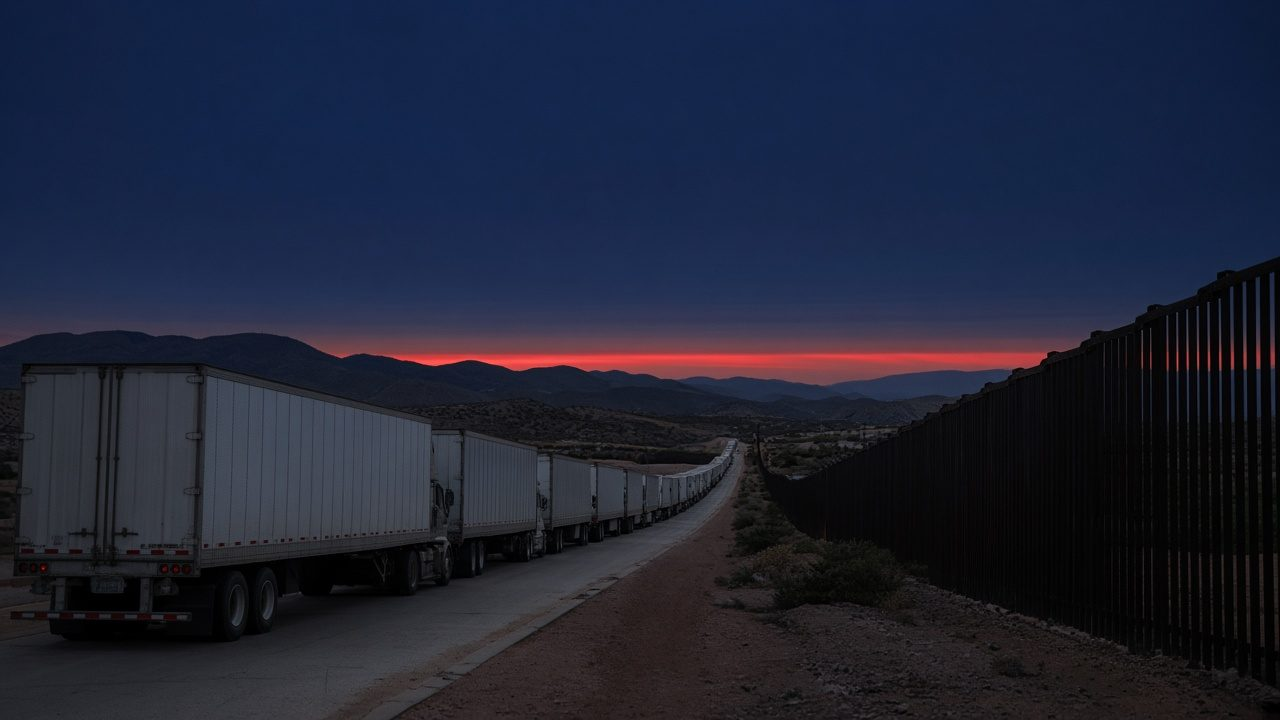
Trump’s threat to double Mexico tariffs over a migrant caravan sounds tough, but the border numbers point to a better weapon. On Thursday, the president warned Mexico that duties on its goods would be “IMMEDIATELY DOUBLED” unless it stops a group of migrants walking north from the Guatemalan border.
The goal is right. America should not let a caravan test a border that finally works. The tool is wrong, though. A tariff is a tax paid by American importers, and enforcement is what actually stopped the last wave.
What Trump Threatened, and Why Now
The post went up on Truth Social a little after 4 a.m. Eastern. “Here we go again!” Trump wrote. He said Mexico “MUST STOP THEM, NOW,” and he added, “There will be no leniency!”
The timing is not random. An estimated 1,500 people, mostly from Central America, set off Tuesday from Tapachula in southern Mexico, according to Reuters. Other estimates range from 1,000 to 2,000. Some migrants told reporters that Democrats’ midterm wins gave them new hope of getting in.
That detail matters. Democrats won both chambers of Congress on Nov. 3 and take control in January. Smugglers sell hope, and a change in Washington is the easiest thing to sell.
Homeland Security Secretary Markwayne Mullin backed the president within hours. “This illegal migrant caravan will NOT be allowed to enter our country. Full stop,” he wrote.
Still, the post left the big questions open. It gave Mexico no deadline. It also did not say which tariffs would double.
What Mexico Says Back
Mexican President Claudia Sheinbaum answered at her morning press conference. “Not a single migrant caravan has reached the north” since Trump returned to office in January 2025, she said.
She acknowledged that people are walking north. However, she said Mexican officials are telling them how hard it is to enter the United States, and Mexico wants to return them to their home countries. She also said there would be “no acts of repression.”
According to Texas Public Radio, Sheinbaum pointed to an earlier caravan that shrank from as many as 600 people to fewer than 100. Mexican authorities have broken up caravans before.
So both governments claim the same goal. Neither wants this group at the Rio Grande. The fight is over who gets credit and what pressure is needed to keep it that way.
The Border Numbers Behind the Caravan
Here is the part of the story that deserves more attention. The border is not wide open, and the data proves it.
Border Patrol made fewer than 99,000 apprehensions at the southwest border in fiscal 2026, which ended Sept. 30. The exact preliminary total was 98,708. Customs and Border Protection says that is a 95% decline from the more than 1.8 million a year recorded under President Biden.
The monthly figures on CBP’s fiscal 2026 encounters page tell the same story. The low came in January, at 6,077. The high came in May, at 10,011. For comparison, the worst single month under the last administration was 249,740.

In other words, the whole caravan, even at its largest estimate, equals roughly a week’s worth of southwest border apprehensions at this year’s pace. That is not a crisis at the line. It is a messaging test, aimed at a new Congress as much as at the border.
There is one caution in the data. CBP has not yet published October figures, so nobody can measure a post-election change. Watch the next release closely, because it will show whether talk in Washington is changing behavior on the ground.
Why Doubling Mexico Tariffs Is the Wrong Tool
Conservatives should be clear about what a tariff is. It is a tax collected at the border from American companies, and it usually ends up in American prices. Our explainer on how tariffs work walks through who actually pays.
The scale here is enormous. The United States imported $534.3 billion in goods from Mexico in 2025, according to the Census Bureau. Through the first nine months of 2026, imports reached $481.6 billion, and September alone hit $62.2 billion.
Texas would feel it first. The state traded $301.8 billion in goods with Mexico last year and handles about three-quarters of U.S.-Mexico land trade, Dallas Fed economist Roberto Coronado told Texas Public Radio.
What Would Actually Double?
Nobody knows yet, and that uncertainty is a cost by itself. Most Mexican goods enter tariff-free under the trade pact known as USMCA.
According to the Congressional Research Service, the administration put a 10% tariff on non-USMCA goods from Mexico on July 24. Yet 88% of imports from Mexico were USMCA-compliant from January through May. Separate Section 232 duties already hit autos and parts, steel, aluminum and copper.
Here is our rough arithmetic. If “doubled” means only the 10% duty moves to 20%, it would cover about 12% of imports. On 2025 volumes, that is roughly $6 billion a year in new taxes. If it reaches autos and steel, the bill climbs fast, and so do prices for trucks, tractors and appliances.
Does the President Even Have the Power?
That is an open question. The Supreme Court struck down the use of emergency powers to impose tariffs on Feb. 20. Since then, the White House has leaned on Section 301 and Section 232, which both require an agency investigation before new duties take effect.
A threat with no clear legal path is weaker leverage, not stronger. Mexico’s negotiators can read the ruling too.

The Conservative Case: Enforce the Law, Don’t Tax the Kitchen Table
The best argument against this caravan is the chart above. Enforcement works. Detention instead of release works. Mexican checkpoints in the south have worked too, and local media reported that authorities in Chiapas turned back some migrants this week. CBP reports that fiscal 2026 was the first year with zero Border Patrol releases, and that message reaches Central America faster than any Truth Social post.
A fiscal conservative should also ask the obvious question. Why fight an immigration problem with a tax that lands on American families and Texas manufacturers? Voters just punished Republicans over prices. Our look at why Republicans lost the midterms found that grocery bills and fuel costs mattered more than any single policy fight.
There is a fair point on the other side. Tariff threats have moved Mexico before, and Sheinbaum’s quick response shows she takes this one seriously. Leverage only works if it is credible.
But the leverage already exists. The two countries are negotiating after the United States declined to renew USMCA at its July review. The agreement stays in effect through 2036 with annual reviews. That process, plus enforcement cooperation, gives Washington plenty of pressure without a new tax.
Mexico Tariffs and the Fight Coming in January
This is also about the next Congress. Democrats will run both chambers in January. Meanwhile, Trump has named Stephen Miller, the architect of the crackdown, as his chief of staff, a signal we covered in our Stephen Miller analysis.
The president also told CBS “60 Minutes” that his deportation push may have been “too tough” for voters. He even suggested he could reach an immigration agreement with Democrats. Mixed signals invite testing, and this caravan is the first test.
Republicans should answer with consistency rather than volume. Keep detention funded. Keep the no-release policy. Keep Mexico’s cooperation in writing through the trade talks.
What to Watch Next
First, watch the caravan itself. If it shrinks in southern Mexico, as earlier groups did, the threat may fade without action.
Second, watch for a Federal Register notice or a new Section 301 or 232 action. Without one, “doubled” is still just a word.
Third, watch CBP’s October numbers. They will show whether the election changed anything at the border.
Finally, watch the trade talks. Sheinbaum heads to the APEC summit in China next week, and the bilateral talks have covered steel, aluminum and auto rules of origin. A deal that locks in border cooperation would beat a tariff fight that taxes Americans.
The border is secure because the law is being enforced. That is the winning argument. Mexico tariffs should be a last resort, not the first move.
Sources
- Reuters via Investing.com: Trump threatens to double tariffs on Mexico if it does not halt migrants (Nov. 12, 2026)
- Texas Public Radio: Trump threatens to double Mexico tariffs as migrants head north (Nov. 12, 2026)
- U.S. Customs and Border Protection: Nationwide Encounters, Fiscal Year 2026
- U.S. Customs and Border Protection: Preliminary fiscal year 2026 border data release (Oct. 16, 2026)
- Congressional Research Service: U.S.-Mexico Trade Relations (IF11175)
- U.S. Census Bureau: Trade in Goods with Mexico (monthly, through September 2026)


